Following the initial excitement with GenAI, according to the Gartner Hype Cycle for 2025, traditional Generative AI has entered the "Trough of Disillusionment," as AI Agents have reached the Peak of Inflated Expectations. This shift indicates that companies have stopped looking for simple text assistants to invest in autonomous systems that plan and act independently.
This evolution is not just a trend, but a scaling necessity. While 99% of global developers claim to be exploring or creating AI agents, only 11% of organizations are actively using these solutions in production.
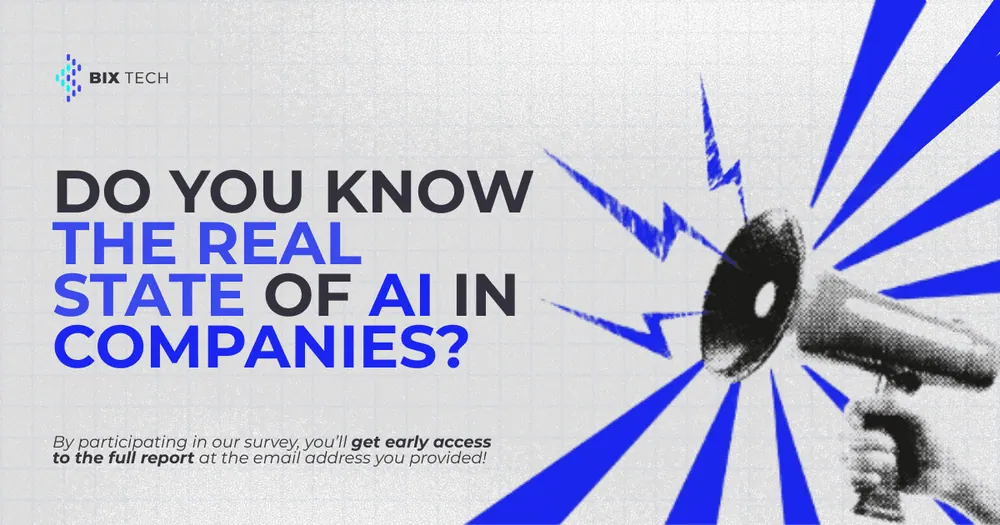
This mismatch between interest and real implementation motivated the launch of our research: AI Agents in Business in 2026. Contribute to our study and receive early access to the results.
History of Autonomy: Why "hype" turned into execution
The idea of intelligent agents isn't new, but it gained massive traction in 2024 with the rise of Agentic AI. Unlike 2022 models, which relied on a prompt for every response, current systems operate in continuous reasoning cycles. The major technological turning point was the transition from stateless interactions to stateful (persistent) systems, capable of executing workflows that last hours or days without human intervention.
Today, the global AI agent market already moves approximately $8.29 billion and is expected to jump to $12.06 billion by 2026, with an annual growth rate of 45.5%.
This growth is supported by the integration of frameworks like LangGraph and CrewAI, which allow for the orchestration of multiple specialized agents in a single operation. While in 2024 we discussed what AI could write, in 2026 the focus is on how many end-to-end processes it can finish.
The Readiness Challenge: Does your company trust its own data?
Despite the optimism, the proper adoption of this technology still faces structural barriers. Recent research indicates that only 34% of companies that invested in AI achieved full implementation of their projects. The main reason isn't a lack of powerful models, but a lack of trust in data. For an AI agent to make autonomous decisions, it requires a governed, integrated database free of silos—a reality that is still distant for 57% of organizations.
Many companies fail by treating AI agent projects as isolated IT initiatives, ignoring that agentic autonomy is, above all, a change in process architecture. Without the visibility of observability tools like LangSmith, projects run the risk of cancellation due to a lack of control over costs and hallucinations.
Financial Impact and the ROI of Autonomy
The market is already projecting results that justify the end of the testing phase. Companies using AI agents report an average Return on Investment (ROI) of 171%. This efficiency is primarily seen in the drastic reduction of cost per task. While a human interaction costs between $3 and $6 on average, an AI agent executes the same function for values between $0.25 and $0.50. Beyond direct savings, agentic AI acts as a revenue accelerator: Sales Conversion: Agentic GTM (Go-to-Market) platforms improve conversion rates by 4 to 7 times. Operational Efficiency: Autonomous workflows generate cost reductions of up to 70%. Response Time: Processes that took 32 hours to resolve are now finished in about 32 minutes.
FAQ: Frequently Asked Questions**
Are companies prepared for total autonomy?
Most are still in the structuring phase. The biggest obstacle is what the market calls "AI-ready data." Without clean and well-structured data, agents cannot generalize knowledge to situations outside of basic training, leading to operational failures.
What is the difference between agents from 2023 and 2026?
2023 systems were focused on reactive chatbots. In 2026, the trend is Multi-Agent Systems (MAS), where teams of specialized bots collaborate to solve complex goals, proactively using external tools and APIs.
How to ensure that the investment in agents brings ROI?
The secret lies in orchestration. Companies using control and monitoring layers can scale their applications without processing costs spiraling out of control. ROI scales from 41% in the first year to over 124% by the third year, as the system learns the company's context.
How to participate in our research?
You can answer our survey here! By participating in this study, we offer you the opportunity to compare your company’s maturity with other market benchmarks.
Next step for your data strategy
The 2026 market will not reward those who only experiment, but those who can put autonomy to work at scale. Agentic Artificial Intelligence is the engine that will allow companies to grow without proportionally increasing their cost structure. At BIX Tech, we have the technical expertise necessary to ensure this transition is done safely.
Separating real agent adoption from pilots starts with knowing which problems call for autonomy, and the criteria for that are laid out in when an AI agent beats a deterministic workflow.
To help us map how companies are handling this transformation, contribute to the AI Agents in Business in 2026 research and help BIX uncover the current landscape of technology within business. If you are trying to separate what AI agents actually deliver today from what is still a pilot, our specialists can help you turn this into a plan with a first deliverable. Talk to our team.