
Data governance and AI fail together. A model trained on data nobody can trace produces decisions nobody can defend, and a governance program that stops at the warehouse boundary leaves most of the company's information unmanaged. Closing that distance is the reason BIX Tech partnered with Orion Governance, a global information intelligence company and the creator of the Enterprise Information Intelligence Graph platform.
The gap is structural rather than a matter of effort. Most organizations run a mix of legacy and modern systems, and traditional governance tools were built for one environment at a time. Decentralized data governance covers how ownership gets distributed without losing consistency, and the technology side of that problem is what a data fabric approach addresses: one view of information flow across sources, formats and clouds.
This partnership brings the EIIG platform to companies in Brazil and other markets where BIX Tech operates, combining Orion's product with delivery and integration work on the ground.
The gaps between data governance and AI
Five gaps show up repeatedly in organizations that already treat governance as a priority and still cannot close it.
Technological coverage. A mix of legacy and modern systems is difficult for tools designed around a single stack, and the missing integration produces fragmented control where each platform is governed on its own terms.
Capabilities and integrations. Many governance products consist of isolated modules stitched together, which makes rollout slow and scaling harder, leaving no unified view of how information actually moves.
Missing automation. Manual cataloging and manual lineage consume time and staff. Governance then lags behind the systems it is supposed to describe, and the documentation is out of date by the time anyone reads it.
Compliance and security. Regulations such as GDPR and LGPD, and sector rules such as Basel III, require demonstrable control rather than a stated policy. Proving it means tracing a number back to its source.
Trust and data quality. Without governance, records drift into being incomplete, inaccurate or stale, which degrades analytics and every model built on top of it. Our guide to data quality covers the checks that catch this inside the pipeline.
| Gap | What it costs | What closes it |
|---|---|---|
| Technological coverage | Each platform governed on its own terms | Metadata layer spanning sources and clouds |
| Isolated modules | Slow rollout, no unified view of flow | Cataloging, lineage and impact analysis in one place |
| Manual processes | Documentation stale before it is read | Automated discovery and metadata capture |
| Compliance burden | Policy stated, control not demonstrable | Lineage that traces a number to its source |
| Data quality drift | Analytics and models inherit bad records | Quality checks tied to governed definitions |
The partnership pairs Orion's EIIG platform with BIX Tech's delivery and integration work.
How the EIIG platform closes them
EIIG is a data governance platform built around a graph of enterprise information, which is what allows it to describe systems it does not own.
Coverage across the estate. The platform supports over 70 different technologies, so governance applies regardless of where the data sits or what format it takes. That breadth is the difference between governing the warehouse and governing the company.
One integrated platform. Data cataloging, data lineage, impact analysis and active metadata management work as a single product rather than separate purchases. A data catalog becomes considerably more useful when lineage and impact analysis read from the same graph.
Automation through AI and machine learning. Discovery, classification and metadata capture run without manual intervention, which is what makes coverage sustainable as the estate grows. Orion reports deployment time measured in weeks rather than the months or years typical of traditional implementations.
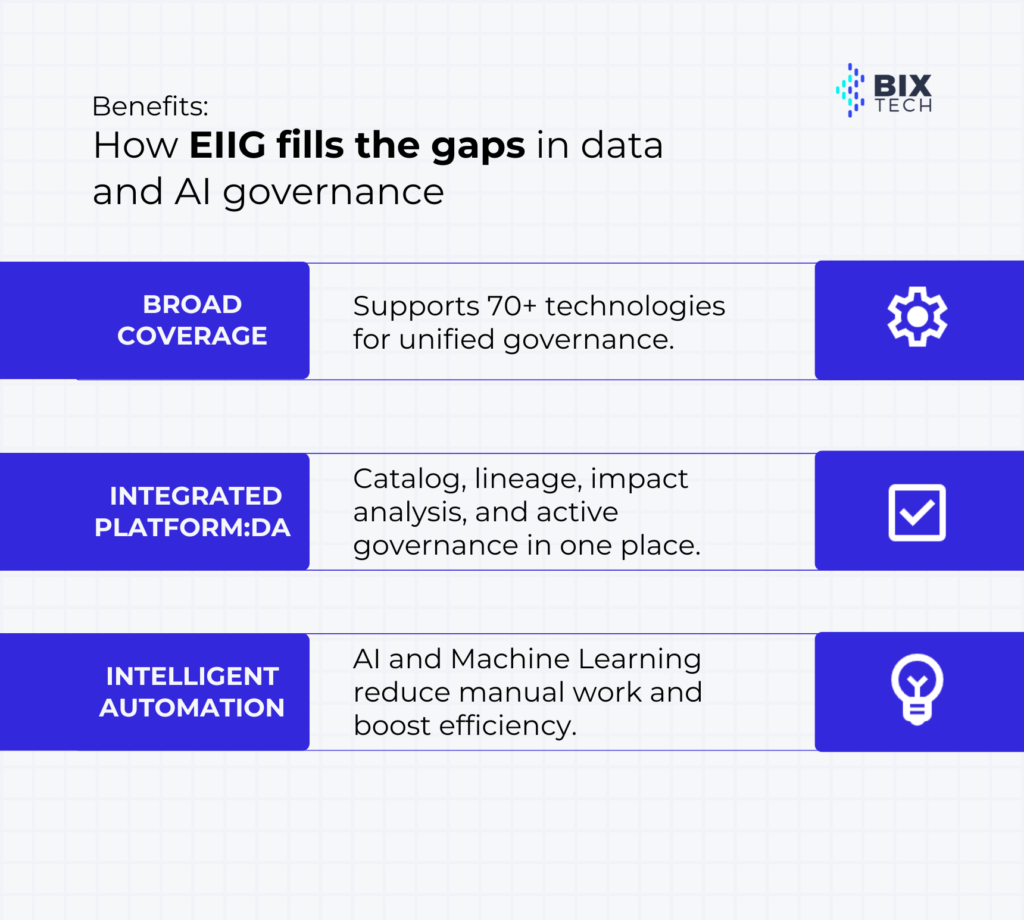
The three capabilities that address the gaps above, as described by Orion Governance.
What the partnership means
The collaboration goes beyond a reseller agreement, because the platform still needs modeling, integration and governance design to produce anything. That work is where BIX Tech comes in, alongside the Power BI governance and reporting practices most clients already run.
"We are excited to join forces with BIX Tech to expand our solutions in Brazil, one of South America's most dynamic markets. BIX Tech's expertise in delivering innovative solutions will be essential in helping our clients accelerate data migration, strengthen governance, and drive their AI initiatives."
Eduardo Eberhardt, Chief Revenue Officer at BIX Tech, pointed to the platform's integration of capabilities:
"The ability of EIIG to integrate various essential functionalities, such as data cataloging and traceability, makes it an indispensable solution for companies looking to digitally transform their processes. We are excited about this partnership and confident that our clients will see significant gains in efficiency and regulatory compliance."
About Orion Governance
Founded in 2017 and headquartered in San Mateo, California, Orion Governance works with organizations in financial services, retail, healthcare, telecommunications and technology, with a recognized role in compliance with strict regulations such as Basel III. The company has offices in the United States, Estonia, Sweden, Singapore, Germany, India and Ecuador.
The EIIG platform applies artificial intelligence and machine learning to build an integrated view of enterprise data independent of vendor, technology or cloud environment. More detail is available at oriongovernance.com.
Governance and AI advance at the same pace or neither advances at all. A company that can trace any number back to its source can also defend the model built on that number, and that traceability is the practical outcome this partnership is meant to deliver.
If your company is trying to extend governance across systems that were never designed to share metadata, or preparing data for AI initiatives that will have to withstand an audit, our specialists can help you assess the estate and design the approach. Talk to our team and move your data maturity forward. ⬇️
What is the relationship between data governance and AI?
Data governance makes AI defensible. A model inherits the quality, lineage and access rules of the data it learns from, so governance decides whether a prediction can be traced, audited and trusted. Without lineage, an organization can describe what a model produced without explaining what it was built on.
What is the Enterprise Information Intelligence Graph?
EIIG is Orion Governance's data governance platform, built around a graph of enterprise information. It combines data cataloging, lineage, impact analysis and active metadata management in one product, supports over 70 technologies, and uses machine learning to automate discovery and classification across systems from different vendors and clouds.
Why do traditional governance tools fall short for AI?
Most were designed for a single environment, and they govern one platform well while leaving the rest of the estate undescribed. AI projects draw from everything: warehouses, operational systems, files, legacy applications. Governance that stops at the warehouse boundary cannot document where the training data came from.
How long does an EIIG implementation take?
Orion reports deployment measured in weeks rather than the months or years common with traditional governance implementations, a difference it attributes to automated discovery and to integrations that ship with the platform. Actual timelines depend on how many systems are in scope and how much metadata already exists.