Modern data environments change rapidly in 2026. APIs evolve and information volumes vary by the hour, which can cause static pipelines to fail. In this scenario, Data Agents emerge as autonomous components that converse with each other to ensure reliable and efficient operations. At BIX Tecnologia, we help companies implement these intelligent architectures to create systems that learn and adapt.
What defines a Data Agent?
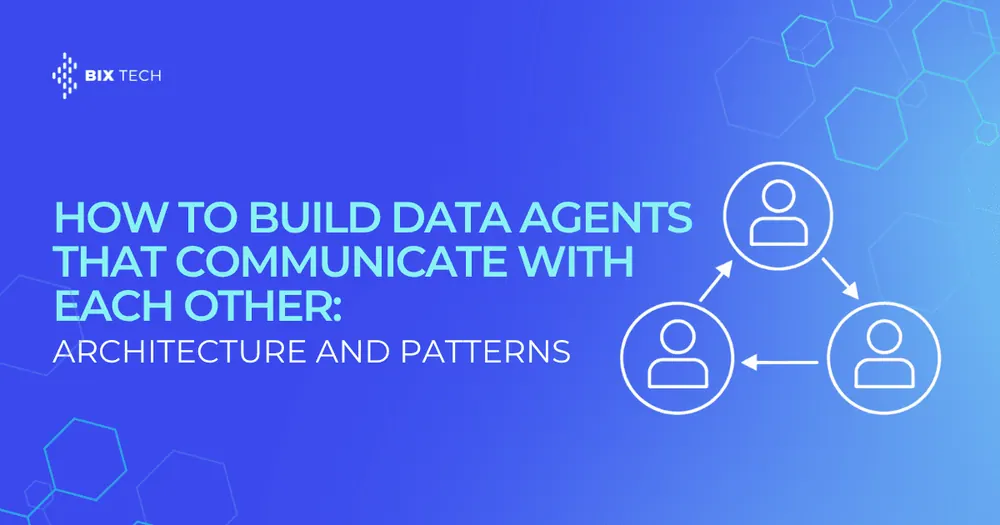
A Data Agent is an autonomous software component with specific reasoning capabilities. It understands a determined role, such as data ingestion or data quality. Additionally, it knows how to use tools like SQL connectors and vector databases. These agents exchange structured messages and maintain the context of previous conversations. We can think of them as intelligent microservices that plan and coordinate actions instead of just executing code.
Why is communication between Data Agents important in 2026?
As companies advance in AI maturity, collaboration between agents brings practical benefits. Modularity allows for the addition of new specialists without rebuilding the entire system. Resilience increases because agents recover from failures on their own. Collaborative systems allow specialists to work in parallel to reduce response time. Furthermore, agents can negotiate priorities to control cloud processing costs.
Fundamental capabilities for collaborative Data Agents
Before choosing tools, it is necessary to establish solid foundations. Each agent must have a clear identity and a delimited domain of action. Messages need to be standardized, using formats like JSON Schema to ensure integration. Maintaining short and long-term memory is essential for intelligent decisions based on history. Moreover, agents must operate under governance guidelines that protect sensitive data.
Reference architecture for Data Agent systems
A modern architecture must be event-driven and observable. The core of the system is an event bus, such as Kafka or NATS, which transports tasks. For long-running tasks that require execution guarantees, we use workflow engines like Airflow or Temporal. Shared knowledge is stored in vector databases for fast retrieval of documents and schemas. Telemetry monitors every decision and tool call to generate cost and performance dashboards.
Communication models for Data Agents
There are different ways to organize how Data Agents converse. In the orchestrated model, a coordinator plans the sequence of actions, which is ideal for rigid compliance flows. In choreography, agents react to events independently and scalably. The blackboard model allows everyone to read from and write to a shared state to solve complex problems. Choosing the right pattern depends on the balance between centralized control and agility.
Roles that work in the real world
To start the implementation, we recommend focusing on high-impact roles. Below, we list the main functions that a team of agents can assume:
30, 60, and 90-day implementation plan
In the first 30 days, the focus should be on proving the pattern in a specific use case. Implement ingestion and quality agents with a simple event bus. In the next 60 days, add the Schema Guardian and the governance Agent. During this phase, establish security policies and create dashboards to monitor the cloud budget. At 90 days, scale the system with Planner Agents and optimize resource allocation among them.
Security and compliance by design
Data protection must be present in every layer of the architecture. We minimize the exposure of sensitive information through on-demand tokenization techniques. It is essential to encrypt data in transit and at rest, limiting the scope of access for each agent. Immutable audit logs record every data mutation to ensure complete transparency. BIX Tecnologia works with the main market solutions, such as Google Cloud and AWS, to guarantee secure environments.
If your company is evaluating new AI architectures, migrating workloads between platforms, or looking to improve governance and costs, our specialists can help structure the best solution for your context. Talk to our team and advance the maturity of your data.
FAQ: Frequently Asked Questions about Data Agents
What is the difference between an agent and a microservice? Microservices generally execute fixed functions. Agents combine APIs with reasoning and memory to plan steps and adapt to changes.
Do I need Large Language Models (LLMs) for all agents? No. Many agents, such as the Schema Guardian, can be rule-based. Use LLMs only for tasks that involve natural language or ambiguity.
We set strict limits on time and the number of interactions. We also use a guardian agent to evaluate if the discussion is still adding value.
How to control the costs of these systems? We implemented FinOps Agents that monitor token and processing spending, adjusting the complexity of queries according to the available budget.
Where should I start the migration? Transform your current processes into tools that agents can call. Start with quality and governance flows before automating the complete planning.