Data teams rarely struggle to collect data. The real challenge is trusting it-especially when pipelines span multiple sources, changing schemas, and fast-moving business requirements. One silent upstream change can ripple into dashboards, machine learning models, and operational decisions.
That’s where data quality checks come in-and where Great Expectations stands out as a pragmatic, developer-friendly framework for validating data. This guide explains how to implement data quality checks with Great Expectations in a way that’s scalable, testable, and aligned with modern analytics engineering practices.
Why Data Quality Checks Matter (More Than Ever)
Data quality issues don’t always show up as obvious failures. They often appear as “almost correct” numbers that cause real business damage:
- A join key suddenly becomes nullable and silently drops rows
- A metric spikes because a duplicated data load wasn’t deduplicated
- A new enum value appears (e.g., a new “status” type) and breaks downstream assumptions
- A timestamp shifts time zones and causes reporting drift
Data quality checks create guardrails that:
- Detect anomalies early (before stakeholders find them)
- Make expectations explicit (so logic doesn’t live only in someone’s head)
- Provide consistent validation across environments (dev/staging/prod)
- Improve confidence in BI, analytics, and ML outputs
What Is Great Expectations?
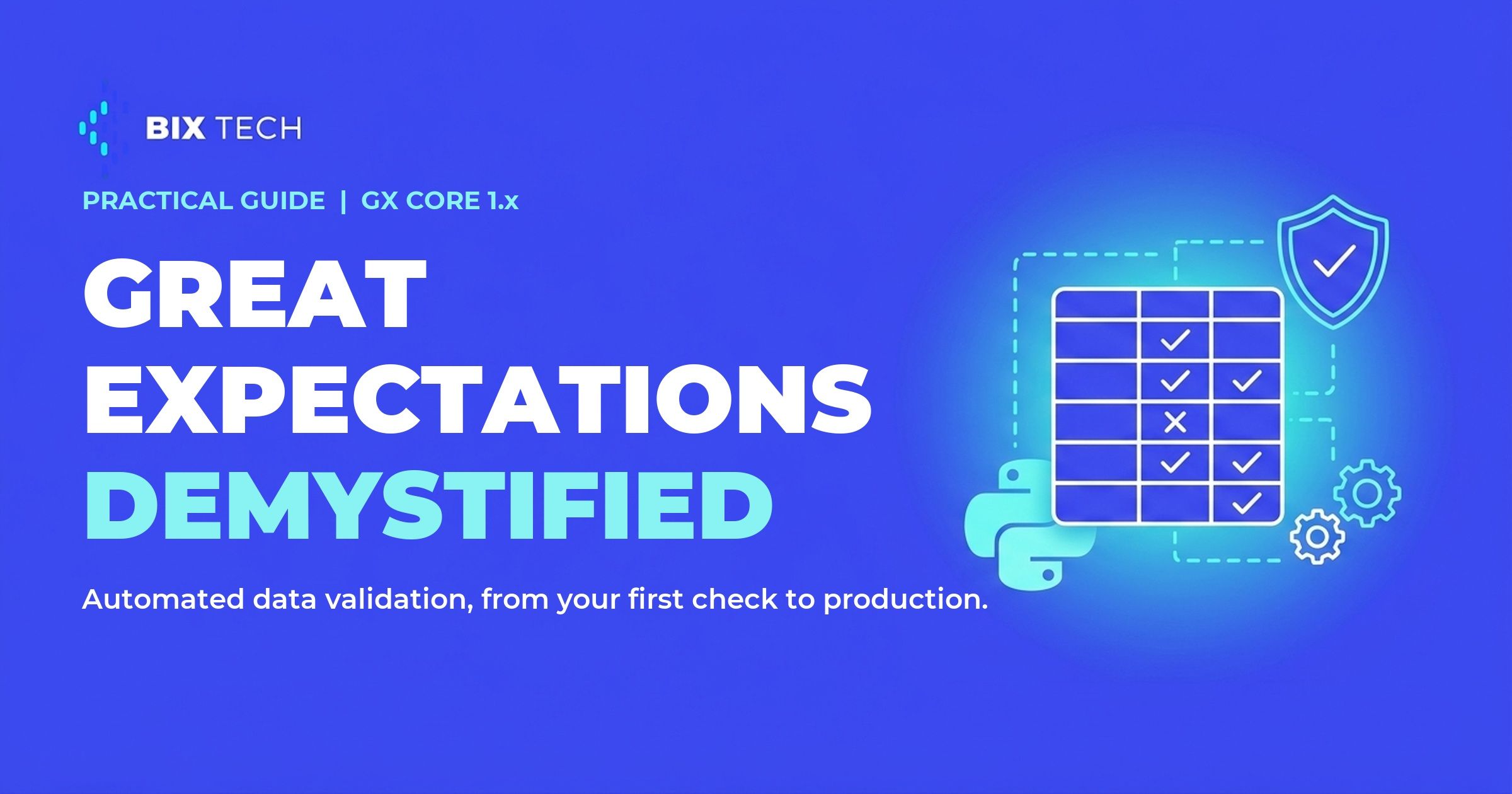
Great Expectations is an open-source data quality framework, primarily used in Python-based data ecosystems, that lets teams define, execute, and document expectations about their data.
In practice, you write checks like:
- “Column
emailshould never be null” - “
order_totalshould be between 0 and 10,000” - “
statusshould be one ofpending,paid,shipped,refunded” - “
created_atshould not be in the future” - “
customer_idshould be unique”
These checks are grouped into Expectation Suites, executed via Checkpoints, and can generate human-readable Data Docs that provide a clear validation report.
Key Concepts You Need to Know
1) Expectations
An expectation is a single rule about your data. Examples include:
expect_column_values_to_not_be_nullexpect_column_values_to_be_uniqueexpect_column_values_to_be_betweenexpect_column_values_to_be_in_setexpect_table_row_count_to_be_between
A strong expectation is:
- easy to understand,
- tied to business meaning,
- stable over time (or intentionally versioned).
2) Expectation Suites
A set of expectations bundled together-usually per dataset (table), domain (e.g., “payments”), or pipeline stage (raw vs. curated).
3) Checkpoints
A Checkpoint is how you run validation. It’s where you define:
- which dataset to validate,
- which expectation suite to use,
- what counts as “success/failure,”
- and which actions to take (e.g., store results, generate docs, notify systems).
4) Data Docs
Great Expectations can generate documentation pages showing:
- which expectations passed/failed,
- unexpected values,
- counts and samples,
- and validation history.
These docs are extremely useful for operational transparency-especially when multiple teams rely on the same datasets.
Where Great Expectations Fits in a Modern Data Stack
Great Expectations commonly validates:
- Data warehouse tables (Snowflake, BigQuery, Redshift, Postgres, etc.)
- Data lake files (Parquet/CSV via Spark or Pandas)
- Transformation outputs (post-ETL/ELT)
- ML feature datasets (before training or inference)
It also integrates well with orchestrators and CI/CD, such as:
- Airflow, Prefect, Dagster (pipeline execution)
- GitHub Actions/GitLab CI (testing)
- dbt projects (as a complementary testing layer when you need richer profiling or value-level validation)
Step-by-Step: Implementing Data Quality Checks With Great Expectations
1) Identify the “Data Contracts” That Matter
Before writing checks, decide what “good data” means for each dataset. A lightweight approach is to document:
- Required columns (schema assumptions)
- Nullability rules (what can/can’t be missing)
- Range constraints (e.g., revenue ≥ 0)
- Uniqueness (IDs, natural keys)
- Referential integrity (foreign keys should map to valid parents)
- Freshness (data should be updated within X hours)
- Distribution expectations (percent null, accepted categories, etc.)
These become your data contracts-and Great Expectations becomes the enforcement mechanism.
2) Start With a “Minimum Viable” Expectation Suite
A common mistake is trying to validate everything at once. Start with the checks that catch the most expensive failures:
Recommended baseline checks (high ROI)
- Row count: detect sudden drops/spikes
- Required columns: ensure schema doesn’t drift unexpectedly
- Not-null checks: for business-critical fields
- Uniqueness: primary keys or natural keys
- Enum validation: accepted categories for statuses/types
- Basic numeric ranges: protect against negative/absurd values
Once stable, expand into:
- regex format validation (emails, UUIDs)
- cross-column checks (if supported via custom expectations or logic)
- distribution drift detection (e.g., category proportions)
3) Generate Expectations Efficiently (But Review Them)
Great Expectations supports profiling and “scaffolding” expectations based on observed data. This is useful for speed-but it should be treated as a draft.
Best practice: profile → generate → manually curate.
- Remove overly strict expectations that will fail often for legitimate reasons
- Add business rules that profiling won’t infer (e.g., “refunds can’t exceed original payment amount”)
- Version expectation suites like code changes
4) Run Validations at the Right Pipeline Stages
Data quality checks are most effective when placed strategically:
Raw/Ingestion layer
Validate:
- schema presence,
- file completeness,
- basic row counts,
- ingestion timestamps.
Staging/Transformation layer
Validate:
- joins didn’t explode row counts,
- keys are unique,
- null rates haven’t changed,
- categories remain valid.
Curated/Serving layer (BI/ML-ready)
Validate:
- business metric constraints,
- dimensional integrity,
- freshness SLAs,
- feature store assumptions.
The goal is to fail fast and fail close to the source of the problem.
5) Turn Data Validation Into a “Quality Gate”
For production-grade data pipelines, validation should not be an afterthought. Treat it like unit tests for data:
- If critical expectations fail, stop the pipeline step and alert
- If non-critical expectations fail, log results and raise warnings
- Store validation results for auditing and trend analysis
This “quality gate” pattern prevents bad data from propagating into downstream analytics and applications.
6) Make Failures Actionable (Not Just Noisy)
A data quality system fails when teams ignore alerts. To avoid alert fatigue:
- Classify expectations by severity (critical vs. warning)
- Provide clear error context (unexpected values, sample rows, counts)
- Link failures to owners (dataset owners or domain teams)
- Track recurring failures as backlog items (not repeated emergencies)
Great Expectations helps by capturing rich validation results and showing exactly what failed, where, and how.
Practical Examples of Great Expectations Checks
Example 1: Customer Table (Curated Layer)
Common expectations:
customer_idis unique and never nullemailis not null and matches a basic patternsignup_dateis not in the futurecountry_codeis in an approved list
Why this matters: customer identity data is foundational-bad records break attribution, lifecycle metrics, and segmentation.
Example 2: Orders Table (Analytics Layer)
Common expectations:
order_idis uniqueorder_totalis ≥ 0currencyis one of supported codesorder_statusin {pending, paid, shipped, canceled, refunded}- row count does not drop more than X% day-over-day
Why this matters: orders feed revenue reporting; silent issues become finance escalations fast.
Example 3: Event Tracking (High-Volume Pipelines)
Common expectations:
event_nameis not nulluser_idnull rate below a threshold- timestamps within expected window
- accepted event_name list (or at least “unknown” rate below threshold)
Why this matters: analytics instrumentation changes frequently. Expectations catch breaking tracking updates early.
How to Operationalize Great Expectations in the Real World
Version Control and Review
Treat expectations like code:
- store suites in Git,
- use pull requests,
- require review for changes to “contract-level” rules.
This prevents accidental weakening of important checks and helps teams understand why rules changed.
CI/CD for Data Quality
Add validation runs in CI for:
- sample datasets,
- staging tables,
- recent partitions.
This reduces the probability of merging changes that break data assumptions. For a deeper implementation blueprint, see CI/CD in data engineering for seamless data pipeline deployment.
Monitoring and Trend Visibility
Over time, teams benefit from tracking:
- frequent offenders (which expectations fail repeatedly),
- drift patterns (null rates creeping up),
- changes by source system.
Even simple reporting on validation history can uncover upstream quality debt. If you need a practical approach to tracing issues end-to-end, use data pipeline auditing and lineage to trace every record.
Featured Snippet FAQ: Great Expectations for Data Quality
What is Great Expectations used for?
Great Expectations is used to define, run, and document data quality checks (called expectations) to validate that datasets meet required standards before they’re used in analytics, reporting, or machine learning.
What are “expectations” in Great Expectations?
Expectations are explicit rules about data-such as “this column should not be null,” “values should be unique,” or “numbers should fall within a range.” They represent testable assumptions about correctness.
How do you implement data quality checks with Great Expectations?
Implementation typically includes: defining expectations for key datasets, grouping them into expectation suites, executing them via checkpoints in pipelines, and reviewing results through validation outputs and generated documentation.
Where should data quality checks run in a pipeline?
They should run where they prevent the most damage: after ingestion (raw), after transformations (staging), and before serving data to BI/ML (curated). Many teams implement a quality gate that blocks downstream steps when critical checks fail.
Common Pitfalls (and How to Avoid Them)
Writing too many expectations too soon
Start small with high-impact checks, then expand. A focused suite that teams trust beats a massive suite everyone ignores.
Overfitting expectations to today’s data
If you generate expectations from profiling, review and loosen constraints that will legitimately evolve (like row counts or category distributions).
No ownership model
Data quality improves when datasets have clear owners and failure routes. Without ownership, validation becomes noise.
Treating data docs as optional
Documentation isn’t just a nice-to-have; it’s how teams debug quickly, onboard faster, and maintain confidence across stakeholders. Establishing this rigor is easier when you follow essential data management best practices every team should adopt.
Final Thoughts: Data Quality as a Competitive Advantage
Reliable data isn’t only about avoiding mistakes-it’s about moving faster with confidence. Great Expectations provides a flexible, engineering-friendly way to implement data quality checks that scale with your stack, your team, and your business.
When expectations are clear, validated continuously, and operationalized as a pipeline quality gate, data becomes a dependable asset rather than a recurring risk.
If your team is putting data quality checks into a production pipeline, our specialists can work through the implementation with the team that will maintain it. Talk to our team.