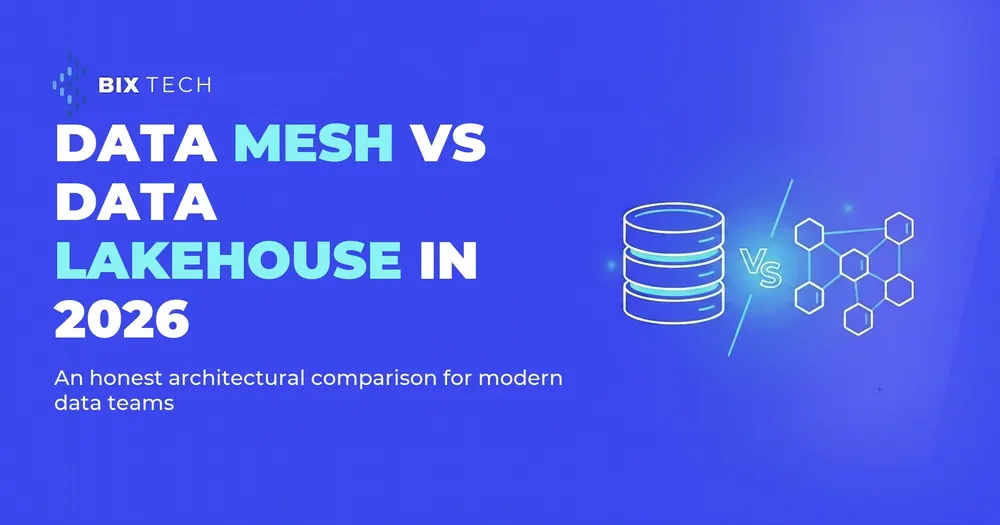
The Data Mesh vs Data Lakehouse debate is loud again in 2026, and the honest answer starts by disarming the question itself. The two show up side by side in vendor decks as if they were competing options, but they solve different problems and live in different layers of your data architecture. Treating one as a replacement for the other usually gets expensive.
A Data Lakehouse is a technical architecture. It unifies the cheap storage of a data lake with the transactional reliability of a data warehouse inside a single platform. A Data Mesh is an organizational model. It decentralizes data ownership to domain teams and treats every dataset as a product. One answers "where and how do we store and process the data", the other answers "who owns the data and how is it served". Comparing them on the same yardstick is like comparing a foundation to an org chart.
In this agnostic comparison you will see what each approach actually solves, where each one fits, and why so many mature companies end up running both at once. The goal is not to crown a winner in the Data Mesh vs Data Lakehouse race, but to help your team decide based on the reality of the operation instead of the trend of the moment, a mistake we have unpacked before in decentralized data governance.
Data Mesh vs Data Lakehouse: comparing two different layers
The confusion is understandable. Both terms emerged in the same window and both promise to fix the "messy data lake". The lakehouse attacks the problem through technology, proposing a single, governable storage layer, a shift we cover in data lakehouse architecture. The Data Mesh attacks the same symptom through organization, arguing that the bottleneck is not the tool but the central data team becoming a funnel for every request.
The lakehouse term was popularized by Databricks around 2020, while Data Mesh was coined by Zhamak Dehghani, then at Thoughtworks, in 2019. That origin already explains the difference in nature. One is a platform proposal, the other is an operating-model proposal, and that distinction changes everything when you plan how data flows across teams, as we discuss in what is data engineering.
In practice, the two do not fight over the same space. You can implement a Data Mesh using lakehouses as the technical substrate of each domain, and you can run a fully centralized lakehouse without any hint of mesh. Grasping this avoids the most common trap, which is picking a label before understanding the problem, something that shows up often in poorly scoped modern data stack projects.
Data Lakehouse: the architecture that unifies storage and analytics
The data lakehouse solves a concrete pain. Keeping the data lake and the data warehouse separate creates duplicated data, double cost, and fragile governance. The architecture merges the two by placing a transactional metadata layer on top of object storage, a topic we explore in Delta Lake benefits and real-world use cases. The same data then serves BI, data science, and machine learning without redundant pipelines.
Open table formats are what make this possible. Delta Lake, Apache Iceberg, and Apache Hudi bring ACID transactions, versioning, and schema evolution directly over Parquet files, something a raw data lake never offered. According to the official Apache Iceberg documentation, the format was designed for huge analytic tables with consistency guarantees, and that is one reason it became the backbone of platforms like Databricks.
The lakehouse tends to fit when a company wants to consolidate its stack, cut data movement, and serve mixed analytics and AI workloads from a single source. It is the natural choice for teams leaving a legacy warehouse behind and asking "what's next", a scenario we cover in you've built a data warehouse, what's next. The caveat is governance. Centralizing storage does not automatically centralize accountability for data quality.
Data Mesh: the organizational model that decentralizes ownership
The Data Mesh starts from a different premise. It assumes that in a large company a single central data team cannot know every business domain deeply, and therefore becomes a bottleneck. The answer is to hand ownership back to whoever generates the data, treating each domain as the owner of its own data product, a logic close to the decentralized governance approach we advocate.
Four principles hold the approach together: domain-oriented ownership, data treated as a product, a self-serve platform for teams, and federated computational governance. In practice, this means the sales team publishes and maintains its own datasets with a contract, documentation, and an SLA, instead of filing a ticket with the central team. That contract discipline echoes the rigor that dbt brought to data transformation.
Because it is a socio-technical model, the Data Mesh demands more process maturity than tooling. It makes sense when the organization has many domains, many data consumers, and a central team drowning in requests, and it makes little sense in small operations, where decentralization only adds coordination cost. The data quality monitoring and the self-serve platform need to be solid first, otherwise the mesh becomes distributed chaos instead of autonomy.
Comparison table and how to decide in 2026
The table below sums up the difference in nature between the two approaches. Read it as a decision map, not a scoreboard, because in most mature cases the answer is to combine the two rather than choose, a recurring theme in Databricks predictions for 2026.
| Criterion | Data Lakehouse | Data Mesh |
|---|---|---|
| Nature | Technical storage and compute architecture | Organizational and ownership model |
| Question it answers | Where and how do we store and process data | Who owns the data and how it is served |
| Central unit | A single, governed platform | The business domain as data-product owner |
| Governance | Centralized on the platform | Federated across domains |
| Fits when | Consolidating stack, serving BI, data, and AI from one source | Scaling across many domains with a saturated central team |
| Main risk | Accountability staying centralized on the platform | Coordination and standardization across domains |
The real decision criterion is not technical, it is about scale and organizational topology. If the bottleneck is a fragmented stack and the cost of moving data, the lakehouse solves it, as it does in many migrations we run comparing Snowflake vs Databricks. If the bottleneck is a central team that cannot scale across dozens of domains, the problem is the operating model, and that is where the Data Mesh comes in, often running on per-domain lakehouses built on formats like Delta and Iceberg.
Choosing between Data Mesh vs Data Lakehouse ultimately means choosing which layer your pain lives in. BIX Tech works in an agnostic way with multiple data, cloud, and engineering solutions, and the right architecture shifts with the size, maturity, and topology of each operation. If your company is redesigning its data architecture and is unsure whether the next step is to unify the platform or decentralize ownership, our specialists can help you structure the right model for your context. Talk to our team and move your data maturity forward. ⬇️

FAQ: Frequently asked questions about Data Mesh vs Data Lakehouse
What is Data Mesh vs Data Lakehouse, in practice? A Data Lakehouse is a technical architecture that unifies the data lake and the data warehouse into a single, governed platform. A Data Mesh is an organizational model that decentralizes data ownership to domain teams and treats each dataset as a product. One answers "how we store data", the other "who owns it". They are not direct competitors.
What is the difference between Data Mesh and Data Lakehouse? The difference is one of layer. The lakehouse operates at the infrastructure level, solving storage, transactions, and compute in one place. The Data Mesh operates at the organizational level, distributing accountability and governance across domains. You can implement a Data Mesh using lakehouses as the technical base of each domain.
Does Data Mesh replace the Data Lakehouse? No. Because they operate in different layers, they do not replace each other. Many mature companies run both: lakehouses as the technical substrate of each domain and the Data Mesh as the ownership and federated-governance model on top.
When should you choose a Data Lakehouse over a Data Mesh? Choose the lakehouse when the pain is technical: a fragmented stack, duplicated data, movement cost, and mixed BI, data, and AI workloads that need one reliable source. The Data Mesh fits when the pain is organizational, with a central team that cannot scale across many domains.
How do you start a migration to a lakehouse or a Data Mesh? Start by diagnosing the real bottleneck. If it is technical, prioritize consolidating storage and governance into a lakehouse. If it is organizational, invest first in the self-serve platform and data contracts before decentralizing. In both cases, a solid foundation of data quality and governance is a prerequisite.