The Lakehouse architecture has moved from bet to default starting point for anyone designing data platforms in 2026, and Databricks is the name most associated with the model. Behind that shift sits an idea that is easy to explain and hard to execute: bring together, on a single platform, the cheap storage of a data lake and the reliability of a data warehouse. This is not vendor talk; Databricks itself reported surpassing a US$ 5.4 billion annualized revenue run rate in early 2026, growing 65% year over year.
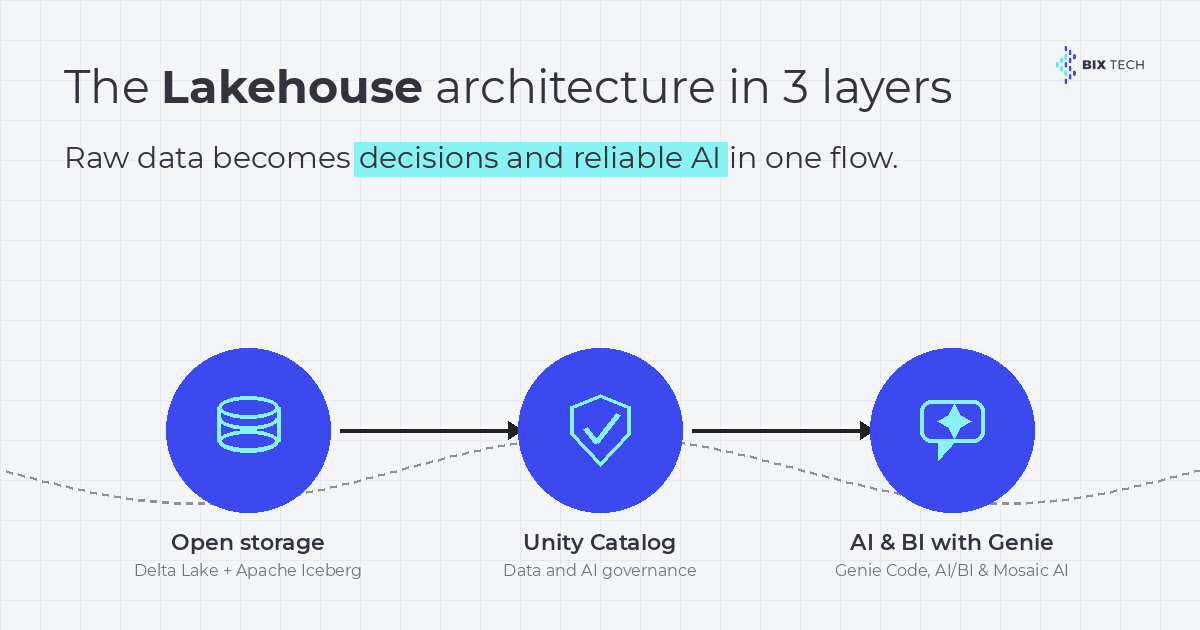
What changed this year is not the concept but the maturity of the pieces that support it. Three fronts came together: open storage formats, centralized governance with Unity Catalog, and an artificial intelligence layer that now lives inside the platform itself. Teams that followed how the modern data platform came to power analytics and AI have already seen this direction take shape.
This guide shows how those three layers fit together in practice, what each one solves, and where Genie Code and Unity Catalog enter the daily workflow of a data team. The goal is to give a CTO or Head of Data the map to decide whether, and how, a Databricks Lakehouse fits their context.
What the Lakehouse architecture is (and what changed in 2026)
The Lakehouse is a data management model that combines the benefits of the data lake and the data warehouse on one platform: the open, cheap storage of the lake with the reliability, governance, and query performance of the warehouse. It rests on two core technologies, Delta Lake (the storage layer with ACID transactions and schema enforcement) and Unity Catalog (the governance layer), according to the official platform documentation. For anyone still weighing whether the Lakehouse is the future of unified analytics, 2026 brought concrete answers.
This year's headline is interoperability. In June 2025, Databricks announced full Apache Iceberg support, letting managed tables be read and written by external engines through an open catalog API. Add to that Delta UniForm, which lets a single copy of the data be read as Delta, Iceberg, or Hudi. In practice, the data stops being locked to one tool, which reshapes the lock-in conversation that surfaces in every Snowflake versus Databricks comparison.
That openness has a direct effect on engineering. Teams that already understand what data engineering really is can keep the same processing engine while exposing the data to other consumption platforms. The figure below sums up how the three layers connect.
Unity Catalog: data and AI governance in one layer
If open storage is the foundation, Unity Catalog is the nervous system. It unifies discovery, access control, lineage, and sharing across data and AI assets, such as tables, dashboards, models, and agents, spanning workspaces and clouds, as the official product page describes. Instead of scattering access rules across many systems, the company concentrates governance in one place.
The catalog works with automatic column-level lineage and fine-grained access control, including the attribute-based model that applies column masks and row filters according to governed tags. For teams building bulletproof Databricks pipelines with Unity Catalog, that layer extends to models and agents too, not just tables.
One openness milestone is worth noting: Databricks open-sourced Unity Catalog in June 2024, under the Linux Foundation and the Apache 2.0 license, in a move announced at the Data + AI Summit. For organizations that treat data and AI governance as a single problem, that convergence is the most relevant point of the current architecture.
AI inside the Lakehouse: AI/BI Genie, Genie Code, and Mosaic AI
This is where most of the confusion in 2026 lives, and the names are worth separating before committing to any strategy for applying AI to data. The "Genie" brand covers two different products, for different audiences. On one side, AI/BI Genie, built for business users. On the other, Genie Code, built for technical teams. The table helps keep them apart:
| Capability | Who it is for | What it does | Status |
|---|---|---|---|
| AI/BI Genie | Business and analysts | Ask questions about the data in natural language and generate SQL and visualizations | GA since June 2025 |
| Genie Code | Engineers and data scientists | Agent that builds pipelines, debugs failures, and maintains systems, the evolution of the former Databricks Assistant | GA since March 2026 |
| Mosaic AI / Agent Bricks | AI teams | Build, serve, and evaluate models and agents on top of Unity Catalog | Evolving (Beta) |
AI/BI Genie lets a manager ask, in plain language, something like "what was revenue by region last quarter" and get the SQL query, the table, and the chart, as the feature documentation describes. It is the entry point for AI for people who do not write code, and it connects directly to the broader picture of how the modern data platform powers analytics and AI.
Genie Code, announced as part of the Genie family in March 2026, is an agent that works inside the developer's flow. It builds pipelines, debugs production failures, and runs multi-step tasks from a single prompt in what the platform calls agent mode. Because it is the evolution of the former Databricks Assistant, it brings the platform closer to the agent-driven future explored in those Databricks 2026 predictions for the Lakehouse.
For teams that need to build their own models, Mosaic AI bundles model serving, vector search, and an agent framework integrated with the catalog. Anyone who wants to understand the end-to-end path can start with a beginner's guide to machine learning before moving on to more sophisticated agents.
How to decide the architecture for your context
No platform is a universal answer, and BIX Tech works precisely with multiple data, cloud, and engineering solutions, choosing according to the reality of each operation. Databricks tends to fit well when the use case leans toward machine learning at scale, heavy distributed processing, or unifying data and AI under one governance model. In scenarios geared more toward pure BI over already structured data, other combinations may make more sense, as the detailed comparison with Snowflake shows.
Three decisions tend to define a project's success, and they hold for any Lakehouse architecture:
- An open table format from day one, so you avoid the technical debt of a painful migration later.
- Governance born alongside the platform, with catalog, lineage, and access control, rather than a second-year retrofit.
- Concrete use cases before infrastructure, so generative AI delivers business value instead of becoming a showcase.
The right architecture rarely comes from the tool alone; it comes from matching the platform to the problem, which is why a vendor-agnostic read of how the modern data platform powers analytics and AI matters more than any single feature list.
The Lakehouse architecture of 2026 is no longer only about choosing where to store the data; it is about uniting open storage, governance, and artificial intelligence into one flow, where Genie Code accelerates the technical team and Unity Catalog keeps everything under control. When those three layers talk to each other, the data project leaves the pilot stage and becomes a real platform, much like AI moved from the lab into industry.
Where to go deeper on Databricks
For a component-by-component view of the platform, Databricks explained: the modern data platform covers what each layer does and where it sits. Databricks and the Lakehouse details how structured and unstructured data end up in the same storage layer, and the Databricks Lakehouse features and real-world use cases sets out when Delta Lake is the right base for BI and ML workloads and when it is not.
On the engine and pipeline side, the Databricks Photon Engine explains where vectorized execution changes query time and where the gain disappears, and optimizing pipelines in Apache Spark covers partitioning, caching, and shuffle in practice. For assemblies that cross systems, real-time data pipelines with Airflow, Kafka, and Databricks and SAP connectors with Airbyte and Databricks work through two end-to-end builds. To stop bad records before they reach consumers, data trust scores and circuit breakers with Unity Catalog shows how to halt a pipeline on a quality failure instead of publishing the run.
On the AI layer, Databricks Genie Code covers the agent that writes and debugs pipeline code, integrating AI agents with Databricks to automate queries deals with the permission and audit layer those agents need, and generative AI for data analysis with Databricks and Hugging Face walks through deploying open models on the platform.
When the decision is between platforms, Databricks vs BigQuery compares the two for analytics and AI workloads, and Azure Databricks vs Microsoft Fabric is the relevant comparison for teams already standardized on Azure. For what the platform is heading toward, 12 predictions for the Lakehouse in 2026 lists the shifts worth planning around.
If your company is weighing how to structure a Lakehouse architecture with AI, Genie Code, and Unity Catalog, our specialists can help design the best architecture for your context. Talk to our team and advance the maturity of your data. ⬇️

What is the Lakehouse architecture? It is a model that combines, on a single platform, the open and cheap storage of a data lake with the reliability and governance of a data warehouse, built on transactional table formats such as Delta Lake.
What is the difference between AI/BI Genie and Genie Code? AI/BI Genie answers business questions in natural language over the data and generates SQL and charts. Genie Code is an agent for technical teams that builds pipelines and debugs code, and it is the evolution of the former Databricks Assistant.
What is Unity Catalog for? To centralize data and AI governance: discovery, lineage, access control, and sharing of tables, models, and agents across workspaces and clouds.
Does Databricks replace the data warehouse? It depends on the case. For machine learning at scale and unifying data and AI, the Lakehouse usually covers the need well. For pure BI over structured data, it is worth comparing alternatives before deciding.
Does BIX Tech work with Databricks? Yes. BIX Tech works in a vendor-agnostic way, choosing the architecture according to the reality of each operation.