A2A communication (Agent2Agent, the open standard that lets AI agents built by different teams and tools discover each other and exchange tasks) stopped being an experiment in 2026. At the project's one-year mark in April, the protocol passed 150 supporting organizations, according to the Linux Foundation, with production use across supply chain, financial services, and insurance. When an agent runs on AWS and needs to call another on Azure, this standard is what makes the conversation possible without a brittle point-to-point integration, which changes how teams think about multi-agent systems.
Connecting agents, however, is only half the job. The other half is orchestrating the network: deciding who talks to whom, keeping context across exchanges, and preventing the flow from stalling in the middle of a long task. This is where LangGraph comes in, a framework that models agent coordination as a stateful graph instead of a rigid chain of calls.
The fit between protocol and orchestrator defines how mature a project really is. What follows makes clear what changes once agents speak through an open standard, when the supervisor model beats the swarm model in LangGraph, and how to keep a multi-agent network observable and governable once it reaches production.
What A2A communication is and why it became a standard in 2026
A2A communication solves a specific problem: autonomous agents that need to collaborate even though they were built by different teams, clouds, and frameworks. Each agent publishes an Agent Card, a document that describes what it does, how it can be invoked securely, and which skills it offers. From there, a client agent finds a remote agent, sends a task, and tracks the result, all over HTTP transport with JSON-RPC messages and SSE streaming for long responses. That design is what makes data agents that communicate with each other possible without custom glue code for every new integration.
It helps to separate A2A from another standard that often appears alongside it. MCP (Model Context Protocol) handles the agent-to-tool relationship: it standardizes how an agent reaches APIs, databases, and resources. A2A handles the agent-to-agent relationship. The two are complementary, solve different problems, and were designed to work together, which is why both advanced as companies built MCP-powered AI agents.
The traction is not theoretical. The protocol has been integrated into Microsoft's Azure AI Foundry and Copilot Studio and into AWS Amazon Bedrock AgentCore, alongside Google Cloud, with SDKs in Python, JavaScript, Java, Go, and .NET, per the Linux Foundation one-year report. That cross-cloud reach is what makes it realistic to think about scaling AI agents beyond a single provider.
LangGraph: state and control for the agent network
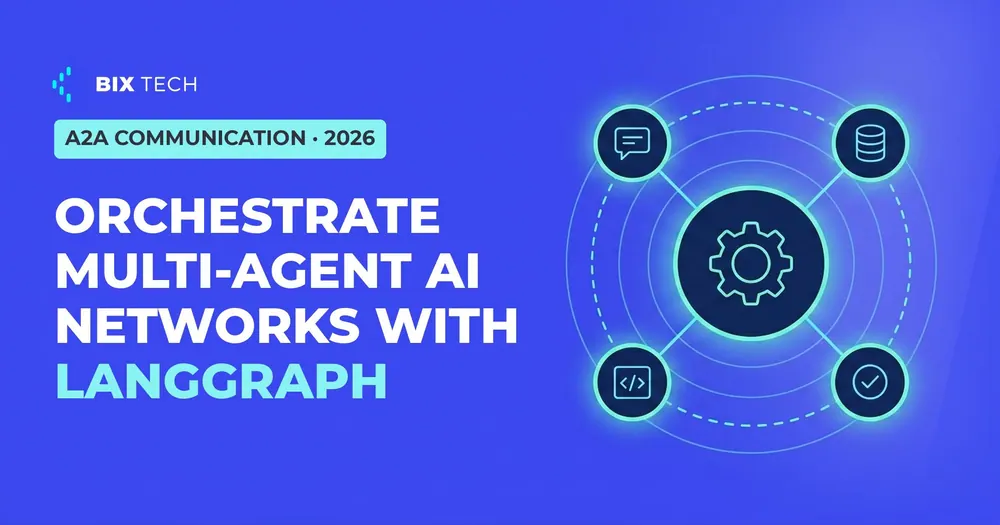
If A2A is the handshake between agents, LangGraph is the coordination brain inside your system. It represents the flow as a directed cyclic graph, where nodes are agents, tools, or memory modules, and edges define control and the path data takes. Unlike a linear pipeline, the graph allows cycles, branches, and resumptions, the foundation of any serious orchestration of AI agents.
The differentiator is shared, persistent state. LangGraph keeps context alive throughout the whole flow, so one agent can analyze a document, another can flag an issue, and the process can pause for human review without losing any history. That fine-grained control is what separates a demo prototype from an operation built around reliable AI agents.
Supervisor or swarm: which pattern to use
Within LangGraph, two architectures dominate the coordination of an agent network. In the supervisor model, an orchestrator agent receives each request, decides which specialist should act, and centralizes the handoffs. In the swarm model, agents pass the baton directly to one another using Command objects that point to the next node in the graph. The choice is not about which is better, but about what the operation needs, the same reasoning that applies to any custom AI agent project.
| Criteria | Supervisor | Swarm |
|---|---|---|
| Routing | Centralized in the orchestrator | Direct between agents |
| LLM calls | 2 per domain (route + run) | 1 per domain after the first |
| Routing accuracy | Higher, dedicated decision | Depends on each agent |
| Latency | Higher due to the intermediary | Lower, no intermediary |
| Best fit | Critical, auditable flows | Fast, fluid tasks |
In practice, the supervisor tends to be more predictable because routing is that node's only job, with a focused prompt. The swarm tends to be more agile because it drops the intermediary call, at the cost of spreading the routing decision across agents. Many mature teams combine both, using supervision where risk is high and direct handoff where volume is high, an approach aligned with how LangChain for enterprise data gets structured in real architectures.
How to build a multi-agent network in practice
Combining A2A and LangGraph follows a path that repeats across companies that have already taken this to production. The diagram below summarizes the five stages of a multi-agent network, from each agent's identity card to the governance layer that keeps everything under control.
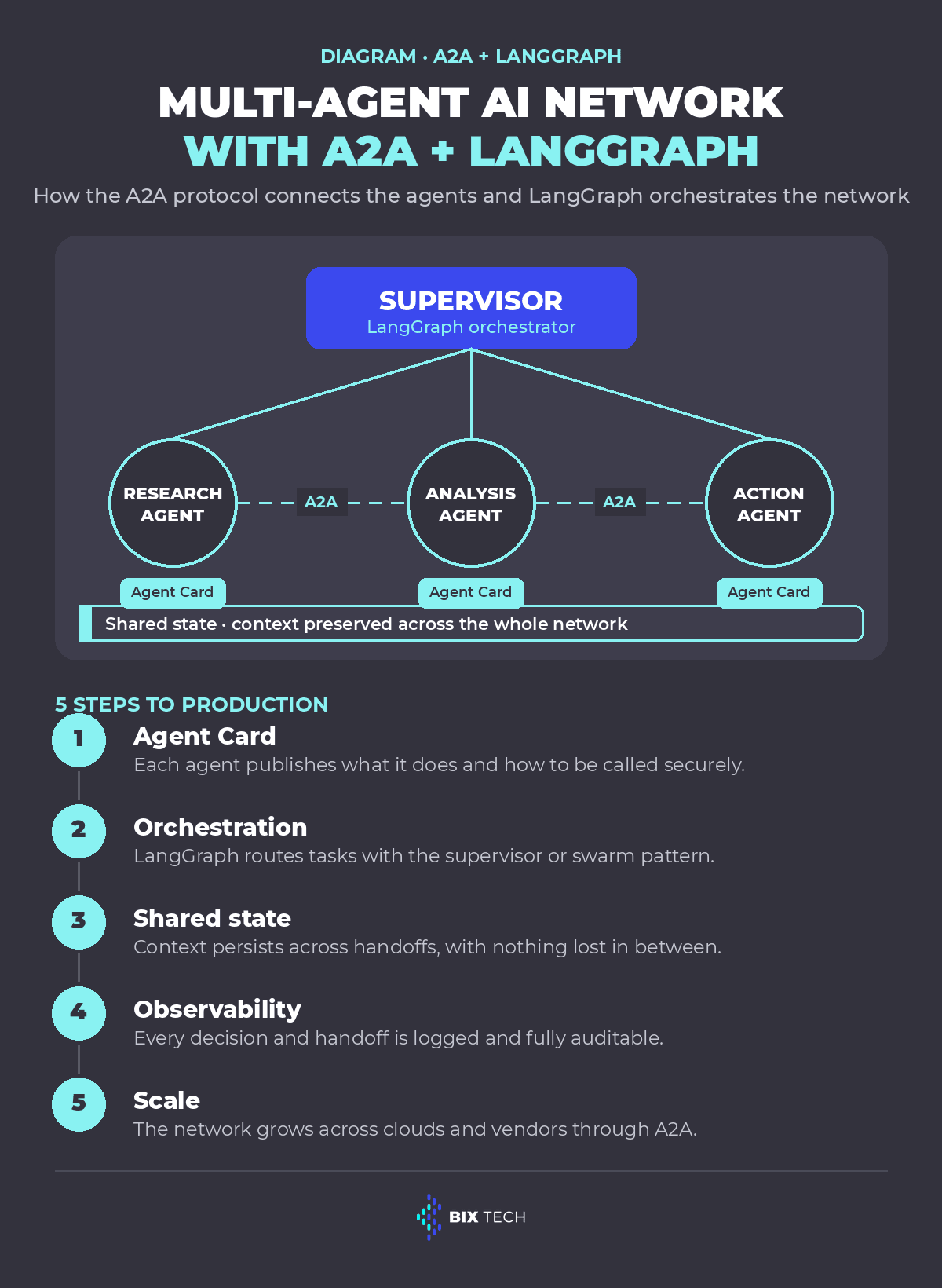
Everything starts with each agent's Agent Card, the A2A document that states what it does and how to be called securely. Next, LangGraph takes over orchestration, usually with a supervisor deciding the routing and holding the conversation state across nodes. Shared state ensures no context is lost in the handoffs, the point that often determines whether a network turns into a quality, multi-agent solution or just returns loose answers.
The fourth stage is the one that most separates pilot from operation: observability and governance. Without logging every decision, every handoff, and every tool call, the network becomes a black box that is impossible to audit. For that reason, instrumenting the flow with strong observability for LLM applications is usually a prerequisite for releasing agents into regulated environments. The fifth stage, scaling, only makes sense once that base is mature enough to monitor hallucinations reliably.
This arrangement does not remove the hard decisions. Cost per LLM call, acceptable latency limits, and the level of autonomy the operation tolerates remain situational choices with no single answer, much like the broader question of whether AI agents replace teams. The advantage of pairing an open protocol with a stateful orchestrator is that each of these decisions can be tuned without rewriting the entire network.
A2A communication solves interoperability, and LangGraph solves coordination. Together, they move agents out of demo territory and into networks that companies can operate, audit, and expand, the kind of foundation BIX Tech helps design by working with multiple data, cloud, and engineering platforms, depending on each operation's reality.
Before wiring agents together with LangGraph, it helps to settle the framework itself, and our guide to choosing an AI agent framework compares LangChain, LangGraph and PydanticAI.
If your company is building an AI agent network and wants it to be interoperable, observable, and production-ready, our specialists can help design the best architecture for your context. Talk to our team and move your agents up the maturity curve. ⬇️
Orchestrating agents and orchestrating data pipelines are different problems that share a word; for the pipeline side, see workflow orchestration with Apache Airflow.
What is A2A communication? It is the open Agent2Agent standard that lets AI agents built by different teams and tools discover each other, exchange messages, and delegate tasks through a common interface, now maintained by the Linux Foundation.
What is the difference between A2A and MCP? MCP connects an agent to its tools, APIs, and data. A2A connects agents to each other. They are complementary standards, designed to work together.
Where does LangGraph fit in? LangGraph orchestrates the network inside your system. It holds shared state, controls the paths between agents, and allows pauses for human review, while A2A handles communication between agents of different origins.
When should I use supervisor instead of swarm in LangGraph? Use supervisor when you need predictable, auditable routing in critical flows. Use swarm when speed and lower latency matter most in simpler tasks. Mature architectures often mix the two.
Is A2A communication ready for production? Yes. At its one-year mark, the protocol passed 150 supporting organizations and records production use in sectors such as financial services, insurance, and supply chain, with integration across the major clouds.