The semantic layer has moved from data engineering jargon to a question of how much you can trust what your AI agents tell you. Most agents in production today talk straight to the data warehouse, translate a user question into SQL, and return a number. The trouble shows up when two agents answer "what was net revenue last quarter?" with different figures, because each one interpreted "net revenue" its own way.
In 2026 that risk got numbers attached to it. According to Gartner, organizations that prioritize semantics in AI-ready data can raise their agents' accuracy by up to 80% and cut costs by up to 60% by 2027. The takeaway is blunt: context, not the model, is usually the bottleneck for anyone trying to move LLMs into real business workflows.
So it pays to understand what this layer is, why it decides whether the agent is right or wrong, and how to start building yours without rewriting your entire data architecture. That is what this guide breaks down.
What a semantic layer is (and why 2026 made it unavoidable)
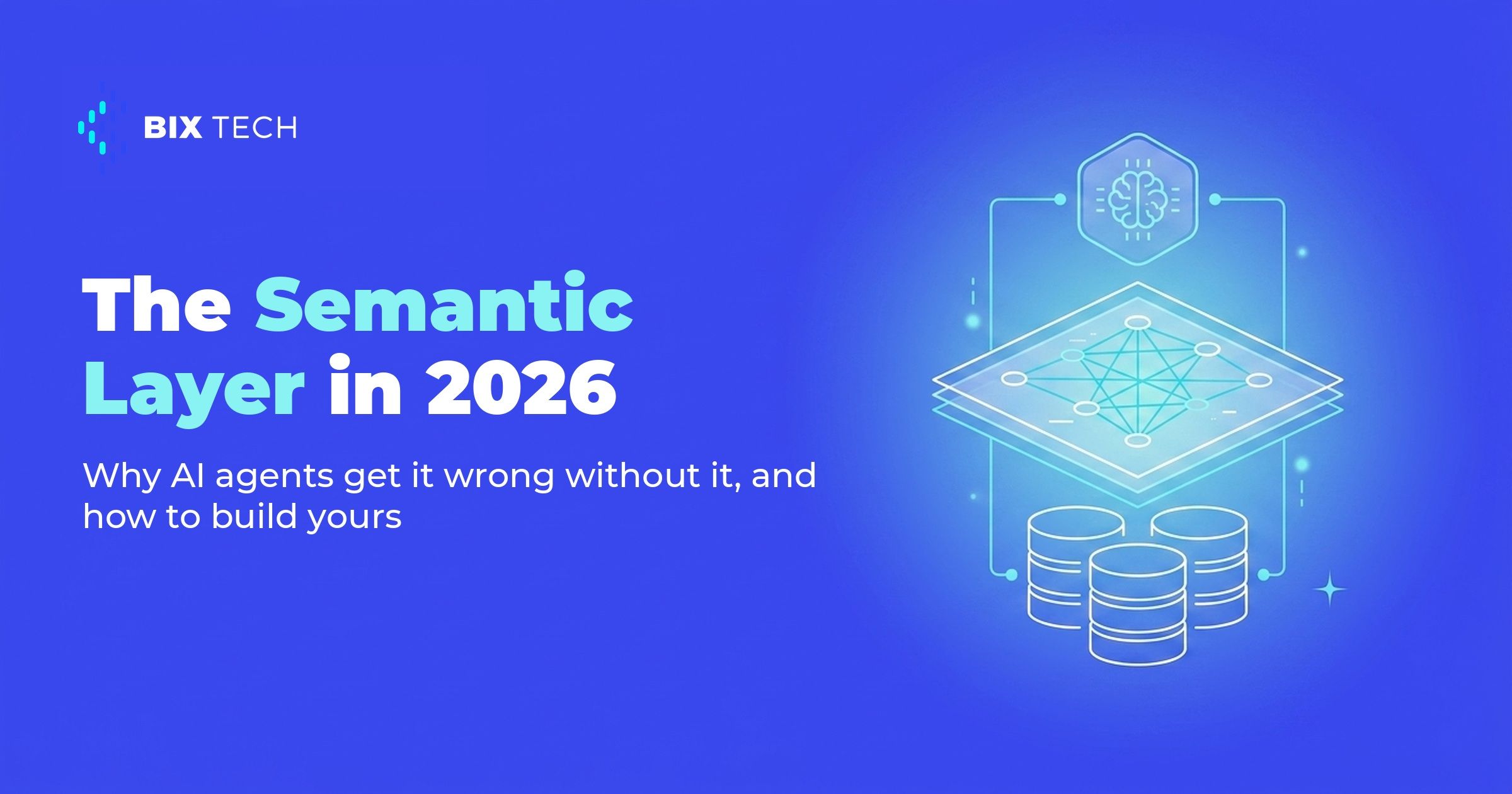
A semantic layer is the translation between the physical data model and the language of the business. In one place, it defines what metrics like "net revenue", "active customer" or "churn" actually mean, which tables and filters feed each calculation, and which rules govern every dimension. Instead of each dashboard or agent reinventing the formula, they all read the same definition, which ties directly into the discipline of data governance.
This is not a new idea. Business intelligence tools have carried semantic models for years, and modern modeling practices with dbt in the data stack cemented the idea of versioned, auditable metrics. What changed is the consumer: it used to be an analyst reading a chart, and now it is an autonomous agent generating SQL and making decisions in a loop.
That shift in consumer is exactly why the semantic layer became a 2026 priority. A human notices when a number looks off and digs in; an agent running analytics at machine speed propagates the error downstream with the same confidence it would carry a correct one. The semantic layer is what gives the agent the meaning the schema alone never holds.
Why AI agents get it wrong without a semantic layer
The error rarely lives in the language model. It lives in what the model receives. When an agent hits the raw data warehouse, it sees table and column names, not business rules, and has to guess the intent behind every question. On benchmarks that mimic real enterprise schemas, with many tables and knowledge scattered across documents, the text-to-SQL accuracy of frontier models drops sharply compared to idealized lab settings.
Then add cost. With no ready definitions, the agent writes longer queries, gets them wrong, retries, and burns more tokens on each iteration, a tax that compounds once you put agents to work at scale. It is no surprise that Gartner expects more than 40% of agentic AI projects to be canceled by the end of 2027, largely on rising costs and weak risk control.
There is also the governance and traceability problem. When every agent defines its own metrics, nobody can audit where a number came from, the opposite of what practices like governed transformation with dbt are built to guarantee. The semantic layer solves all three at once: it supplies context to be accurate, reuses definitions to be cheaper, and centralizes rules to be auditable.
| Without a semantic layer | With a semantic layer |
|---|---|
| Agent translates the question straight into SQL over the raw schema | Agent queries pre-validated metrics and definitions |
| "Net revenue" can shift from one agent to another | A single definition governs every consumer |
| Errors and retries inflate token consumption | Predictable queries cut cost per answer |
| Hard to trace where a number came from | Centralized lineage and rules make auditing easy |
How to build your semantic layer
Building a semantic layer is less about a specific tool and more about a sequence of decisions. BIX Tech works across multiple data, cloud and engineering solutions, and the right choice varies with each operation's maturity and the existing stack, whether that is Snowflake, BigQuery or another data warehouse already in place. The path below works as a starting point.
Start with the metrics that hurt the most. Map the ten to fifteen indicators that show up in every leadership meeting and lock a single definition for each, with its formula, filters and source, the same discipline that separates a data warehouse delivering real value from one that just stores rows. This business agreement, before any code, is what gives the layer real meaning.
Next, materialize those definitions where they can be versioned and tested. Modeling metrics in layers, with staging, intermediate rules and final tables, is a settled practice with dbt and keeps every number auditable. From there, expose the layer through a stable interface, such as a metrics API or governed views, so the agent queries ready definitions instead of inventing SQL.
Finally, connect the agent to that layer and monitor it. The agent should receive the metric catalog as context and be instructed to use existing definitions rather than improvise. Track accuracy, cost per answer and divergence with the same data quality yardstick you already apply to the rest of the pipeline, and iterate with continuous data quality monitoring.
None of this means throwing away what you have. Teams that already invested in dbt modeling, in governance, or in a mature warehouse are most of the way there, and the semantic layer becomes the bridge that finally makes those assets ready for the agentic era. The work is in centralizing meaning, not starting over.
A semantic layer only holds up when the entities and relationships under it are defined first, which is the job described in our explainer on logical data models.
The semantic layer is what separates an agent that looks smart from one trustworthy enough to back a decision. In 2026, under pressure to show returns and control the cost of AI projects, it stopped being an architecture detail and became a prerequisite for any agent that touches business data. If your company is building AI agents on top of critical data and wants them to land the right number consistently, our specialists can help design the right semantic layer for your context. Talk to our team and move your data maturity forward. ⬇️

What is a semantic layer in data? It is the layer that translates the physical data model into business language. It centralizes the definitions of metrics, dimensions and calculation rules in one place, so dashboards, reports and AI agents all use the same source of truth instead of recomputing each indicator on their own.
Why do AI agents get it wrong without a semantic layer? Because without it the agent reads only raw tables and columns and has to guess what each metric means when generating SQL. That produces conflicting answers to the same question, drives up token consumption through retries, and makes auditing hard. The semantic layer supplies the missing context and makes answers consistent.
Are a semantic layer and a data warehouse the same thing? No. The data warehouse stores and processes the data; the semantic layer sits on top of it and defines what each number means. You can run a mature warehouse on Snowflake or BigQuery and still lack a semantic layer, which is what gives business meaning to what is stored.
How do I start building a semantic layer? Begin by defining the ten to fifteen metrics leadership uses most, each with a single formula, filter set and source. Materialize those definitions in a versioned, testable way, expose them through a stable interface like a metrics API, connect the agent to that catalog, and monitor accuracy and cost.
How much does a semantic layer improve AI agent accuracy? According to Gartner, organizations that prioritize semantics in AI-ready data can raise agent accuracy by up to 80% and cut costs by up to 60% by 2027. The gain comes from removing guesswork: with ready definitions, the agent stops reinterpreting each metric on every query.