Durable workflow orchestration has moved from an infrastructure afterthought to a core decision for anyone running data and AI in production. The reason is simple: processes that run for minutes, hours, or days, such as a heavy ingestion pipeline or an agent that chains dozens of model calls, break halfway through all the time. When that happens, the question that separates a reliable system from a fragile one is direct: does the work restart from zero, or does it continue exactly where it stopped?
That is the promise of durable execution, and it is the ground where Temporal.io has established itself. The technology treats a process's state as persistent by default, so a network failure, a deploy in the middle of a run, or a crashed worker do not erase the progress already made. For teams operating data pipelines or trying to move AI agents beyond the prototype, that changes the game.
The market noticed. In February 2026, Temporal raised US$ 300 million in a Series D round at a US$ 5 billion valuation, led by Andreessen Horowitz, according to the company. This article focuses on what durable workflow orchestration is, why 2026 pushed it to the center of the conversation, and where it fits in modern data platforms and agentic systems.
What is durable workflow orchestration?
Durable execution is the guarantee that your code runs to completion, no matter what happens to the infrastructure beneath it. Instead of treating each step as an isolated call that is lost on the first failure, the platform records everything and rebuilds the state when something goes wrong. In practice, it is the difference between an orchestration process that survives instability and one that needs a human babysitter every time a server restarts.
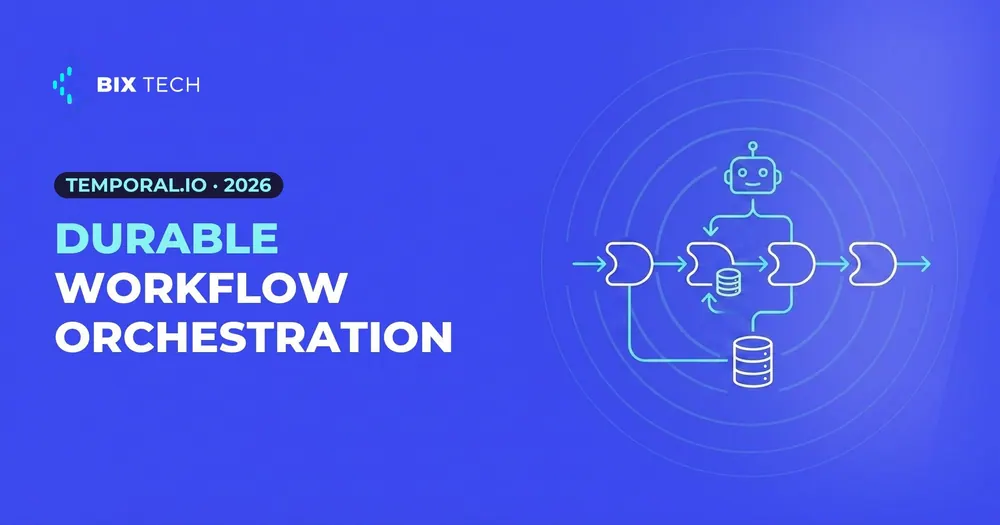
Temporal splits the logic into two pieces. The workflow holds the business logic, the sequence of decisions that must happen, while activities handle interactions with the outside world, which is where instability lives: an API that will not respond, a slow database, a language model that times out. According to the platform documentation, every action is written to an event history, and when a worker crashes, another one takes over and replays that history to recover the previous state before moving on. Activities can be retried automatically by policy, without the developer writing retry code by hand, a pattern familiar to anyone who has built reliable, reproducible pipelines.
A comparison helps avoid confusing this with what already exists. A message queue delivers a task and forgets about it; a scheduler fires a job at a set time and does not know what to do if it fails midway. Durable execution carries the full state of the process in a fault-tolerant way, allowing it to pause, resume, or replay from any point. That model is what underpins the more resilient data integration architectures, where reliability does not depend on an operator being awake at three in the morning.
Why 2026 made durable execution central
The loudest signal came from capital. Beyond the US$ 300 million Series D, Temporal reported revenue growth above 380% year over year and more than 20 million installs per month, with 9.1 trillion lifetime action executions on its cloud, according to figures the company disclosed. Numbers of that magnitude suggest durable execution has left the niche of transactional systems and become a foundation for AI at scale.
The product roadmap followed the same direction. At the Replay 2026 event, Temporal announced capabilities aimed squarely at data and agents: Serverless Workers running on AWS Lambda, Standalone Activities for job processing without complex queuing, Workflow Streams to deliver tokens and updates in real time, and external storage for large payloads on Amazon S3. For teams handling metadata-driven ingestion of large volumes, dealing with heavy payloads without bloating the workflow history solves a concrete pain.
The most revealing announcement was about integration. The platform added support for the Google ADK and the OpenAI Agents SDK, making each model call and tool execution run as an activity with automatic retries and recovery. It is no coincidence that companies like OpenAI, Replit, ADP, and Coinbase appear among publicly cited users; when an agent needs human-in-the-loop or a transaction cannot fail halfway, reliable AI agent orchestration depends on exactly this kind of guarantee.
Durable workflow orchestration for data pipelines and AI agent systems
In data pipelines, the gain shows up in long processes full of external dependencies. An ingestion that pulls data from a dozen third-party APIs, applies transformations, and loads into a lakehouse has many points where something can stall. With durable execution, every completed step is recorded, so a failure at step eight does not force a redo of the previous seven, which cuts reprocessing cost and the risk of duplicated data in the analytics platform.
In AI agent systems, the problem is even sharper. Most frameworks treat each model call as fire-and-forget, with the agent's state living only in memory; when the process dies, the progress dies with it. That is why reliable AI engineering requires externalizing state, and durable execution does that by construction. An agent that plans, calls tools, and waits for human approval can stay suspended for hours without consuming resources and resume intact when the answer arrives.
This does not turn durable execution into the answer for everything, and here the stance has to be situational. Scheduling tools like Apache Airflow still fit predictable batch loads very well, such as a nightly data warehouse refresh or a weekly model retrain. The table below summarizes where each approach tends to make more sense.
| Criterion | Scheduled orchestration (Airflow-style) tends to fit | Durable execution (Temporal-style) tends to fit |
|---|---|---|
| Nature of the load | Finite, predictable batch | Long-running, open-ended processes |
| Trigger | Time or DAG dependency | Event, code decision, or external interaction |
| State between steps | Reprocesses the job from the start on failure | Resumes at the exact point it stopped |
| Human waiting | Awkward to model | Pauses for hours or days at no cost |
| Typical case | Warehouse refresh, nightly ETL | Transactions, AI agents, distributed sagas |
The combined reading is that many operations run both: scheduling for classic data engineering and durable execution for application logic and agentic systems. The selection criterion is not which technology is trending, but which load profile you need to sustain. Defining that clearly, before adopting any tool, is what separates a mature data strategy from one more layer of expensive complexity.
Durable workflow orchestration is, in the end, an engineering answer to an old problem that the age of AI agents only made more visible: real-world systems fail, and whoever does not design for failure pays the price in production. More than the specific tool, what matters is treating reliability and state as architectural decisions from day one, whether in a data pipeline or a fleet of agents.
If your company is building data pipelines or AI agent systems that need to run reliably in production, our specialists can help define the orchestration architecture that fits your context. Talk to our team and advance the maturity of your data. ⬇️
Temporal and Airflow solve different halves of the same problem, and our pillar covers when Airflow fits and when another approach is better.

Frequently asked questions
What is durable workflow orchestration? Durable workflow orchestration is a model in which a process's state is persisted by default, guaranteeing that the code runs to completion even in the face of infrastructure failures. If a server crashes or a network flickers, execution resumes exactly where it stopped, without reprocessing completed steps. It is the foundation of durable execution platforms like Temporal.io.
What is the difference between Temporal and Airflow? Temporal is a durable execution platform for long-running, transactional, event-driven processes written as code. Apache Airflow is a DAG-based scheduler optimized for predictable batch pipelines, such as nightly loads and model retraining. They are not direct competitors: many operations use Airflow for data engineering and Temporal for application logic and agents.
Why use durable execution for AI agents? Because AI agents in production fail constantly when state lives only in memory: if the process dies, the progress vanishes. Durable execution externalizes that state, gives automatic retries and recovery to each model call, and lets an agent wait for human approval for hours without losing context, making reliable agentic systems possible.
Is Temporal.io free or paid? Temporal has an open source core that can run on your own infrastructure, plus a managed service, Temporal Cloud, billed by usage. In 2026 the company reported more than 20 million installs per month and 9.1 trillion lifetime executions on its cloud, according to its own figures. The choice between self-hosting and the managed service is situational.
How do you start with durable workflow orchestration? The practical path is to map the processes that suffer most from failures and long waits, such as heavy ingestions or multi-step agents, and model them as workflows and activities. It helps to start with a high-value, low-risk case, measure the gain in reliability and reprocessing, and only then expand. A data consultancy can accelerate that design and avoid common pitfalls.