dbt in 2026 is no longer just the "data build tool" that ran SQL inside the warehouse. It has become the backbone of the modern analytics stack. Today it organizes data transformation into versioned layers, defines reusable metrics, and delivers governed context to the AI agents that are starting to consume data on their own. Understanding that shift is the starting point for any team looking to modernize its data platform.
The shift is more than talk. On June 1, 2026, Fivetran completed its merger with dbt Labs, first announced in October 2025, with the stated goal of building the data infrastructure for "trusted AI agents," according to TechTarget. When ingestion and transformation live under one roof, the way you approach data governance changes for good.
This guide breaks down what changed, how dbt positions itself as a transformation layer, the role of semantic models, and why well-modeled pipelines are a prerequisite for AI. The aim is practical: to give a Head of Data or an analytics engineer a map for deciding where dbt fits along their analytics maturity journey.
What changed for dbt in 2026
The execution engine was rewritten. dbt Fusion, built on technology from the SDF Labs acquisition and written in Rust, was open-sourced as dbt Core v2.0 and parses large projects in seconds, something the previous Python runtime could not deliver, as detailed on the dbt Labs blog. For teams maintaining hundreds of models, that cuts daily friction and brings development closer to solid data modeling practices.
At the market level, the Fivetran and dbt Labs union signals where the industry is betting: ingestion, transformation, and semantic context on a single plane. A quick agnostic note here. The choice between dbt, cloud-native tooling, or a broader platform depends on each operation's reality, and there is no single architecture that fits every cloud data management setup.
The semantic layer spec was modernized too. The old measures gave way to metrics as the primary building block, YAML nesting was reduced, and semantic annotations now live inside the model itself, according to the official dbt documentation. Less ceremony to define a metric means more people on the team can maintain the governance layer over the long run.
dbt as a transformation layer: from ELT to analytics engineering
dbt was born for the ELT model, where you first extract and load raw data into the warehouse and only then transform it in place. Instead of shuffling data between tools, the analyst writes models in SQL, versions everything in Git, and lets the data build tool materialize the final tables. That inversion is what brings analytics work closer to software best practices.
From there comes the analytics engineering culture: automated tests, documentation generated from the code itself, and traceable data lineage. Because quality tests live in the same layer as the transformation, the team validates information before it reaches dashboards, a principle we explore in our guide to dbt Cloud and CI/CD. Reliability stops being a one-off audit and becomes part of the pipeline.
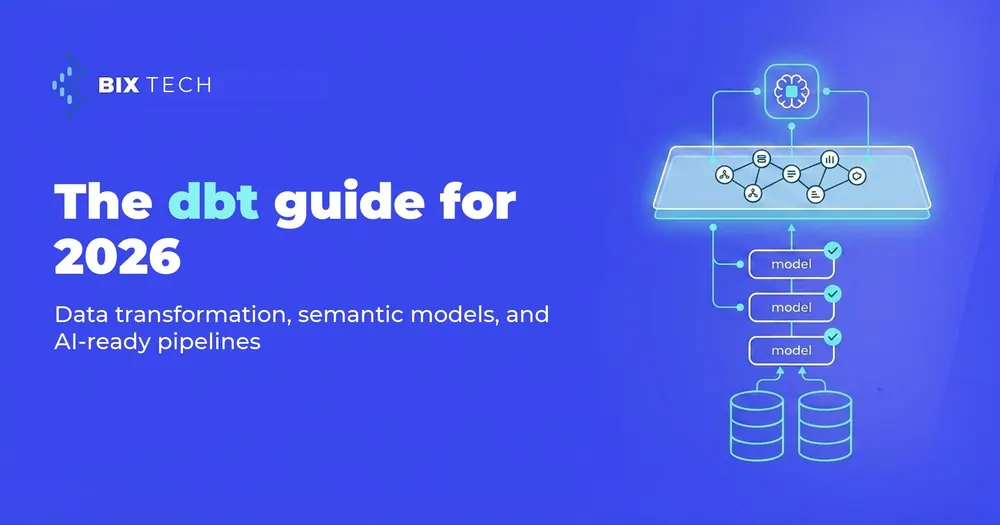
In practice, a dbt project tends to organize itself into layers with distinct responsibilities. That separation keeps the model readable as your data warehouse grows in value:
| Layer | What it does | Who consumes it |
|---|---|---|
| Staging | Standardizes and cleans raw data from each source | Intermediate models |
| Intermediate | Applies business rules and reusable joins | Mart models |
| Marts | Delivers ready-to-use tables and metrics per domain | BI, reports, and AI agents |
Semantic models: the bridge between data and decisions
The semantic layer is where a metric is defined once and consumed consistently across every tool. "Net revenue" ends up with a single formula, no matter who opens the report, which eliminates the classic mismatch of numbers between teams. That alignment is what makes a choice between BI platforms a matter of fit rather than of conflicting metrics.
The movement gained industry weight. dbt joined the Open Semantic Interchange initiative, alongside partners such as Snowflake and Tableau, to create an open standard for semantic metadata, as announced by Snowflake. Standardizing how a metric is defined is what lets you swap visualization tools without rewriting the business logic.
For self-service BI, the payoff is direct: analysts explore data within guard-rails, without reinventing calculations for every dashboard. The same governed definitions also power AI-powered data analysis, so a chart and an assistant answer the same question with the same number.
AI-ready pipelines: why agents need governed data
AI agents do not invent context, they inherit whatever your architecture provides. Without a governed metric definition, an agent answering "what was last quarter's margin?" can pick the wrong column and return a plausible but false number. That is why governed pipelines became a precondition, not an accessory, for building reliable AI agents.
The very thesis of the Fivetran and dbt Labs merger points this way: deliver governed, semantically rich data to support trusted agents at scale. When the pipeline already carries tests, lineage, and defined metrics, the agent consumes a substrate it can trust, which cuts the governance rework needed to plug AI on top.
Getting started does not mean rebuilding everything. The usual path is to map your most critical metrics, model them first in dbt, and only then expand coverage, always tied to the reasons 2026 is the year to invest in data optimization. Maturity comes in layers, not all at once.
Where to go deeper on dbt
If the starting point is the transformation layer itself, from ETL to ELT with Airbyte and dbt explains why the order of the steps changed and what that costs in the warehouse, while data modeling and transformation with dbt goes model by model through a working project. dbt in the modern data stack places it next to ingestion, orchestration, and BI, and implementing dbt in an existing data warehouse is the one to read when the warehouse already has years of SQL in it and cannot be paused.
On the metrics layer, how the dbt Semantic Layer works in practice covers the mechanics of defining a metric once and querying it from any tool, and dbt semantic models for AI agents extends the same idea to agents that need a governed definition before they can answer a business question.
Trust in the output comes from tests, documentation, and lineage. automating data quality and cleansing with dbt covers the test suite that catches a broken load before the dashboard does, and dbt with governance and version control covers ownership and review. To make that visible outside the data team, automating documentation and auditing with dbt and DataHub and data governance with DataHub and dbt show how the catalog reads dbt metadata directly.
As the project grows, the constraints become engineering ones. dbt Cloud with CI/CD covers running tests on every pull request, dbt Mesh across multiple teams covers splitting one monolithic project into domains with contracts between them, and dbt vs Airflow clears up the recurring confusion between transformation and orchestration. Airbyte, dbt, and Airflow together assembles the three from scratch.
dbt in 2026 has consolidated a role that had been maturing for years: the layer where raw data becomes trusted, governed information ready for any consumer, from the dashboard to the autonomous agent. If your company is structuring the data transformation and semantic layer that will feed both BI and AI, our specialists can help design the right architecture for your context. Talk to our team and move your data maturity forward. ⬇️

FAQ: Frequently asked questions
What is dbt and what is it used for in 2026? dbt is a data transformation tool that lets analysts and engineers write, test, and document SQL models inside the data warehouse, following the ELT approach. In 2026, beyond transforming data, it centralizes metric definitions in the semantic layer and delivers governed context to BI tools and AI agents, making it the core of modern analytics engineering.
What changed for dbt in 2026? The biggest change was both technical and strategic. The new dbt Fusion engine, written in Rust, was open-sourced as dbt Core v2.0 and speeds up parsing of large projects. In the market, Fivetran completed its merger with dbt Labs in June 2026 to unite ingestion, transformation, and the semantic layer on a single plane aimed at trusted AI agents.
What is the difference between dbt and a data warehouse? The data warehouse is where data is stored and where processing happens, such as Snowflake, BigQuery, or Databricks. dbt is the transformation layer that runs on top of it: it orchestrates, versions, and tests the SQL that builds the final tables. One stores the data, the other organizes it and makes it trustworthy.
What is the dbt semantic layer? It is the layer where each business metric is defined once and consumed consistently across every tool. It ensures that "revenue" or "margin" carry the same formula in any report or AI agent, removing number mismatches between teams and serving as a single source of truth.
Why do data pipelines matter for AI projects? Because AI agents inherit the quality of the data they receive. Without governed, tested metrics, an agent can respond with plausible but wrong numbers. Pipelines with tests, lineage, and a semantic layer deliver the trustworthy context AI needs to avoid hallucinating about corporate data.