GCP Dataplex is Google Cloud's governance layer for data spread across BigQuery and Cloud Storage, and its most useful capability has little to do with cataloging. It runs data quality checks for you, on a schedule, against tables you never wrote a test for.
That matters because of where quality checks usually live. Most teams put them inside the transformation layer, so a table only gets validated if someone remembered to write an assertion for it. Raw landing zones, ingestion tables and files in buckets rarely qualify, and they are exactly where a bad load starts.
One naming detail before anything else. On April 10, 2026, Google renamed Dataplex Universal Catalog to Knowledge Catalog, and the release notes confirm the API, client libraries, CLI and IAM names stayed on dataplex. So the console says Knowledge Catalog, your Terraform still says google_dataplex_datascan, and the product is the same one.
What GCP Dataplex is, and what changed in 2026
Dataplex started as a way to organize lakes, zones and assets over storage buckets. It has since absorbed the catalog role: Data Catalog began a phased shutdown in June 2026, and its metadata responsibilities moved here. What you get today is a single control plane that discovers data, catalogs it, profiles it, scores its quality and tracks its lineage.
The scope covers BigQuery native tables, Iceberg REST Catalog tables, and Cloud Storage data through BigLake or external tables. Preview connectors for Oracle, MySQL, SQL Server and PostgreSQL extend the metadata side to databases outside Google Cloud, which matters if you are consolidating active metadata management instead of running one catalog per platform. For teams already using BigQuery as their analytics engine, governance stops being a separate product to buy and becomes a tab on the table you were already looking at.
How GCP Dataplex automates data quality
The automation is a four step loop, and the first step is the one most teams skip.
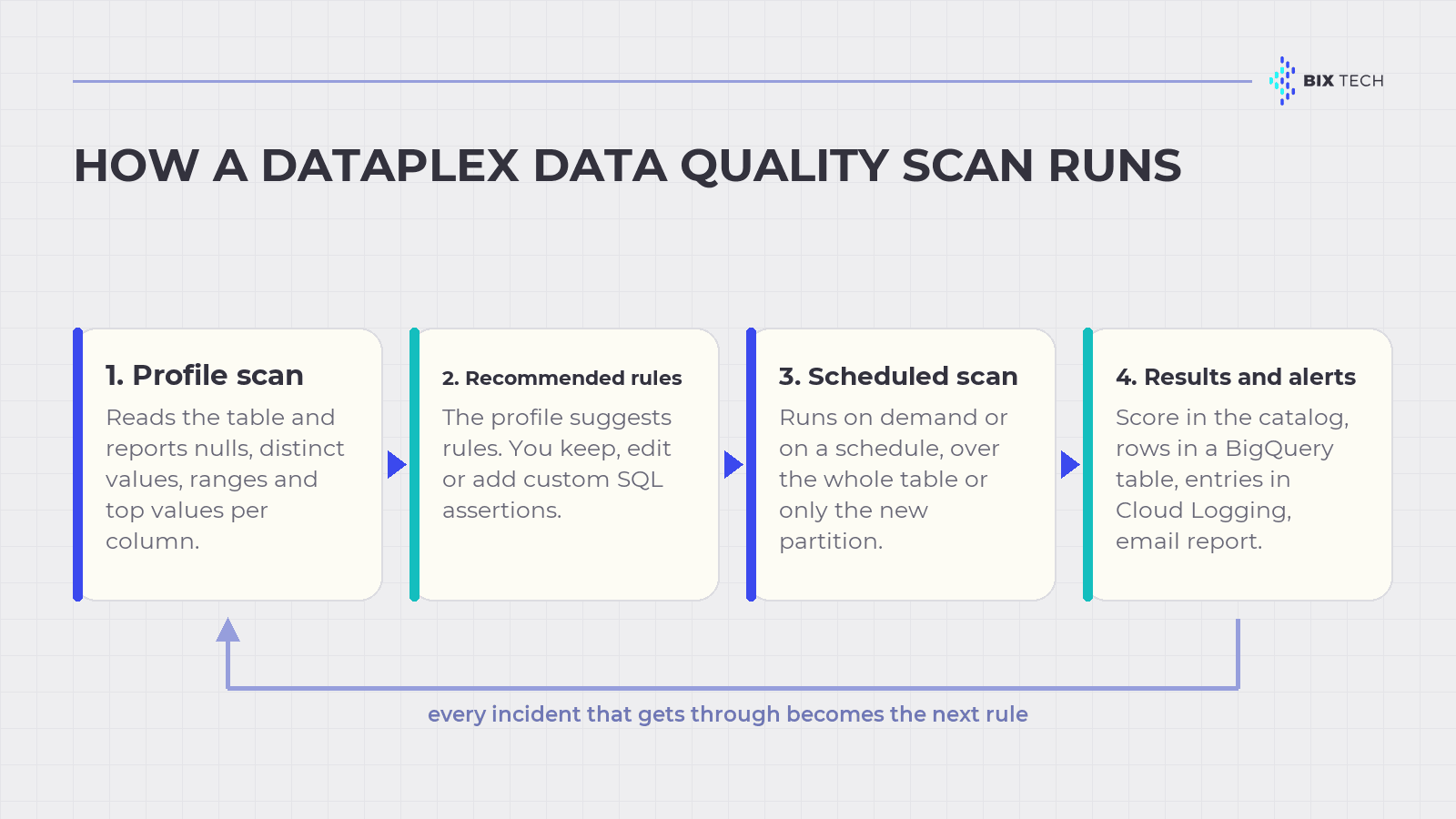 The Dataplex data quality loop. Profiling produces the rules, the scan enforces them, and every incident that slips through becomes the next rule.
Profiling writes the first draft of your rules
A data profile scan reads the table and reports, per column, the percentage of nulls, the number of distinct values, the ten most common values with their frequency, and, for numeric columns, average, standard deviation, minimum, maximum and quartiles. String columns also get average, minimum and maximum length.
Those statistics do more than document the table. Dataplex turns them into recommended data quality rules, so you start from a rule set derived from the real distribution of values instead of a blank page. You keep what makes sense, drop what does not, and add what a profile could never infer, such as a business rule that an order total must equal the sum of its line items.
The rules you actually configure
Rules fall into three families, and each one maps to one of the dimensions data quality is measured on: completeness, validity, uniqueness, accuracy, consistency, freshness and volume.
| Rule type | What it checks | Where it fits |
|---|---|---|
nonNullExpectation | The column has no nulls | Completeness on keys, amounts, timestamps |
rangeExpectation | Values fall inside a min and max | Validity on prices, ages, percentages |
setExpectation | Values belong to an allowed list | Validity on status, country, category codes |
regexExpectation | Values match a pattern | Validity on document numbers, emails, SKUs |
uniquenessExpectation | No duplicate values in the column | Uniqueness on natural and surrogate keys |
statisticRangeExpectation | A mean, min, max or sum stays in range | Accuracy and volume drift on aggregates |
rowConditionExpectation | Custom SQL evaluated per row | Cross column business rules |
tableConditionExpectation | Custom SQL evaluated per table | Row counts, referential checks |
sqlAssertion | Custom SQL that must return zero rows | Anomaly queries and reconciliation |
Every rule carries a threshold, so you decide whether a column must be 100% clean or whether 98% is acceptable. Rules also carry ignoreNull, a dimension and a description, and since April 2026 they can be saved as reusable templates and shared across scans, which is what keeps a hundred tables from drifting into a hundred slightly different definitions of a valid customer ID.
Scope, schedule and cost
A scan runs on demand or on a schedule, over the entire table or incrementally against a date or timestamp column, normally the partitioning column. Incremental scope is what makes daily checks affordable on large tables. You can also sample a percentage of rows and apply a rowFilter to narrow the scan further.
Cost follows that configuration. Auto data quality and data profiling sit in the premium processing tier, metered in DCU-hours and billed per second with a one minute minimum, and consumption scales with rows, columns, rule count, partitioning and scan frequency according to the Dataplex pricing page. The same discipline that keeps BigQuery costs predictable applies here: partition the table, scan incrementally, and do not schedule hourly what changes daily.
Where the results land
Results go to four places at once, and this is where the automation becomes operational. The score publishes to the catalog entry under a data-quality-scorecard aspect and appears on the Data quality tab of the table in BigQuery. Detailed rows go to a results table you nominate, partitioned by job_start_time, with columns such as rule_passed and rule_rows_passed_percent. Cloud Logging receives structured data_quality_scan_rule_result entries, the hook for alerting policies and for routing failures into an incident channel. Up to five addresses can also receive an email report triggered by a low score, a failed job or every run, per Google's auto data quality documentation.
Unifying governance across BigQuery and Cloud Storage
Files in buckets are the blind spot in most governance programs. Nobody knows what is in them, nothing validates them, and they leak into analytics anyway.
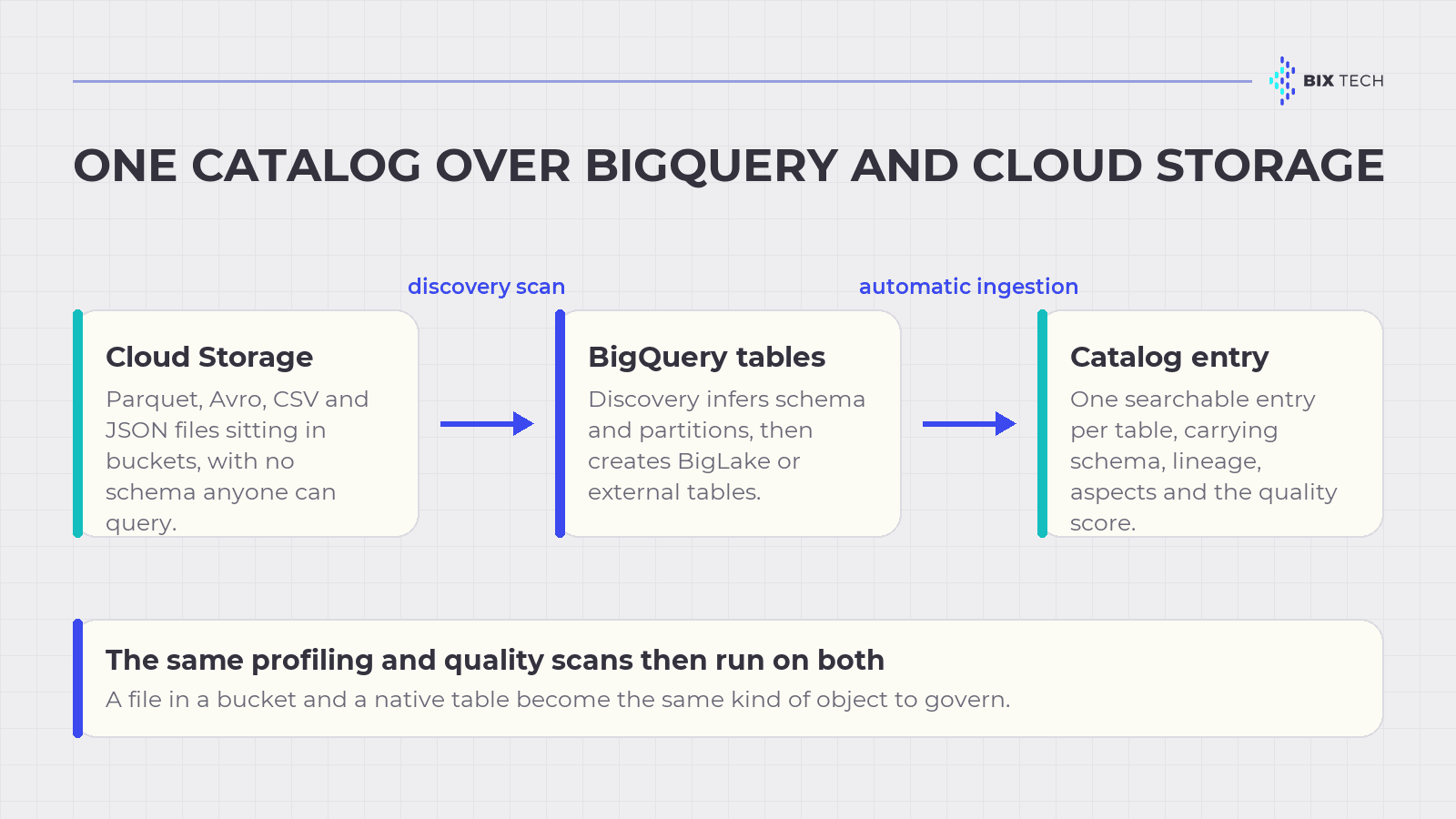 Discovery turns raw files into queryable tables and catalog entries, so the same quality scans cover both storage layers.
Automatic discovery, generally available since June 2026, closes that gap. You point a discovery scan at a bucket and it infers schema and partition layout, then creates a BigQuery dataset named after the bucket, populated with BigLake, external or object tables. Google's documentation on discovering Cloud Storage data describes the scan as recurring, so schema changes get picked up rather than frozen at creation time, and no copy of the data is made.
From that point the distinction between a file and a table mostly disappears. Both are catalog entries, both carry lineage, and both can be the target of a profiling or quality scan. That is what makes the approach useful for organizations pursuing decentralized data governance, where domain teams own their data while the platform team still needs one consistent way to see and score all of it.
Where Dataplex fits, and where it does not
Dataplex earns its place when your data already lives in Google Cloud and the gap is coverage rather than sophistication. Turning on profiling and scheduled scans across a few hundred tables takes hours, and it validates tables no one would have written tests for.
The constraints are real, though. Scans target BigQuery and Iceberg REST Catalog tables only, so anything outside that has to be exposed through BigQuery first. Tables with BIGNUMERIC columns cannot be profiled, a single scan is limited to a thousand rules, and column level quality scores are available through the API rather than the console. Rules also live in the scan configuration, so version control and code review depend on you managing them as Terraform or YAML instead of clicking through the interface.
Where a code first workflow matters more than coverage, tools such as dbt tests or Great Expectations in production pipelines keep assertions in the same pull request as the transformation and run inside the pipeline, so a failure can block a downstream job. Dataplex scans run beside the pipeline and report; blocking requires wiring the Cloud Logging signal back into your orchestrator. Neither model wins in the abstract, and most mature stacks end up running both. At BIX Tech we work across Google Cloud, AWS, Azure, Databricks and open source stacks precisely because the right answer changes with the platform, the team and the failure modes that actually hurt.
The honest way to evaluate Dataplex is to look at what goes unmonitored today. If your critical marts are well tested while your landing zone and your buckets stay dark, a managed scanner that covers everything cheaply buys more reliability than a better assertion framework on the tables you already trust.
If your team is running analytics on Google Cloud and quality checks only cover part of the stack, our specialists can help you design the governance and validation architecture that fits your context. Talk to our team and move your data maturity forward. ⬇️
FAQ: frequently asked questions
What is GCP Dataplex used for?
GCP Dataplex is Google Cloud's governance service for data across BigQuery and Cloud Storage. It discovers and catalogs datasets, profiles columns, runs scheduled data quality scans, tracks lineage and publishes a quality score to each table's catalog entry, so governance runs as a managed service instead of custom tooling.
How does GCP Dataplex automate data quality?
A data profile scan reads the table and recommends rules from the real distribution of values. You accept or edit those rules, then schedule a quality scan over the whole table or only new partitions. Results publish to the catalog entry, a BigQuery results table, Cloud Logging and email reports.
Is Dataplex the same as Knowledge Catalog?
Yes. Google renamed Dataplex Universal Catalog to Knowledge Catalog on April 10, 2026. The API, client libraries, CLI and IAM identifiers still use the dataplex name, so existing Terraform and scripts keep working and both names refer to the same product.
Can Dataplex check data quality on Cloud Storage files?
Indirectly, and reliably. A discovery scan infers schema and partitions from a bucket and creates BigLake or external tables in BigQuery. Profiling and quality scans then run on those tables exactly as they do on native ones, without duplicating the underlying files.
How much does a GCP Dataplex data quality scan cost?
Auto data quality and data profiling are billed in the premium processing tier, metered in DCU-hours and charged per second with a one minute minimum. Consumption depends on rows, columns, rule configuration, partitioning and scan frequency, so incremental scope is the main cost lever.