
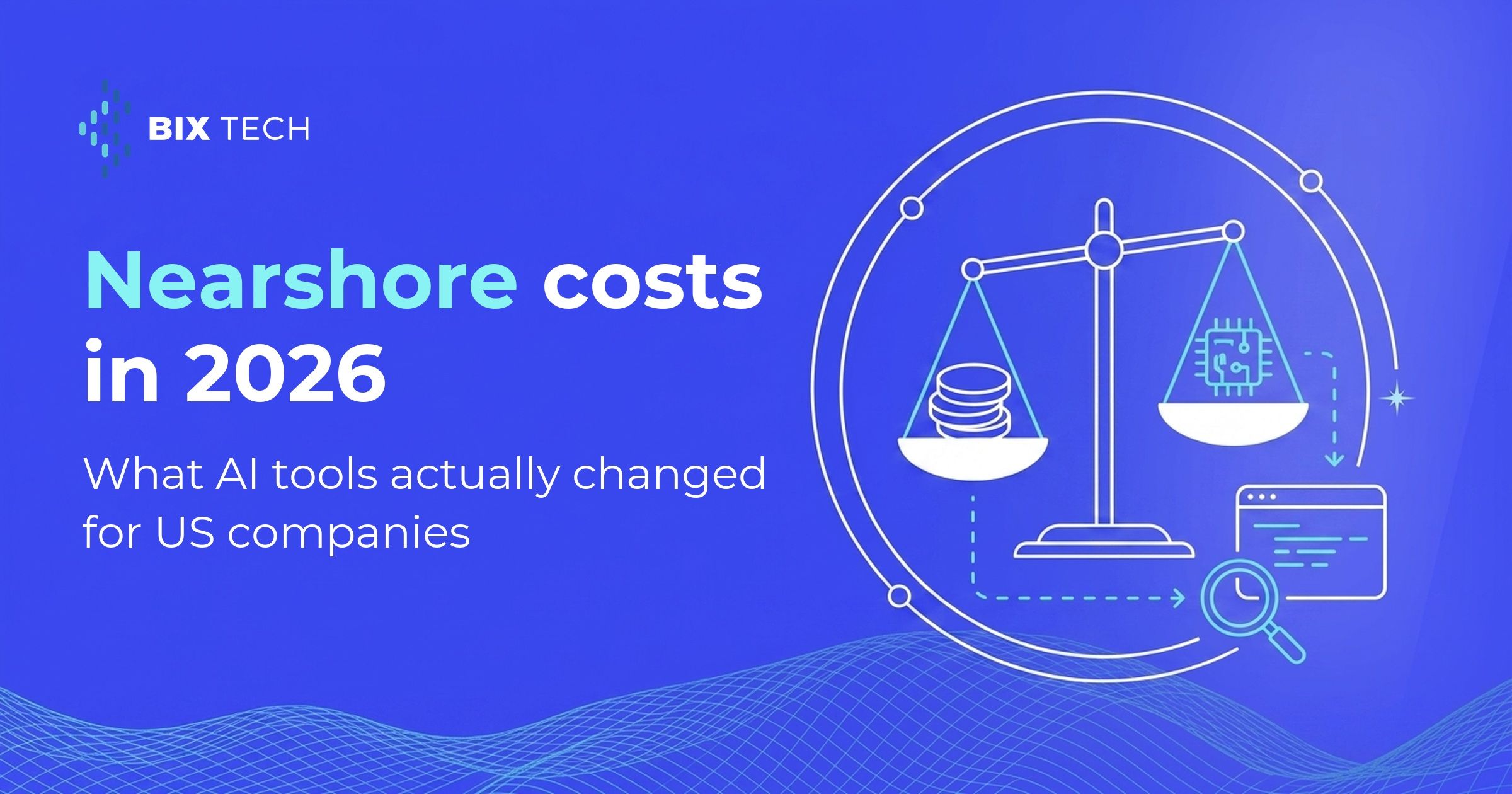
Nearshore software development costs went down in 2026 while AI adoption inside engineering teams went close to universal, and the two facts are connected in a way most vendor decks skip. Accelerance's 2026 outsourcing rates guide records Latin American software development rates falling 7.1% year over year, with Central and Eastern Europe down 4.4% and Asia down close to 8%. Cheaper hours arrived. Cheaper software did not follow automatically, and the gap between those two things is where AI changed the economics of software development instead of simply discounting it.
The reason sits in where engineering time now goes. AI tools compressed the cost of producing code and inflated the cost of verifying it, which reshapes both the composition of a nearshore team and the line items on an invoice. Buying capacity today means buying review throughput, architectural judgment and delivery discipline far more than keystrokes, a shift that also redefines what choosing a custom software development company should look like.
For a US company renegotiating a contract this year, that distinction is worth real money. A partner billing 20% less per hour while needing 40% more hours to reach a production-ready state is more expensive, and no timesheet will ever show it. Seeing it requires measuring at the level of reviewed, merged and deployed change, which is the same discipline that separates a mature engineering partner from a cheap supplier of hours when you are building a nearshore team that scales.
What nearshore software development costs look like in 2026
Rate benchmarks anchor every other conversation, so start there. Accelerance's 2026 guide, which surveys software firms across the main outsourcing regions, places Latin American junior developers at $33 to $45 an hour and senior developers at $60 to $75. Central and Eastern Europe runs slightly higher at the senior end while Asia sits lowest, and all three regions fell year over year. Those bands cover most of the engagements US buyers sign today, including the ones focused on data engineering and platform work.
| Region | Junior developer | Senior developer | Year-over-year rate change |
|---|---|---|---|
| Latin America (nearshore for the US) | $33 to $45 / hour | $60 to $75 / hour | down 7.1% |
| Central and Eastern Europe | $31 to $39 / hour | $64 to $76 / hour | down 4.4% |
| Asia | $24 to $31 / hour | $31 to $41 / hour | down close to 8% |
The comparison that decides the business case is internal cost. The US Bureau of Labor Statistics puts the 2025 median annual wage for software developers at $135,980, or $65.38 an hour, and that figure sits before benefits, payroll taxes, equipment, recruiting fees and management overhead. Fully loaded, an internal senior engineer routinely lands above the top of the Latin American senior band, which explains why the nearshore model held through the AI wave instead of being erased by it, and why outsourcing remains a live option for teams under hiring constraints.
Rate and cost are separate variables. A rate is what you pay per hour, while cost is what you pay per unit of working, reviewed, deployed software. AI moved those two numbers in opposite directions for many teams, so a proposal competing only on the first is asking you to ignore the second, which is the same trap described in the hidden costs of cheap solutions.
What AI tools actually changed in nearshore delivery
Generation got cheaper, review became the constraint
Adoption is settled at this point. Google's 2025 DORA report, built on responses from nearly 5,000 technology professionals plus over 100 hours of qualitative research, found roughly 90% using AI at work, a median of two hours a day spent working with it, and more than 80% believing it raised their productivity. DORA's central conclusion is that AI behaves as an amplifier, magnifying the strengths of high-performing organizations and the dysfunctions of struggling ones, which is precisely why two vendors with identical tooling deliver at very different levels of maturity.
Perceived productivity and measured productivity diverge, though. METR ran a randomized controlled trial with 16 experienced open-source developers across 246 tasks in repositories they had worked on for years, and found they took 19% longer to finish tasks when AI tools were allowed. Those same developers estimated afterward that AI had made them 20% faster. Self-reported efficiency is therefore a weak basis for a contract, and a partner quoting AI-driven savings without delivery metrics is quoting a feeling rather than a result, which matters most on projects that put AI agents inside the development lifecycle.
The bottleneck moved downstream. LinearB's 2026 Software Engineering Benchmarks Report, drawn from 8.1 million pull requests across 4,800 engineering teams in 42 countries, found that AI-generated code waits 4.6 times longer for a first review than human-written code, and that teams with high AI adoption merged 98% more pull requests while review time rose 91%. Acceptance rates point the same way, at 32.7% for AI-authored code against 84.4% for human-authored code. Review capacity, rather than authoring speed, is where a delivery pipeline now backs up.
Developers describe the friction in the same terms. The 2025 Stack Overflow Developer Survey found 84% of respondents using or planning to use AI tools, up from 76% the year before, while positive sentiment fell from over 70% in 2023 and 2024 to 60%. Its top frustration, cited by 66%, is AI output that is "almost right, but not quite," and 45.2% report that debugging AI-generated code takes longer than writing it themselves. Roughly a third express any trust in the accuracy of what these tools produce, which puts a hard floor under the verification work that any production system still demands.
Team composition moved toward verification
Rate cards changed shape along with the work. Boilerplate implementation absorbs fewer hours, so the traditional pyramid of one senior engineer over several juniors compresses from the bottom. What expands is senior review capacity, test and QA engineering, and the platform work that keeps generated code inside guardrails, a pattern already visible in teams that treat testing as a gate instead of a final chore.
| Function | What changed with AI tooling | What to look for in a 2026 proposal |
|---|---|---|
| Implementation | Faster first drafts, more code produced per engineer | Fewer billed hours on boilerplate, not a lower standard for the output |
| Code review | Became the main queue and the main source of delay | Named reviewers, review SLAs, and a cap on pull request size |
| QA and testing | Higher volume of change to validate per sprint | Automated coverage as part of the engagement, not an add-on line |
| Architecture | Higher cost of an early wrong decision at speed | Senior involvement in design, documented decisions, no lone-agent sprawl |
| Platform and tooling | CI, scanning and observability carry more weight | Provenance of generated code and security scanning in the pipeline |
The practical consequence for a buyer is a blended rate that stays flat or rises even as published regional rates fall. A senior-weighted team of five costs more per hour than a pyramid of eight, and it can still be cheaper per shipped feature. Asking for the composition behind a blended rate therefore reveals more than asking for a discount, especially on work where governance and auditability are part of what you are buying.
How to re-evaluate a nearshore partnership in 2026
A renegotiation goes better when the questions target delivery evidence rather than tooling logos. Every vendor now claims AI-assisted development, so the claim carries no information. What carries information is whether the partner can show what the tools did to their cycle time, their defect rate and their review queue, the same evidence base that makes trust in a distributed engineering relationship something you can verify instead of assume.
| Question to put in the room | What a strong answer contains |
|---|---|
| What is your median cycle time, and how much of it is review? | Real numbers from their own tooling, plus the trend over the last two quarters |
| How do you review AI-generated code differently? | A written policy: provenance tagging, size limits, mandatory human sign-off |
| What is the seniority mix behind this blended rate? | A named roster with roles, not a generic ratio |
| How do you handle IP and licensing on generated code? | Contract language on ownership, plus scanning for license contamination |
| What happens to the rate if AI makes your team faster? | A mechanism, whether that is fixed scope, capped hours or a milestone model |
Contract structure deserves as much attention as the rate. ISG Index data shows the global technology services market reaching a record $39.4 billion in annual contract value in the first quarter of 2026, up 29% year over year, while traditional IT outsourcing inside managed services slipped 7% to $7.9 billion in the same period. Demand is migrating toward AI, data and cloud work priced against outcomes, so a pure time-and-materials contract for a well-defined scope is increasingly a mismatch with how AI-heavy delivery actually consumes budget.
Governance of generated code is the newest line item worth negotiating explicitly. Ask which model touched the code, whether the partner scans for license contamination and vulnerable dependencies, and who signs off before a merge. Teams that already run observability and traceability as standard practice answer in minutes, and the ones that improvise reveal something about the review discipline behind their rate.
Time zone overlap, finally, went from a convenience to an economic argument. When review is the constraint, the value of a reviewer who is awake during your working day rises, because an asynchronous review round trip that costs four hours in a nearshore setup can cost a full day at twelve hours of separation. That arithmetic is why the nearshore case strengthened rather than weakened as AI reshaped the workflow, and it applies equally to IT staffing arrangements and to full delivery teams.
Nearshore software development costs in 2026 reward buyers who change the unit of measurement. Published rates dropped across every major region, AI compressed the effort of writing code, and the constraint relocated to review, verification and architectural judgment, where senior people and mature process still decide the outcome. A partnership evaluated on the real price of shipped software will look very different from one evaluated on cost per hour, and it is usually the cheaper of the two over a year. BIX Tech works across multiple delivery models, from dedicated nearshore squads to project-based engagements, because the right structure depends on scope, risk tolerance and how much review capacity a company already has in house.
For a less numerical view of the model, focused on how nearshore teams turn distance into a bridge for collaboration, there is also our earlier piece on the nearshore advantage in global collaboration.
If your company is re-evaluating a nearshore partnership or pricing a new engineering engagement for 2026, our specialists can help you model the real cost of delivery and design the team composition your roadmap needs. Talk to our team and put numbers behind the decision. ⬇️

Frequently asked questions
How much does nearshore software development cost in 2026? Accelerance's 2026 outsourcing rates guide places Latin American junior developers at $33 to $45 an hour and senior developers at $60 to $75, with regional rates down 7.1% year over year. Central and Eastern Europe runs slightly higher at the senior end. Final cost depends on seniority mix, scope and engagement model rather than on the headline rate alone.
Did AI tools make nearshore development cheaper? Published hourly rates fell across every major region in 2026, so the price of an hour went down. Total cost is a separate question. AI shifted effort from writing code to reviewing it, and LinearB's 2026 benchmarks found review time rising 91% in teams with high AI adoption, which offsets part of the savings unless the partner has review capacity to match.
Why are nearshore software development costs falling if demand for AI work is rising? Two forces run in parallel. Rate declines come from a larger pool of AI-augmented developers and higher automation in delivery, while demand concentrates in AI, data and cloud engagements. ISG Index recorded a record $39.4 billion in technology services contract value in the first quarter of 2026, even as traditional IT outsourcing contracted 7%.
What should a US company ask a nearshore partner about AI-assisted development? Ask for median cycle time and the share of it spent in review, the written policy for reviewing AI-generated code, the seniority roster behind the blended rate, contract language on IP and licensing for generated code, and how pricing adjusts if the team gets faster. Tooling names alone say nothing about delivery quality.
Is nearshore still better than offshore now that AI closed part of the skill gap? Neither model is universally better, and the choice is situational. Asian rates remain the lowest at $31 to $41 an hour for senior developers, while Latin America offers time zone overlap that matters more in 2026 because review, the current bottleneck, benefits from synchronous work. Scope complexity and review capacity usually decide which fits.