LLM governance has become the line that separates the pilot that impresses from the AI a company actually trusts to operate. After two years spent putting copilots and AI agents to work at scale, the question has moved. It is no longer "can the model answer?", but "who approved that prompt, how much did it cost, and why did it respond that way?".
The bottleneck is rarely the model's capability. It sits in control. According to Gartner, more than 40% of agentic AI projects are expected to be canceled by the end of 2027, largely on runaway cost and weak traceability over what the system does. An ungoverned agent is an expensive black box, the opposite of what you expect once LLMs move into real business workflows.
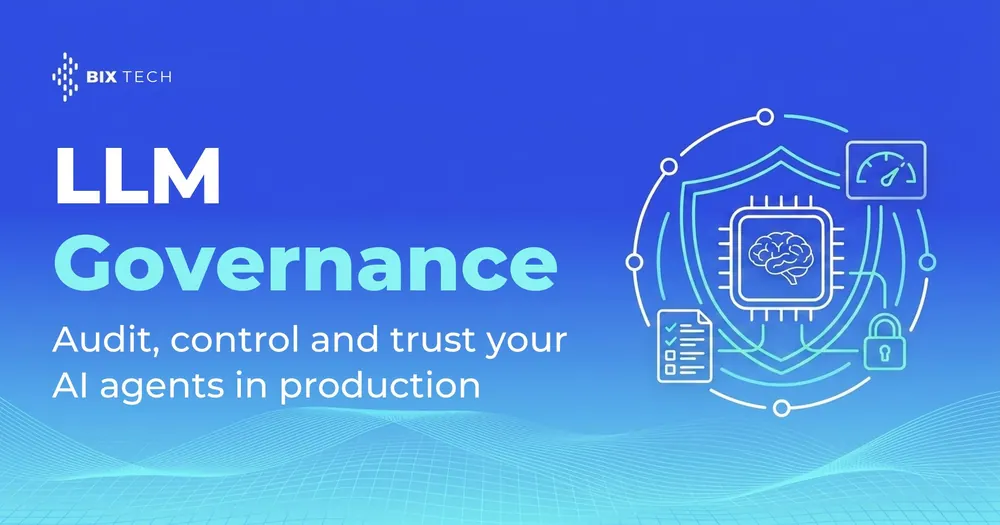
Governing an LLM in production is different from governing a database. The behavior is probabilistic, the output changes on every call, and the cost scales with usage. That is why LLM governance brings together four technical fronts, prompt versioning, output auditing, cost attribution and compliance logging, plus the organizational controls that put accountable people in the loop, all resting on a solid base of data governance.
What LLM governance is and why it became a priority in 2026
LLM governance is the set of policies, technical controls and responsibilities that make a language model's behavior traceable, auditable and predictable in production. It is not a single tool, but a discipline that crosses engineering, data and business, in the same spirit as treating AI engineering as an operating capability rather than an isolated experiment.
The pressure arrived from two sides at once. On one side, regulation: the EU AI Act began applying obligations to general-purpose models in August 2025, the NIST published a generative AI profile within its AI Risk Management Framework, and ISO/IEC 42001 formalized the first AI management system standard. On the other side, cost: when every answer burns tokens and an agent chains dozens of calls, the bill climbs fast and demands the same data quality and control any serious pipeline needs.
The difference between an experimental agent and a production system lives right there. The prototype runs in a notebook, with the prompt in the code and no record of what it answered. The production system versions every change, keeps the audit trail and knows who pays the bill, the same maturity that separates a loose script from governed agentic data engineering.
The technical stack of LLM governance
Prompt versioning is the starting point. The prompt is code: it defines the agent's behavior and changes the result as much as swapping the model does. Keeping it in a registry with history, review and rollback avoids the classic scene where someone edits an instruction in production and nobody knows what broke, a sibling discipline to the version control that dbt brought to data.
Output auditing records what went in and what came out of each call: prompt, retrieved context, response and metadata. Without that trail, investigating a wrong answer turns into guesswork. With it, the team reconstructs the case, measures hallucination and tunes what needs fixing, the same way you would monitor hallucinations in LLM applications to keep them reliable.
Cost attribution per team answers the question every director asks at month-end: who spent what. Tagging each call by team, project or feature turns a single opaque invoice into a usage report, the basis for setting budget, cutting waste and prioritizing, the same logic behind treating multi-agent systems as a measurable cost center.
Compliance logging closes the loop for audit and regulation. Recording immutably who called the model, with which data and under which policy is what lets you answer an audit, honor a data-deletion request and prove that sensitive information never leaked into the prompt, a concern that connects straight to data privacy in the age of AI.
| Technical pillar | What it records or controls | Risk it prevents |
|---|---|---|
| Prompt versioning | History, review and rollback of every prompt | Silent change that breaks behavior |
| Output auditing | Prompt, context, response and metadata per call | Wrong answer with no trail to investigate |
| Cost attribution per team | Token usage tagged by team and project | Opaque invoice and blown budget |
| Compliance logging | Immutable trail of access, data and policy | Failed audit and sensitive-data leakage |
The organizational controls that make agents trustworthy in production
Technology without defined accountability governs nothing. The first organizational control is the owner: every agent in production needs a clear person responsible for its behavior, cost and risk, just as any solid multi-agent system has someone who answers for it. Without an owner, the audit trail becomes a dead archive.
The second is the human in the loop on higher-impact decisions. Not every agent action can be autonomous. Approving a refund, sending a customer email or altering a record calls for a human review point, calibrated to the risk of the operation, a principle that holds for any mature setup that orchestrates and observes AI agents without losing control.
The third is alignment with a recognized framework. Instead of inventing rules from scratch, companies anchor their AI policy in the NIST AI Risk Management Framework, in ISO/IEC 42001 or in the EU AI Act, depending on the market they serve. That alignment gives legal, security and engineering a common language, and it saves rework when the audit arrives, reinforcing the data governance foundation that sustains adoption.
Getting started does not require buying an entire suite. The pragmatic path raises maturity in stages: first basic logging of prompts and responses, then cost attribution, next access policies and human review, and finally formal alignment to the chosen framework. It is the same ladder BIX Tech climbs with clients building secure, production-ready LLM applications, always tool-agnostic and focused on each operation's context.
| Maturity level | What already exists | Next step |
|---|---|---|
| Experimental | Prompt in the code, no logging | Centralize prompts and log calls |
| Controlled | Logs and prompt versioning | Attribute cost per team and project |
| Governed | Cost, access and human review defined | Align to NIST, ISO 42001 or the AI Act |
| Auditable | Immutable trail and formalized policy | Review and evolve with continuous audit |
Governing LLMs in 2026 is less about slowing innovation and more about making it trustworthy enough to scale. Auditing what the agent answered, controlling how much it costs and aligning everything to a framework is what turns a promising pilot into a system a company puts in front of customers and regulators without fear. Teams that treat this as engineering, not as a bet, are the ones that can trust their own AI.
Governance controls are easier to define when the scope of each agent is deliberate, and choosing that scope starts with the architecture decision behind AI agents.
If your company is moving AI agents into production and needs to audit, control and trust what they do, our specialists can help structure LLM governance for your context. Talk to our team and move your AI maturity forward. ⬇️

FAQ: frequently asked questions
What is LLM governance? It is the set of policies, technical controls and responsibilities that make a language model's behavior traceable, auditable and predictable in production. In practice, it combines prompt versioning, output auditing, cost attribution and compliance logging, plus the organizational controls that define owners and human review points.
Why did LLM governance become a priority in 2026? Because regulation and cost grew together. The EU AI Act started requiring obligations for general-purpose models, NIST and ISO published AI risk-management standards, and token consumption by chained agents made the bill unpredictable. Without governance, the project turns into an expensive black box that is hard to defend in an audit.
What is the difference between an experimental agent and a production one? The experimental one runs with the prompt in the code, no record of what it answered and no clear owner. The production one versions every prompt, keeps an audit trail of inputs and outputs, knows the cost per team and has human review on higher-impact decisions. The difference is traceability and accountability, not model capability.
How do you audit an AI agent's responses? Log every call in full: prompt, retrieved context, generated response and metadata such as model, version and user. With that immutable trail, the team reconstructs any case, measures hallucination, investigates a wrong answer and proves compliance. Without the record, auditing becomes guesswork after the fact.
How do you start implementing LLM governance? Raise maturity in stages, without buying an entire suite at once. Begin by centralizing prompts and logging calls, then attribute cost per team, next define access policies and human review, and finally align the policy to a framework like the NIST AI RMF, ISO/IEC 42001 or the EU AI Act. Each stage reduces risk right away.