API development is the work of designing, building, securing and maintaining the interface that other software uses to reach your system. An API is a promise made to code you do not control and cannot patch. That is what separates it from the rest of your codebase: an internal function can be renamed on a Tuesday, and a published field cannot.
The consequence shows up as an asymmetry in cost. While an API has one consumer, every decision in it is reversible in an afternoon. Once it has thirty, the same decisions become negotiations with people who have already shipped against your mistakes. Nothing in that arithmetic depends on the language, framework or cloud you picked.
So the durable part of API development is a sequence of decisions rather than a stack: what shape the interface takes, what its contract must promise, who may touch which records, how it changes without breaking anyone, and what it takes to run. Each decision narrows the next, and the order below follows that.
What API development actually involves
Before any of those decisions, it helps to see where they sit. Treat API development as six stages instead of a coding task, each one producing something the next stage consumes. What the first stage produces is a document rather than code, which is why the order resists shortcuts: skip that step and every stage after it inherits the ambiguity.
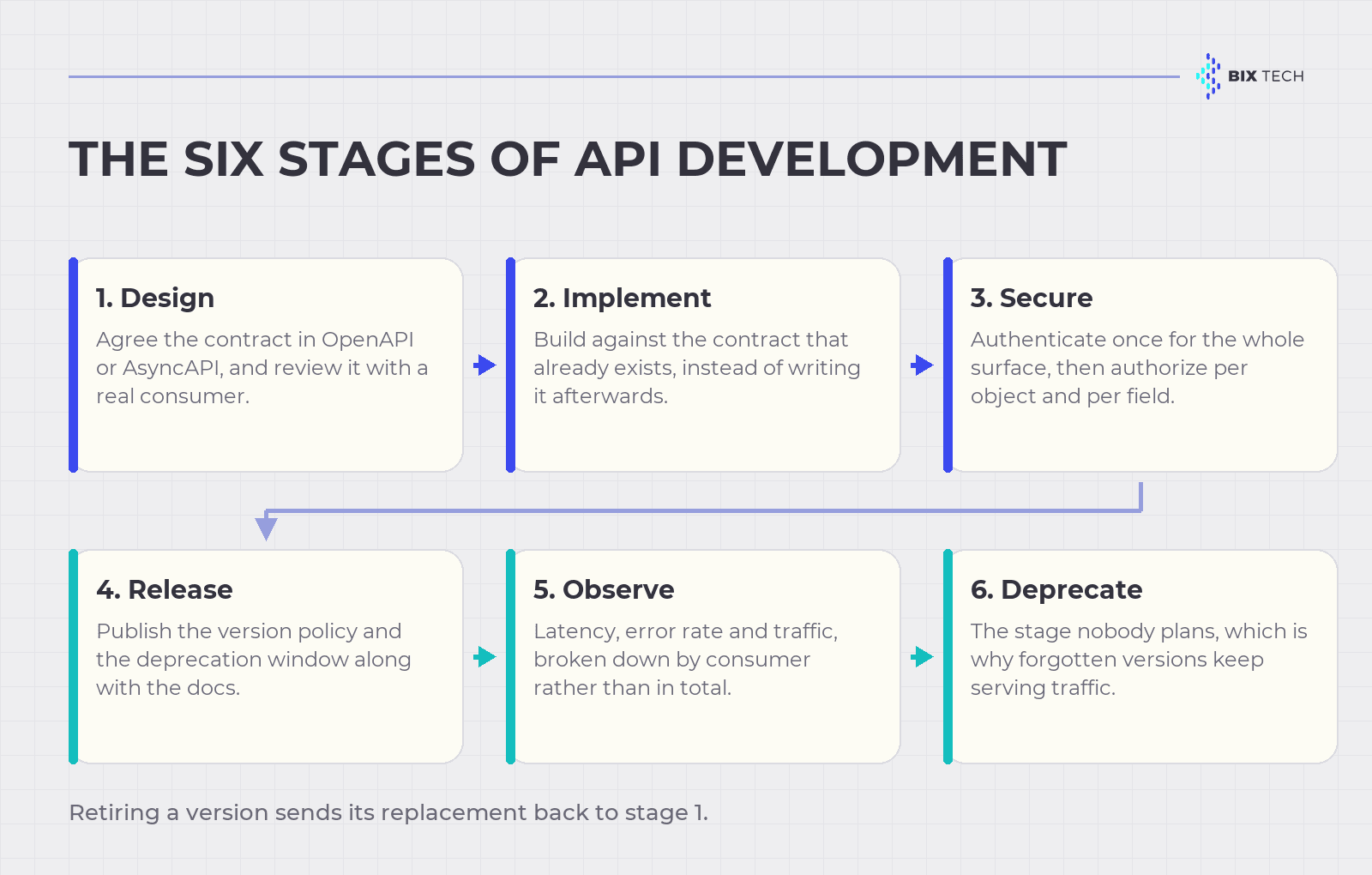
That document is the contract, and it is what makes the other five stages tractable. For request and response interfaces it is usually an OpenAPI description, a machine-readable file listing every operation, parameter, response shape and error. For message-driven interfaces, AsyncAPI plays the same role across transports such as Kafka, MQTT and WebSockets. Either way the interface exists as a reviewable document before it exists as running code.
Writing it first changes who gets to disagree, and when. A field name argued over in a schema review costs minutes, and the same argument after three clients have shipped against it costs a migration. Holding that document stable while the code behind it keeps moving is the whole point of change-resilient software architecture.
What the contract can promise, though, depends on the shape of the interface it describes. A resource, a query and an event are three different kinds of promise, so that choice comes first.
Request, query or event: choosing the interface shape
There is no ranking among the options, only fit. The useful question is what the consumer needs to do, and most organizations end up running several shapes at once because they serve several kinds of consumer.
| Shape | Typical form | What the consumer gets | Fits when | Main cost |
|---|---|---|---|---|
| Resource-oriented | REST over HTTP, described in OpenAPI | Addressable resources, standard methods, cacheable responses | Public and partner interfaces, many client types, caching matters | Nested reads get chatty and clients over-fetch |
| Query-oriented | GraphQL | One endpoint where the client declares the fields it wants | Several client shapes reading overlapping data | Query cost limits, caching, per-field authorization |
| Procedure-oriented | gRPC with Protocol Buffers | Typed calls, including streaming in both directions | Service-to-service traffic inside your own network | Browsers need a proxy and traffic is harder to inspect |
| Event-oriented | Messages on a topic, or webhooks | Notification the moment state changes | Many consumers reacting to change, producer decoupled from consumer | Delivery guarantees, ordering, retries and replay |
The official gRPC documentation defines four call shapes: unary, server streaming, client streaming and bidirectional streaming. That range explains why it dominates internal traffic where latency is the constraint, and why it rarely appears as a public interface. GraphQL answers the opposite need, letting a mobile and a web client read the same graph without either receiving a payload built for the other. Events answer a third need, since a consumer that has to know the moment something changes should not be polling to find out, which is the territory event-driven architecture covers.
The choice follows the consumer rather than the team's preference, and BIX Tech works across all four shapes for that reason. An interface read by one partner and an interface read by a hundred customers are different engineering problems, which is where multi-tenant architecture becomes the deciding constraint. When the consumers are analytics tools rather than applications, the pattern shifts again toward API-first analytics.
Whichever shape wins, the contract behind it has to answer the same questions. The ones teams leave unanswered are reliably the same four.
What belongs in the contract
A contract that lists only paths and field types leaves the hard parts undefined, and clients fill the gap by inferring behavior from what they observe. Once inferred, it binds you as tightly as anything you wrote down. The conventions that prevent this are collected in API design principles, and four of them are worth settling before the first endpoint ships.
Pagination. Offset pagination is simple and drifts when rows are inserted mid-scan, so a client walking pages can see a record twice or miss it entirely. Cursor pagination stays stable under writes and gives up the ability to jump straight to an arbitrary page. Pick one per collection, document the maximum page size, and treat the default as part of the contract rather than a configuration value.
Idempotency. Any write a client might retry needs a key that lets the server recognize the retry instead of repeating the work. In the convention Stripe popularized, the client sends a unique key per logical operation as a request header and the server stores the outcome of the first attempt under it, so a repeat returns the original response. Without that, a timeout on a payment call leaves nobody able to say whether it happened.
Errors. Inventing an error envelope per service is a tax every client pays forever. RFC 9457 defines a problem detail format for exactly this, so a consumer parses a failure the same way across every interface a company publishes. Error shape tends to get decided by whoever wrote the first handler, which is precisely why it belongs in the review with everything else.
Limits. A quota nobody can see is a surprise. Advertise the remaining allowance in response headers so a well-behaved client slows down before it collects 429 responses, and publish the policy next to the reference. The IETF has been standardizing the field names for this, and the practice does not wait on that work finishing.
Those four govern how a caller may use the interface. None of them says which records that caller is allowed to touch, and that is the question with the worst failure mode attached to it.
Where authorization actually belongs
Authorization is where API development breaks most often. OWASP's API Security Top 10 has long placed broken object level authorization first: an endpoint receives an object identifier and acts on it without checking that the caller owns that object. The route is authenticated, the query runs, and the caller reads someone else's record by changing a number in a URL. The field-level version sits nearby, where a response carries properties the caller should never see because the serializer returns the whole model.
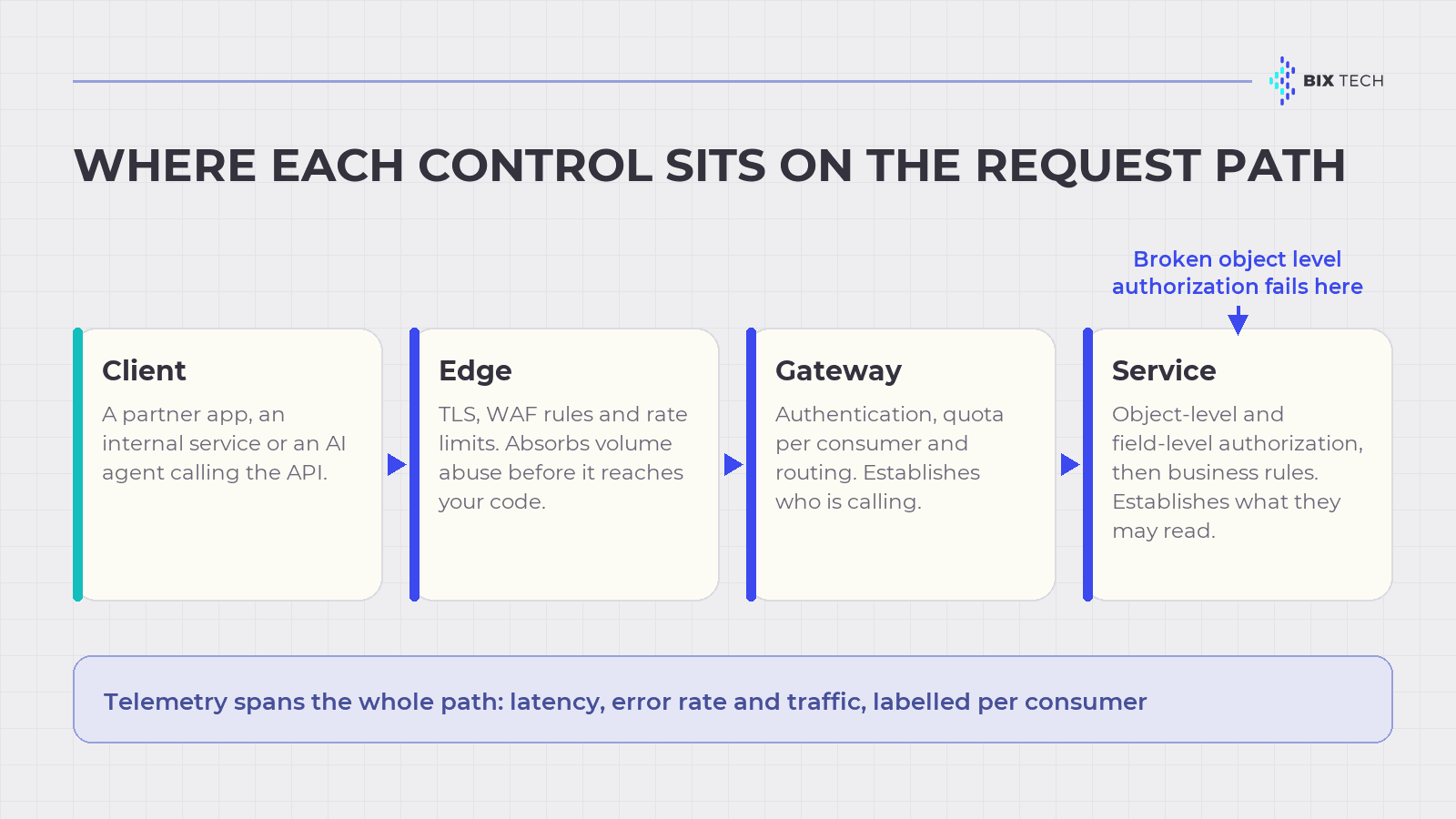
Placement matters as much as the check. A gateway can establish who is calling and how often, and it cannot know whether invoice 4471 belongs to this tenant. That decision lives in the service, next to the data, which is why buying a gateway does not close the risk at the top of the list. The same reasoning drives zero trust architecture, where no network position earns trust on its own.
For authentication, the durable position is the authorization code flow with PKCE for anything user-facing, and short-lived credentials for service-to-service calls. Stateless tokens are convenient and move the hard problems to revocation and expiry, trade-offs worked through in is JWT secure for authentication. Whatever the mechanism, pick one for the whole surface, because two authentication models on one interface is how exceptions become permanent.
The same list names undocumented endpoints and forgotten versions as a risk in their own right, the cheapest one to fix and the most commonly ignored. It also has a code-level twin, since a serializer that leaks a field is a defect before it is a breach, which is the connection code quality and application security traces.
Keeping that catalog current raises the next question on its own, because what fills a catalog up is versions.
Versioning and deprecation without breaking clients
Versioning is a policy decision before it is a technical one, and the policy has two halves. The first is where the version lives: pinned per consumer, so a client keeps the behavior it integrated against, with a request header to override the pin for a single call. Stripe's dated versions are the best-known implementation of that idea.
The second half is deciding in advance which changes are additive. New resources, new optional parameters and new response properties can ship without ceremony once everyone agrees they are compatible, and that agreement forces genuinely breaking changes into a deliberate process. A team without the distinction either versions everything, multiplying the surface it has to keep alive, or versions nothing, turning every release into a gamble on what clients depended on.
Deprecation needs the same treatment. Publish the window before the first external client integrates, announce removal in response headers as well as the changelog, and instrument the old version so you can name who still calls it. An endpoint you cannot attribute to a consumer is an endpoint you can never turn off. Handled well, this is the part consumers notice most, and it is a large share of why API quality shows up in adoption and revenue rather than only in engineering satisfaction.
Every decision to this point has been made without naming a language, and that is deliberate. The stack matters, and it matters less than any of them.
Choosing a stack
Any mainstream framework will serve a correct contract, so the real difference is how much arrives included. A batteries-included framework hands you an ORM, an admin and a session system on day one and asks you to accept its conventions. A minimal typed one hands you validation and speed and asks you to choose everything else. In Python that trade-off is FastAPI versus Django, and in JavaScript it is Node.js, NestJS and Express compared.
What sits behind the framework decides more than the framework does. Throughput and failure isolation come from how services are arranged and where state lives, not from the router in front of them, which is the ground backend architecture for high-performance APIs covers.
Reading comparisons is also not the same as having built one. A concrete walkthrough such as building an API with Django REST Framework surfaces the decisions a comparison table hides, and the design patterns worth knowing are what stop the second developer from guessing why the first one structured it that way.
Choosing well still leaves the part that decides whether anyone trusts the interface, and that part starts after the first deploy.
Packaging, testing and measuring it
How the service gets packaged settles two things at once: how it scales under load, and how fast a fix reaches the people calling it. Container images make both repeatable, which is the ground containers and microservices in data environments covers. Some failure modes appear only at real concurrency, pool exhaustion and missing back-pressure among them, and those are worked through for one stack in Node.js backends for data APIs.
Once it is deployed, the quality gates matter more than the framework. Contract testing comes first: because the contract is a file, continuous integration can validate responses against it, and a payload that drifts from the schema fails the build instead of a customer's integration. Putting static analysis and a broader automated testing suite in the same pipeline catches the defects a schema check cannot see.
Interfaces that serve data carry a second surface to test, because a response can satisfy the schema and still return the wrong number. Closing that gap is what testing strategies for data pipelines addresses, and it is the failure consumers of an analytics interface notice first.
What remains is telemetry, labelled per consumer rather than in aggregate. Track the p99, the latency of the slowest one percent of calls: a doubling across all traffic is a puzzle, and a doubling for a single partner is a lead. Which numbers earn that attention and which are decoration is the subject of measuring what matters. Everything else, the gateway and developer portal included, can wait until consumer count justifies the cost.
API development rewards decisions made early and punishes them late. The shape, the contract, the authorization model and the version policy are cheap while the interface has one consumer, and progressively harder after that. None require a vendor, which is why a small team can publish an interface that holds up for years while a larger one ends up with a surface nobody dares to change.
If your company is building an API that several teams or customers will depend on, or trying to bring order to an integration surface that grew without a plan, our specialists can help you settle the contract, the security model and the versioning policy before they get expensive. Talk to our team and move your data maturity forward. ⬇️

FAQ: frequently asked questions
What is API development?
API development is the process of designing, building, securing, versioning and maintaining an interface that other software uses to read or change data in a system. It covers the contract, the authorization model, the error format and the monitoring, not only the code that answers a request.
What is the difference between REST, GraphQL and gRPC?
REST exposes addressable resources over standard HTTP methods and caches well, which suits public and partner interfaces. GraphQL uses one endpoint where the client declares the fields it wants, which suits several client types reading the same data. gRPC uses typed calls with streaming, which suits low-latency traffic between your own services.
How do you secure an API?
Start with authorization, because broken object level authorization sits at the top of OWASP's API Security Top 10. Verify that the caller owns the specific object, not only that the route is authenticated, and repeat the check at field level. Then settle one authentication model, publish your rate limits, and inventory every live endpoint.
What is the best way to version an API?
Pin the version per consumer so a client keeps the behavior it integrated against, and decide in advance which changes count as additive. New resources, new optional parameters and new response properties can ship without a version bump. Publishing the policy and the deprecation window matters more than the mechanism you pick.
How do you start API development from scratch?
Write the contract in OpenAPI or AsyncAPI and review it with a real consumer before writing code. Choose one authentication model, one error format and one version policy, then instrument latency and errors per consumer from the first release. A gateway and a developer portal can wait until consumer count justifies them.