
To choose a programming language and framework well, start from the workload and the team that will maintain the code, and treat the rankings as background noise. Language surveys measure popularity, and popularity answers a different question. A language that 60% of developers use can still be the wrong call for a pipeline that has to process a billion rows, or for a mobile app that ships through an app store.
The stakes are higher than most stack debates suggest. A language decides which libraries are available, which people you can hire and what kind of bugs reach production. On top of it, the framework decides how much of the application is already written for you, and how much you will unlearn if it stops fitting. Both decisions tend to outlast the people who made them.
This guide follows the decision in the order it usually happens: the adoption data, the workload, the framework, and the criteria that still matter after the next ranking.
What the 2025 and 2026 data says about language adoption
Two datasets frame the conversation, and they measure different things. The Stack Overflow Developer Survey 2025, the latest edition, asks developers what they use. More than 31,000 people answered the language question: JavaScript leads at 66%, followed by HTML/CSS at 61.9%, SQL at 58.6% and Python at 57.9%. Python gained 7 percentage points over 2024, the largest single-year jump in the list, which the survey attributes to AI, data science and backend work.
GitHub's Octoverse 2025 report measures something else: who contributes code. By that count, TypeScript became the most used language on GitHub in August 2025, overtaking both Python and JavaScript with about 2.6 million monthly contributors, a 66% increase year over year. GitHub links part of that growth to AI-assisted coding, since a type checker catches a large share of the errors that generated code introduces. Most front-end frameworks now scaffold new projects in TypeScript by default, which pushes the number further.
Read together, the two sources describe a market with three centers of gravity: JavaScript and TypeScript for anything that runs in or near a browser, Python for data and AI, and SQL underneath both. The survey also shows that affection and usage diverge. Rust is the most admired language at 72%, while its usage sits at 14.8%, which says more about the cost of adopting it than about its quality.
None of these numbers tells you what to pick. They show how large each ecosystem is and how easy it is to hire for. For the ranking itself, with the 11 languages that carry the most weight right now, see our list of the programming languages that matter most in 2026.
Match the language to the workload
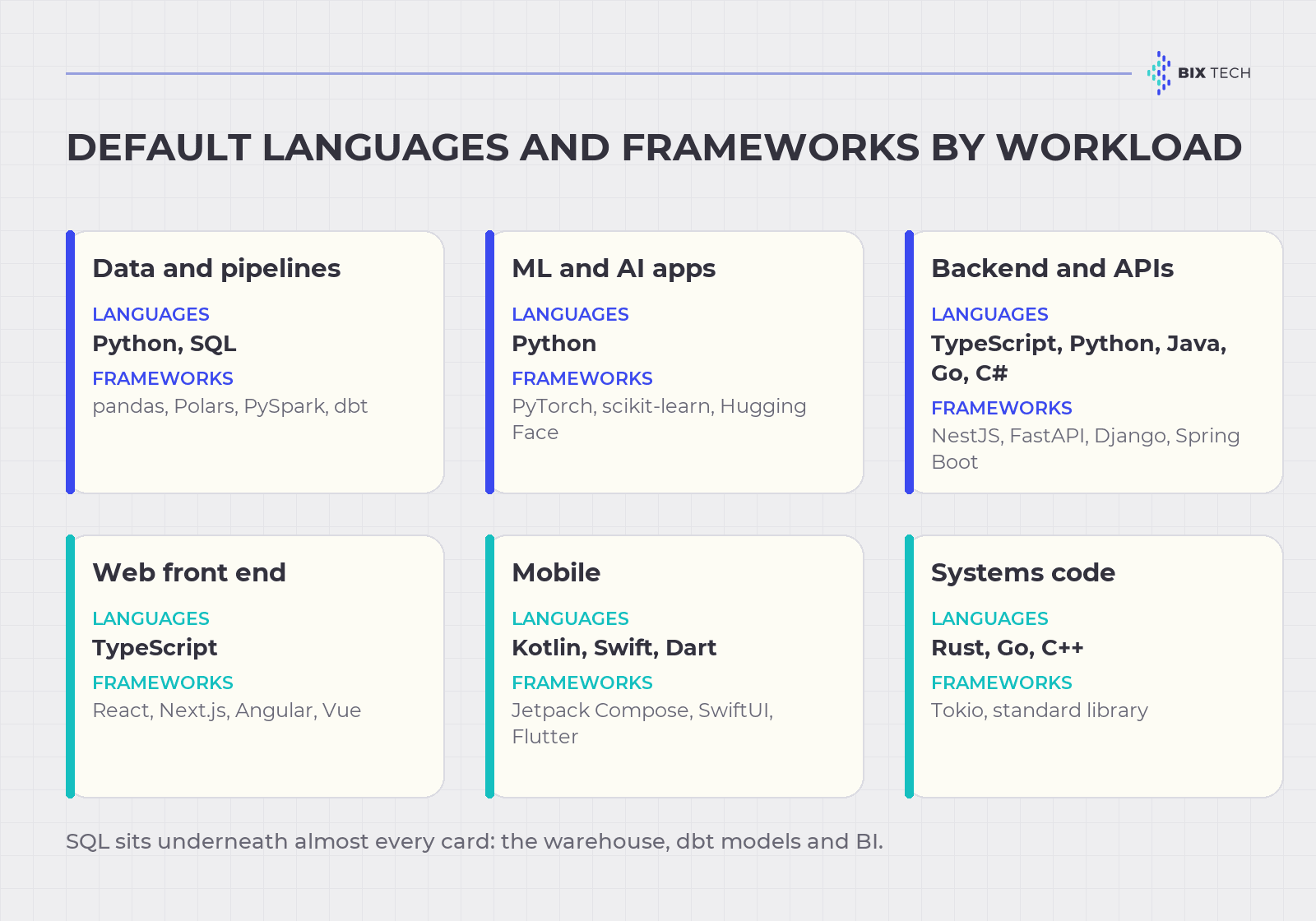
The most reliable shortcut is to ask what the code will spend its life doing. Each workload has a small set of languages with mature libraries, stable tooling and a hiring pool, and moving outside that set has a price you should be able to name. The table below summarizes the defaults we see hold up in production, and when to reconsider them.
| Workload | Default languages | Common frameworks and libraries | Reconsider when |
|---|---|---|---|
| Data analysis and pipelines | Python, SQL | pandas, Polars, PySpark, dbt | Throughput or memory limits dominate: push the work into the warehouse or a compiled engine |
| Machine learning and AI apps | Python | PyTorch, scikit-learn, Hugging Face, PydanticAI | Inference runs at the edge or inside a latency-critical service |
| Backend services and APIs | TypeScript, Python, Java, Go, C# | NestJS, Express, FastAPI, Django, Spring Boot, ASP.NET Core | The team already runs another stack well, or the service is CPU-bound |
| Web front end | TypeScript | React, Next.js, Angular, Vue | Content is mostly static and a lighter site generator is enough |
| Mobile | Kotlin, Swift, or Dart and TypeScript for cross-platform | Jetpack Compose, SwiftUI, Flutter, React Native | You need deep platform features on both iOS and Android |
| Systems and performance-critical code | Rust, Go, C++ | Tokio, standard library | The component is small enough that a managed runtime is fast enough |
Data, analytics and AI
Python is the default here for a practical reason: the libraries are written for it first. pandas, NumPy, PyTorch, scikit-learn and almost every model provider's SDK ship Python before anything else, and the full path from notebook to service is walked through in Python for data analysis, from pandas to FastAPI. The language itself is also changing in ways that matter for data work. Python 3.14, released in October 2025, made the free-threaded build officially supported, which lets CPU-bound threads run in parallel without the global interpreter lock, although it remains an optional build and not every compiled extension supports it yet.
The libraries move too. pandas 3.0, released in January 2026, made copy-on-write the only behavior and introduced a dedicated string type, which breaks chained assignment patterns that many older notebooks rely on. Pinning versions and testing each upgrade on real pipelines therefore belongs in the decision from day one. When a single DataFrame stops being enough, pandas vs NumPy vs Dask compares the next options.
SQL deserves its own line in any data stack. It is the language of the warehouse, of dbt models and of most BI tools, and advanced window functions show how much analysis it handles on its own. Teams that push transformations into SQL often find the Python layer shrinks to glue and orchestration, which is the shift described in the future of SQL in a distributed data world.
Backend services and APIs
Backend is the workload with the widest set of viable answers. TypeScript on Node.js, Python, Java, Go and C# all run large production systems, and the deciding factor is usually the team and the surrounding platform rather than raw performance. A service that mostly waits on databases and other APIs rarely needs the fastest language; it needs a clear contract, good observability and a framework the team understands.
Where performance does matter, the trade-offs are concrete. Go compiles to a single binary and has cheap concurrency, which suits network services and infrastructure tooling. Java has the deepest enterprise ecosystem, and JDK 25, released in September 2025, is a long-term support release with Oracle premier support through 2030. Whatever the language, the harder decisions sit in the interface itself, which is the subject of our guide to API development.
Front end, mobile and systems code
In the browser, the question is mostly settled: TypeScript, with React used by 44.7% of respondents in the Stack Overflow survey and Next.js by 20.8%. On mobile, Google has treated Kotlin as the preferred language for Android since 2019 (the trade-offs against Java are in Java vs Kotlin for Android), Swift plays the same role on iOS, and cross-platform frameworks trade some platform depth for a single codebase.
Systems code is where language choice has the clearest security consequences. In November 2025, Google's Android team reported that memory safety bugs had dropped below 20% of Android's vulnerabilities for the first time, with Rust code showing about a thousand times lower vulnerability density than the platform's C and C++. The same report found Rust changes were rolled back about four times less often. For new components where memory safety is a risk, that is evidence worth weighing against the learning curve.
How to choose a programming language and framework once the workload is clear
With the workload narrowed to two or three candidate languages, the choice moves to the framework, and frameworks differ more in philosophy than in capability. Some ship with most decisions made for you. Others give you a small core and expect you to assemble the rest. Neither approach is superior; the right one depends on how many of those decisions your team wants to own.
Batteries included or assemble your own
Django is the clearest example of the batteries-included model: ORM, admin, authentication and migrations come in the box. Django 6.0, released in December 2025, added a built-in tasks framework for background work, although it defines the API and leaves the worker to a separate backend. A step-by-step build is in building an API with Django and Django REST Framework. FastAPI takes the opposite route, with a thin core built on type hints that generates OpenAPI documentation automatically and fits service-style APIs that sit in front of models or data. The trade-offs between the two, including when a team ends up running both, are laid out in FastAPI vs Django for modern data applications.
The same split exists in the Node.js world. Express is minimal and unopinionated, which makes it quick to start and easy to outgrow. NestJS adds modules, dependency injection and conventions that pay off once several teams share a codebase, and Node.js backends for data APIs covers the patterns that hold up under concurrency. How that choice plays out for products built on data is covered in Node.js, NestJS and Express for data-driven products.
Front-end frameworks and meta-frameworks
On the front end, the decision has shifted from the component library to the meta-framework. React defines components, while Next.js decides routing, data fetching and whether each page renders on the server, at build time or in the browser. Those rendering choices affect search visibility, hosting cost and how fresh the data on screen can be, which is the trade-off explained in Next.js: SSR versus SSG. A working setup that combines React, Next.js and Tailwind CSS is described in our guide to modern frontend development.
Tooling belongs in this decision as well. TypeScript 7.0, released in July 2026, replaced the compiler with a native port that Microsoft measures at 8 to 12 times faster on full builds. It ships without a stable programmatic API, though, so Vue, Svelte, Astro and Angular template checking still depend on TypeScript 6 until version 7.1. A framework choice made today should account for which of those tools it depends on.
The criteria that outlast any ranking
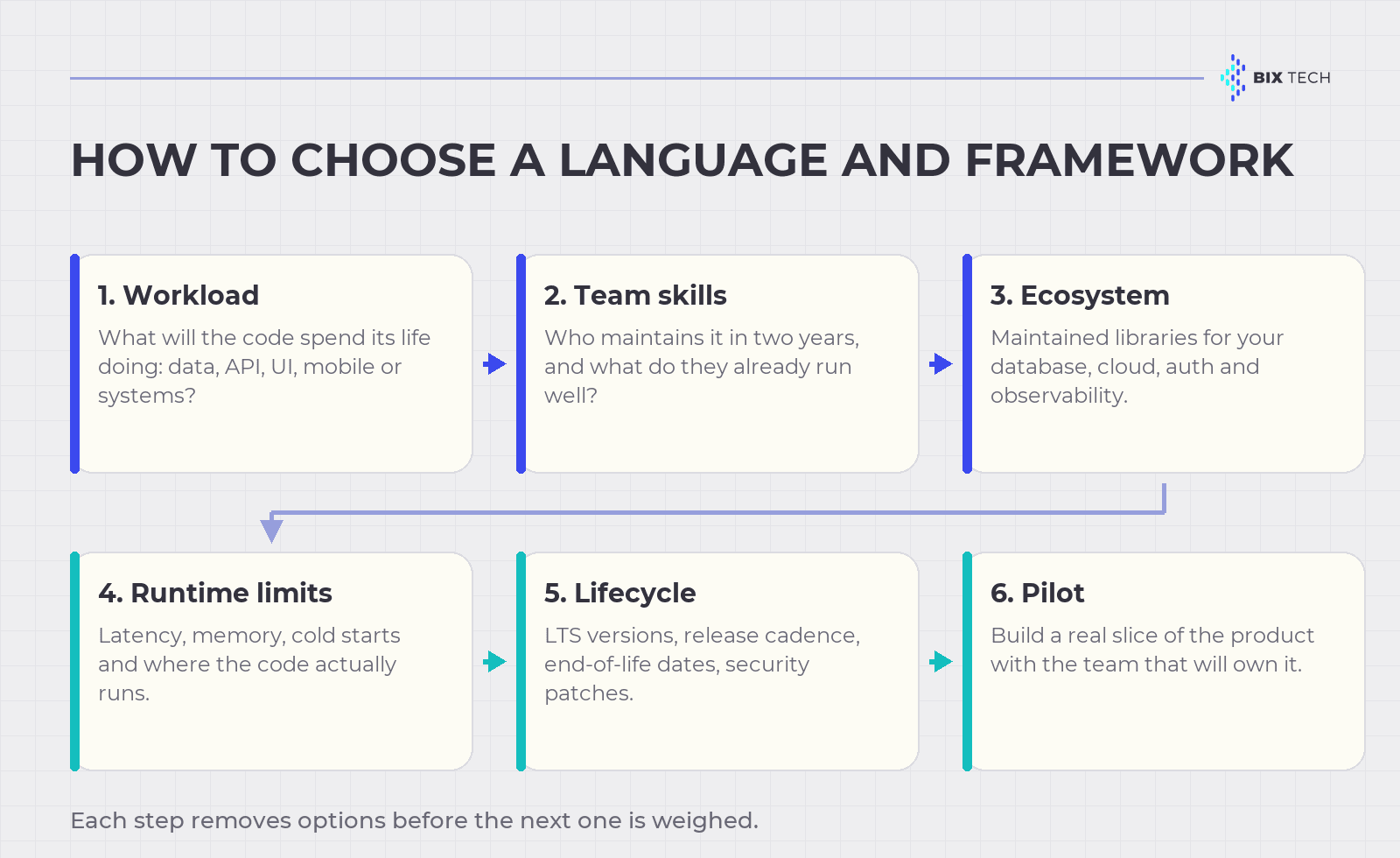
Rankings change every year; the criteria below change slowly. We apply them in this order, because each one tends to eliminate more options than the next, and any different weighting should be explicit and written down.
| Criterion | What to check | Warning sign |
|---|---|---|
| Team skills | Who will maintain the code in two years, not who writes the first version | A stack only one person understands |
| Ecosystem fit | Maintained libraries for your database, cloud, auth and observability | Critical dependencies with a single maintainer or no release in a year |
| Hiring pool | How many candidates you can realistically reach in your market | Every hire needs months of ramp-up in the language itself |
| Runtime constraints | Latency, memory, cold starts, where the code runs | Choosing for peak performance on a service that mostly waits on I/O |
| Typing and AI-assisted coding | Static types or type hints that tools can check | Large dynamic codebases with no type checking in CI |
| Security profile | Memory safety, dependency supply chain, patch cadence | Unsafe native code parsing untrusted input |
| Support lifecycle | Release cadence, long-term support versions, end-of-life dates | Framework major versions that break every year with no migration path |
Two of these deserve a note. Typing has moved up the list because more code is now generated or suggested by AI tools, and a compiler or type checker is the cheapest reviewer you have. Support lifecycle is the one teams forget: a framework version that loses security updates next year turns into unplanned work, which is why long-term support releases such as JDK 25 or Django's LTS line matter for systems that will run for years.
This is also where language choice meets the wider stack. The language, the database, the cloud and the delivery model are one decision seen from different angles, which is the ground covered in how to select a tech stack for sustainable growth.
Common mistakes when picking a language or framework
The most frequent mistake is choosing for the first version instead of for maintenance. A prototype written in the founding engineer's favorite language becomes the production system, and every later hire inherits that preference.
The second is adding a language for one component. Every new language brings its own build tooling, dependency scanning, deployment image and on-call knowledge. A second language is justified when the workload clearly needs it, such as a Rust parser for untrusted input or a Go agent on thousands of hosts, and hard to justify when it saves a few milliseconds on a service that waits on a database.
The third is treating popularity as a guarantee of fit. A heavily used framework is safer to hire for, yet it still carries opinions about structure, rendering and data access. A short pilot on a real slice of the product, run by the team that will own it, reveals those opinions faster than any comparison article.
Where to go deeper
For AI workloads, the same language choice carries into natural language processing with Python, computer vision projects in Python and reliable AI agents built with PydanticAI.
When the front end grows past one team, micro-frontends show how to split it. When the product itself is analytics, embedded analytics with React and Next.js connects the framework to customer-facing dashboards.
If you are building skills rather than a product, ten real-world Python projects is a practical place to start.
Choosing a programming language and framework well means finding the option your team can run for the life of the system. Start from the workload, narrow by team skills and ecosystem, check the runtime limits and the support lifecycle, then pilot before you commit. At BIX Tech we work across Python, TypeScript, Java, Go and the major data platforms, and the right mix varies with each operation.
If your company is choosing a stack for a new product, or trying to consolidate one that grew language by language, our specialists can help you weigh the workload, the team and the lifecycle before the decision gets expensive to reverse. Talk to our team and move your data maturity forward. ⬇️

FAQ: frequently asked questions
How do I choose a programming language for a project?
Start from the workload, then narrow by team skills. Data and AI work usually lands on Python and SQL, browser code on TypeScript, and backend services on whichever of TypeScript, Python, Java, Go or C# your team already runs well. Check library support, hiring pool and support lifecycle before committing, and pilot on a real slice of the product.
What is the most used programming language in 2026?
It depends on what you measure. In the Stack Overflow Developer Survey 2025, JavaScript is the most used language at 66%, followed by HTML/CSS, SQL and Python. By contributors on GitHub, TypeScript took first place in August 2025, overtaking Python and JavaScript according to the Octoverse 2025 report.
Should I use Python or TypeScript for a backend?
Both are solid choices for most backend services. Python fits when the service sits close to data or machine learning code, with FastAPI or Django. TypeScript fits when the team also builds the front end and wants one language across the stack, with NestJS or Express. For I/O-bound services, team familiarity usually matters more than raw speed.
What is the difference between a programming language and a framework?
A programming language defines the syntax and runtime you write code in, such as Python or TypeScript. A framework is a library built on that language that supplies structure and ready-made parts, such as Django for Python or Next.js for TypeScript. You choose the language first, and the framework decides how much of the application is already written for you.
Is Rust worth adopting for business applications?
For most business applications, a managed language is enough and easier to hire for. Rust earns its place in performance-critical or security-sensitive components, such as parsers of untrusted input. Google reported that memory safety bugs fell below 20% of Android's vulnerabilities in 2025 as Rust adoption grew, with Rust changes rolled back about four times less often than C++.