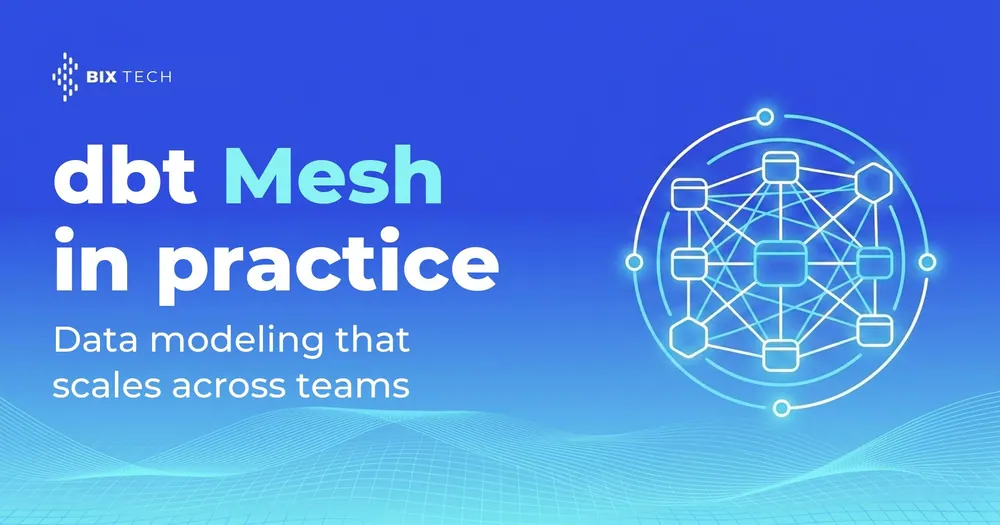
dbt Mesh is dbt's answer to a problem almost every data organization hits as it grows: a single, giant dbt project stops scaling once several teams need to model data at the same time. Instead of one monolith where every model lives together, dbt Mesh lets you split modeling into smaller projects, each with a clear owner, that reference one another in a controlled way. It is the same versioning and testing discipline covered when we looked at dbt for transforming data with governance and version control, now applied at organizational scale.
The symptom is familiar. When finance, marketing, and product all fight over commits in the same repository, the CI pipeline drags, merge conflicts pile up, and nobody is sure who owns which model. That friction usually shows up exactly when a company's data engineering practice matures and more areas start depending on the same tables.
In this practical guide you will learn what dbt Mesh is, when it makes sense to split a monolithic project, how to implement the multi-project architecture with contracts and cross-team references, and what to weigh before scaling. The goal is to help whoever owns the data architecture decide whether the distributed model fits the reality of the operation.
What is dbt Mesh?
dbt Mesh is dbt's approach to organizing data transformation across multiple interconnected projects instead of one central project. Each domain or business unit keeps its own dbt project, with its models, tests, and documentation, and consumes models from other projects through cross-team references. In practice, it brings the principles of domain ownership and decentralization into the governance layer that dbt provides.
The architecture rests on four core features. Cross-project references let one project use another's model without copying code. Model contracts pin the output schema, so a column cannot change without warning. Access modifiers define which models can be consumed from the outside. And model versions let a table evolve without breaking its dependents, which ties directly to the logic of trustworthy data quality monitoring.
It helps to place dbt Mesh in the wider architecture debate. The idea of splitting the platform by domains, with teams owning their own data, is the same one behind data mesh and shows up in discussions about data mesh versus data lakehouse versus data fabric. dbt Mesh is not a new platform; it is a way to apply that philosophy inside the transformation tool many teams already use in the modern data stack.
When should you split a monolithic dbt project?
Not every company needs dbt Mesh. A single project works fine while few people model data and the build fits into an acceptable CI window. The trouble starts as scale grows: many contributors, domains with different cadences, and a dependency graph nobody can read end to end anymore. Recognizing that tipping point is part of treating data quality as a priority rather than an afterthought.
The clearest signals are organizational, not just technical. When one business unit has to wait for another's deploy to publish a model, the ownership boundary is wrong. The table below sums up the triggers that usually mean the monolith no longer fits, a diagnosis similar to what many companies run when they realize they built a data warehouse and need the next step.
| Signal | Single project (monolith) | dbt Mesh (multi-project) |
|---|---|---|
| Number of contributors | Few, a single team | Many, distinct domains |
| Build and CI time | Acceptable | Long, execution queues |
| Model ownership | Central, diffuse | By domain or unit |
| Coupling across areas | Everything together, no boundary | Explicit boundaries with contracts |
| Deploy cadence | Shared | Independent per project |
Splitting too early has a cost too. Creating several projects with only a handful of models adds maintenance overhead with no real gain, so the decision has to be situational. At BIX Tech we work with multiple data and engineering solutions, and the recommendation always depends on team size and the maturity of the company's approach to data governance.
How to implement dbt Mesh in practice
Implementing dbt Mesh in practice starts by designing the domains before writing any code. The first step is mapping which areas produce and consume data, and where the natural boundaries sit between them: finance, product, marketing, operations. Each boundary becomes a dbt project with a defined owner, an arrangement that mirrors how mature data engineering already distributes responsibility.
With the domains defined, the producing project exposes its output models with a contract and access set to public. The contract declares the expected schema and fails the build if someone breaks the format, which turns the model into a stable commitment. Here is a minimal example of a public model with an enforced contract, the kind of guarantee that sustains trust between teams as data flows through the broader dbt workflow:
# project "analytics_finance": exposes a public model with a contract
models:
  - name: fct_revenue
    access: public
    config:
      contract:
        enforced: true
    columns:
      - name: invoice_id
        data_type: varchar
      - name: total_amount
        data_type: numeric
On the other side, the consuming project references that model with the two-argument ref function, naming the source project. There is no copied code and no duplicated logic, just an explicit, traceable dependency, which is essential to keep the data governance layer auditable:
-- project "marketing" consumes the model from the finance project
select *
from {{ ref('analytics_finance', 'fct_revenue') }}
Access modifiers are what keep the boundary healthy. They define what each project can expose and what stays internal, preventing intermediate models from becoming an accidental dependency for another area. According to dbt's documentation, a model defaults to protected, and exposing it to other projects means consciously marking it public, a decision that belongs to a well-structured decentralized governance model.
| Access modifier | Who can reference it | When to use it |
|---|---|---|
private | Only models in the same group | Intermediate and staging models |
protected | Any model in the same project | Default for a domain's internal models |
public | Other projects (cross-project) | Output models that become the domain's interface |
Governance and what to weigh before scaling
dbt Mesh trades coupling for contracts, but that shifts part of the complexity onto governance. Each public model starts to act as an interface between teams, almost a service-level agreement, and changes must respect versioning so they do not break consumers. Treating those contracts with the same rigor as an API is what separates a sustainable mesh from a tangle of fragile dependencies, a principle that also guides agentic data engineering in more automated setups.
There are practical prerequisites to consider. Cross-project references and full-graph visibility rely on features available in dbt's paid tiers, and the team needs the discipline to avoid circular dependencies between domains. You also have to align release cadence, a catalog of public models, and ownership, an effort that usually moves in step with the evolution of the whole data platform architecture.
BIX Tech's stance here is always situational. For a small team with a lean graph, a well-tested and documented monolith remains the simpler choice, as we discussed when weighing how to choose the right data architecture. dbt Mesh shines once the scale of people and domains already charges a price in speed and clarity of ownership.
Scaling data modeling across many teams is, in the end, a boundary problem: where one team's responsibility ends and another's begins. dbt Mesh gives you the technical tools to draw those boundaries, but the real value shows up when the architecture reflects how the company actually works. If your company is feeling the weight of a monolithic dbt project and wants to structure modeling by domains, our specialists can help design the best architecture for your context. Talk to our team and move your data maturity forward. ⬇️

FAQ: frequently asked questions
What is dbt Mesh? dbt Mesh is dbt's approach to organizing data transformation across several interconnected projects instead of one central project. Each domain or business unit keeps its own project and consumes other projects' models through controlled references, with contracts and access modifiers that keep the boundaries clear.
When does it make sense to move from a single dbt project to dbt Mesh? It makes sense when scale starts to hurt: many contributors in one repository, long CI times, frequent merge conflicts, and diffuse model ownership. If only a few people model the data and the build still fits an acceptable window, a well-organized single project is usually enough.
What is the difference between dbt Mesh and data mesh? Data mesh is an organizational architecture concept, with teams owning their own data as products. dbt Mesh is how you apply that philosophy inside dbt, using separate projects, cross-team references, and contracts. One is the principle, the other is the implementation in the transformation layer.
Does dbt Mesh require model contracts? Contracts are not mandatory, but they are strongly recommended for public models. They pin the output schema and fail the build if the format changes, which protects consuming projects. Without contracts, a change in one domain can silently break another area's tables.
How do teams reference models from other projects in dbt Mesh?
Through the two-argument ref function, naming the source project and the model, as in ref('source_project', 'model_name'). This creates an explicit, traceable dependency between projects without copying code, and it only works for models marked with public access.