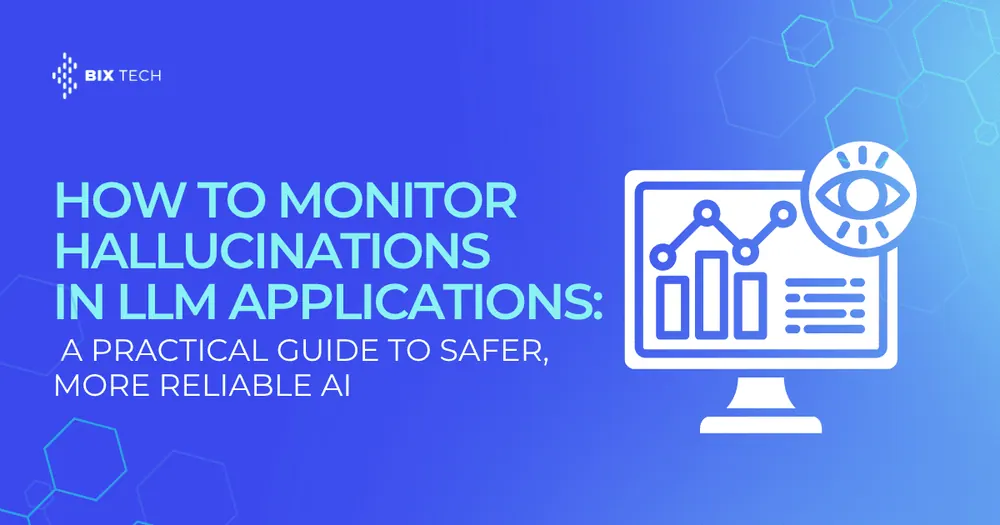
Hallucinations-when a large language model (LLM) produces confident but incorrect or ungrounded output-are one of the biggest obstacles to deploying generative AI in real products. Whether the use case is customer support, internal knowledge search, sales enablement, or code assistance, hallucinations can quietly erode trust, create compliance risk, and increase support costs.
Monitoring hallucinations isn’t a one-time “test before launch” task. It’s an ongoing discipline: defining what “truth” means in your application, measuring it systematically, and building feedback loops that keep performance stable as data, prompts, and models change.
This article walks through a comprehensive, production-friendly approach to hallucination monitoring: what to measure, how to instrument your LLM pipeline, which evaluation methods work best, and what to do when hallucinations spike.
What Counts as a Hallucination in LLM Applications?
A helpful way to monitor hallucinations is to define them in operational terms-something your team can measure consistently.
Common hallucination types
- Factual hallucinations: The model invents facts (dates, numbers, events, product capabilities).
- Source/grounding hallucinations: The model cites a document that doesn’t say what it claims (or fabricates citations).
- Instruction-following hallucinations: The model “makes up” steps, policies, or constraints not provided by the system or the user.
- Entity hallucinations: The model invents people, organizations, APIs, legal clauses, or internal process details.
- Overconfident uncertainty: The model should say “I don’t know,” but instead guesses confidently.
A practical definition for monitoring
For most production teams, a workable definition is:
A hallucination is any output claim that is not supported by the permitted sources for this response (retrieved documents, structured tools/APIs, or explicitly provided context).
This definition is especially effective for RAG (Retrieval-Augmented Generation) systems, where “ground truth” can be tied to retrieved passages or tool outputs.
Why Monitoring Hallucinations Is Different from “Testing Accuracy”
Traditional software testing often checks deterministic behavior. LLMs are probabilistic, and their failure modes change as:
- prompts evolve,
- retrieval indexes update,
- user behavior shifts,
- models are upgraded,
- temperature/decoding parameters are tuned.
Hallucination monitoring is therefore closer to observability than classic QA:
- You instrument the system.
- You track key reliability signals over time.
- You investigate regressions with traces.
- You implement guardrails and feedback loops.
The Hallucination Monitoring Stack (What to Track in Production)
A strong monitoring strategy blends offline evaluation (before releases) and online monitoring (after deployment). Here’s a practical stack of what to measure.
1) Groundedness / Faithfulness (Core Hallucination Signal)
Goal: Determine whether the answer is supported by allowed context (retrieved docs, tool outputs, or provided knowledge base).
How to monitor:
- Use an automated “judge” step (often another model) to score faithfulness: Does the answer only make claims supported by sources?
- Track a groundedness score (0–1 or 0–100) per response and trend it over time.
Best practice: Evaluate claim-by-claim rather than as one holistic judgment. One response can be mostly correct but contain a single risky invented statement.
2) Retrieval Quality Metrics (RAG-Specific)
A surprising number of hallucinations are caused upstream: retrieval fails, so the model fills the gap.
Metrics to monitor:
- Retrieval hit rate: Did the system retrieve anything relevant?
- Top-k relevance: Are the top retrieved passages actually about the user question?
- Context utilization: Did the model use the retrieved context-or ignore it?
- Citation precision: If citing sources, do citations map to passages that support the specific claim?
Practical insight: When groundedness drops, check retrieval first. Many teams waste time tuning prompts when the real issue is missing or low-quality context.
3) “I Don’t Know” and Refusal Behavior
In many business workflows, a safe response is better than a guessed response.
What to track:
- Abstention rate: How often the model says it can’t answer with available sources.
- Correct abstentions vs. incorrect abstentions: You don’t want the model refusing questions it could answer.
- Policy adherence: For regulated domains, track whether the model stays within approved boundaries.
A healthy system typically balances:
- high groundedness,
- moderate abstention when context is missing,
- low incidence of confident guessing.
4) User Feedback Signals (High-Value, Low-Volume)
User feedback is sparse, but it’s real-world ground truth.
Capture signals like:
- thumbs up/down,
- “report an issue” category (hallucination, outdated info, irrelevant answer),
- time to resolution (if used in support workflows),
- follow-up question rate (high can indicate confusion or incorrectness).
Tip: Store the full trace (prompt + retrieved context + model output) for negative feedback items. Those traces become gold for debugging and evaluation sets.
5) Behavioral Drift and Regression Monitoring
Hallucinations often increase after changes to:
- embedding model,
- chunking strategy,
- reranker,
- prompt template,
- system instructions,
- model version.
Track reliability over time:
- groundedness score trends,
- hallucination incident rate,
- evaluation suite score (offline),
- rollback triggers when thresholds are breached.
How to Instrument Your LLM Pipeline for Hallucination Observability
Monitoring requires you to log the right artifacts. For each request, capture:
Required logs (minimum viable)
- user query (redacted as needed),
- system and developer prompts (versioned),
- model name + parameters (temperature, top_p),
- retrieved documents (IDs + text snippets + scores),
- tool calls and outputs (if any),
- final response,
- latency and token usage.
Why versioning matters
Hallucination monitoring is much easier when you can answer:
- Which prompt template was used?
- Which retrieval strategy was active?
- Which model produced this output?
- Which knowledge base snapshot was queried?
This turns hallucination debugging from guesswork into a traceable investigation.
Offline Evaluation: The Fastest Way to Prevent Hallucinations Before Release
Online monitoring catches issues after deployment. Offline evaluation prevents most issues before users see them.
Build a “hallucination-focused” evaluation set
Include questions that commonly trigger hallucinations:
- ambiguous questions (“What’s our refund policy?” when multiple exist),
- missing-context questions (“What are the Q3 numbers?” when not in the KB),
- edge cases (typos, shorthand, partial product names),
- high-risk topics (legal, pricing, medical guidance, compliance).
Recommended evaluation dimensions
For each test question, score:
- Answer correctness (if a ground truth exists),
- Faithfulness/groundedness (supported by sources),
- Relevance (addresses the question),
- Completeness (covers key points without overreaching),
- Citation accuracy (if citations exist).
Use both automated and human review
- Automated scoring scales and helps spot trends.
- Human review is essential for ambiguous cases and for calibrating what “good” looks like.
A practical hybrid approach:
- run automated evaluation on every release,
- sample a subset weekly for human adjudication,
- continuously add failure cases back into the test set.
Online Monitoring: Detecting Hallucinations in Real Time
Once in production, you want fast detection and actionable alerts.
Real-time “risk scoring” for each answer
Compute a per-response hallucination risk score using signals such as:
- low retrieval relevance,
- low groundedness score,
- high claim density (many assertions with little context),
- presence of numbers, dates, legal language (higher risk),
- lack of citations when expected.
Use cases for risk scoring:
- trigger a “safe completion” mode (shorter answer, more citations),
- ask the model to verify claims against sources before responding,
- escalate to a human or fallback flow,
- log for priority review.
Practical Guardrails That Reduce Hallucinations (and Help Monitoring)
Monitoring is strongest when paired with guardrails that reduce failures and produce clearer signals.
1) Enforce “answer only from sources” behavior
In RAG:
- instruct the model to answer strictly based on retrieved passages,
- require citations per paragraph or per claim,
- include an explicit fallback: “I don’t have enough information in the provided sources.”
2) Use structured outputs for high-stakes domains
JSON schemas or function-calling reduce “creative” output and make validation easier.
Examples:
- policy answers must include
source_doc_ids, - product specs must include
confidenceandevidence_quotes, - contract summaries must include
clause_references.
3) Add a verification step (self-check or second model)
A simple but effective pattern:
- Draft answer.
- Extract claims.
- Verify each claim against sources.
- Remove or rewrite unsupported claims.
This verification trace is also valuable for monitoring and audits.
Common Root Causes of Hallucinations (and What Monitoring Reveals)
Root cause: Missing or irrelevant context
Symptoms: retrieval hit rate drops, groundedness drops, abstention rate stays low.
Fix: improve chunking, embeddings, reranking, query rewriting, or index coverage.
Root cause: Prompt encourages “helpfulness over truth”
Symptoms: long answers, confident tone, few citations, high claim density.
Fix: adjust system prompt to prioritize groundedness and “I don’t know.”
Root cause: Model upgrade changes behavior
Symptoms: regression after model version change; different refusal/verbosity patterns.
Fix: run offline evaluation suite before rollout; canary releases; rollback triggers.
Root cause: Knowledge base freshness or governance issues
Symptoms: answers cite outdated documents; user flags “incorrect” but groundedness seems high.
Fix: document lifecycle management, source prioritization, recency weighting, and clear “effective date” metadata. For more on how data gaps impact system reliability, see how data gaps undermine AI systems.
Featured Snippet: Quick Answers to Common Questions
What is an LLM hallucination?
An LLM hallucination is an output that includes claims not supported by the model’s allowed sources (retrieved documents, tool outputs, or provided context), often presented confidently as fact.
How do you measure hallucinations in an LLM app?
Measure hallucinations using groundedness/faithfulness scoring, citation accuracy, retrieval relevance metrics (for RAG), abstention rates (“I don’t know”), and user feedback signals-then trend these metrics over time.
What’s the best way to monitor hallucinations in RAG?
Monitor both retrieval quality (relevance, hit rate, context utilization) and answer faithfulness (claim-by-claim support from retrieved passages). Many hallucinations originate from poor retrieval, not generation.
How can you reduce hallucinations in production?
Use strict source-grounding prompts, require citations, add a verification step for claims, enforce structured outputs for high-stakes answers, and implement a safe fallback when evidence is missing.
A Practical Monitoring Checklist (Production-Ready)
Baseline (must-have)
- Log prompts, retrieved context, tool outputs, and responses
- Track groundedness/faithfulness scores
- Track retrieval relevance and hit rates (RAG)
- Capture user feedback and store full traces for negative events
Mature (high-impact)
- Real-time hallucination risk scoring with alerts
- Automated regression tests before model/prompt/index changes
- Claim-level verification for high-stakes workflows
- Continuous evaluation set expansion from real incidents
Final Thoughts: Hallucination Monitoring Is an Ongoing Reliability Practice
Hallucinations won’t disappear simply by picking a better model. Reliable LLM applications are built through consistent monitoring, thoughtful evaluation, strong retrieval fundamentals, and feedback loops that turn failures into improvements.
When hallucination monitoring is treated like observability-measured, versioned, trended, and acted upon-LLM systems become safer to scale, easier to debug, and far more trustworthy in real business environments. If you want a broader view of modern reliability practices, read observability in 2025 with Sentry, Grafana, and OpenTelemetry, and for compliance-ready traceability consider data pipeline auditing and lineage.
If your application has to answer reliably and you need to catch when it does not, our specialists can work through the implementation with the team that will maintain it. Talk to our team.