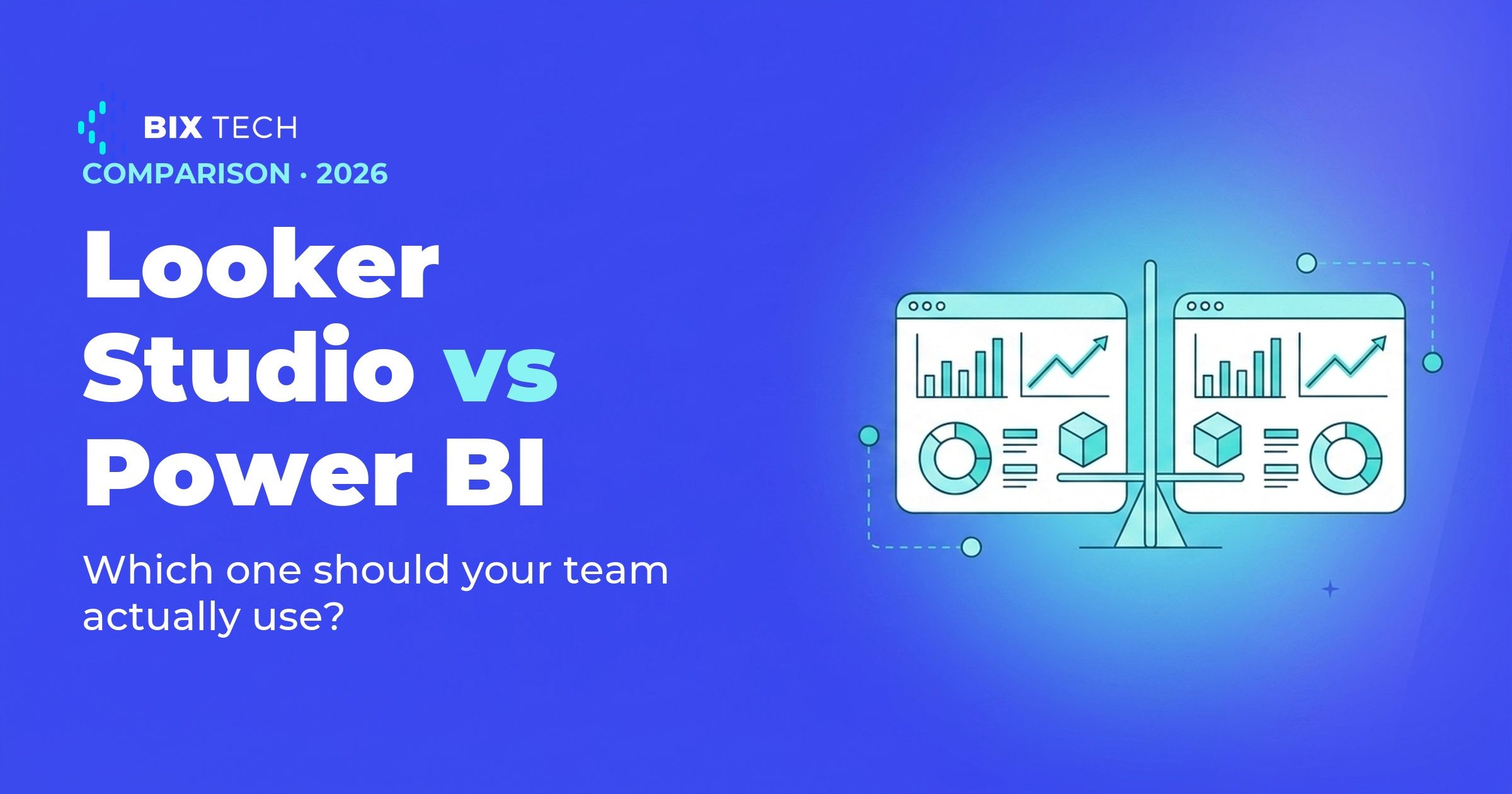
Looker Studio vs Power BI in 2026: which one should your team actually use?
The Looker Studio vs Power BI question is back on every data team's table in 2026, and the honest answer is still "it depends on your context." Both tools solve the same core problem, turning raw data into dashboards that support decisions, yet they start from different philosophies of cost, governance, and integration. Choosing by hype instead of fit tends to get expensive, a trap we unpack in Business Intelligence demystified.
The confusion starts with the names. Looker Studio (formerly Google Data Studio) is free and lives inside the Google ecosystem. Power BI is Microsoft's platform and charges per user to share governed reports. Before comparing price, remember that any BI tool only delivers value when the data underneath it is organized, which depends on solid data engineering.
In this agnostic comparison, you will see the criteria that truly drive the decision, where each platform fits best, and a summary table you can take to your next planning meeting. The goal is not to crown a winner, but to help your team avoid the wrong bill, an outcome closely tied to your analytics maturity stage.
Looker Studio vs Power BI: the criteria that actually matter
Comparing two BI tools by chart count is the fastest route to a bad decision. What moves the needle is a different set of factors, and these are the ones that should guide the choice:
- Cost model. Looker Studio is free on its base plan with no user limit, while Power BI charges a license for every person who needs to consume published reports, a detail that only shows up on the invoice once the project has grown, much like the hidden costs we cover in BigQuery pricing explained for 2026. Before committing to any tool, be clear on why you are adopting it: consolidating data scattered across spreadsheets, ending the hours lost to manual reports, replacing gut feeling with a single source of truth, and getting information to the people who actually decide.
- Modeling depth. Power BI brings table relationships, Power Query transformations, and the DAX language for complex calculations, which fits heavy financial and operational analysis. Looker Studio is faster for lightweight reporting but depends on the modeling being resolved upstream, ideally in the warehouse, a topic we detail in BigQuery vs. Snowflake.
- Governance. Often the most underestimated criterion. Row-level access control, audit trails, and organizational ownership of reports separate a pretty panel from a trustworthy corporate asset. A polished dashboard is useless if it breaks down at decision time, a risk we detail in why dashboards often fail to drive real decisions.
- Integration with the stack you already run. A tool that talks natively to your sources cuts friction, connector cost, and maintenance time. That alignment between tool and source is part of the same discipline that governs your data pipelines.
When Looker Studio fits
Looker Studio shines when your world is Google. If your operation runs on GA4, Google Ads, BigQuery, and Sheets, native connectors deliver reports in minutes with no per-user license, which helps lean teams move from raw reporting toward decision automation without a financial barrier to entry.
The free plan has no viewer limit, which makes it attractive for marketing, agencies, and squads that distribute panels to many people. According to Google Cloud's official documentation, there is also Looker Studio Pro at $9 per user per project per month, adding organizational ownership of reports, support, and team management, the kind of control that matters once a dashboard becomes a real asset, as covered in build dashboards that tell a story.
The caveat appears when your data lives outside Google. Connecting Meta Ads, TikTok, or an ERP usually requires paid third-party connectors, and heavy BigQuery queries carry a cost per volume processed. In other words, "free" has fine print when the source is not native, and understanding BigQuery at scale is what keeps that cost predictable.
When Power BI makes more sense
Power BI tends to fit when the company lives inside Microsoft 365 and needs corporate reporting with real governance. Integration with Excel, Teams, Azure, and Fabric cuts friction, and its robust modeling serves areas like finance, supply chain, and sales, scenarios similar to what we describe in Power BI vs Qlik.
The cost is per license. According to Microsoft's official pricing page, Power BI Pro costs $14 per user per month and Premium Per User (PPU) rises to $24 per user per month, with larger models and more frequent refreshes. For large operations, Microsoft Fabric capacity changes the math: from the F64 SKU upward, viewers no longer need an individual license, a threshold that reshapes governance decisions we explore in Power BI governance.
Power BI's strength appears in cases that demand dense analytical calculation and per-profile access, where writing DAX with Power BI Copilot speeds up complex logic. When the environment is hybrid, with legacy data and cloud warehouses side by side, it also connects well to broader architectures, as discussed in lakehouse, data lake, or data warehouse.
Comparison table: Looker Studio vs Power BI in 2026
The table below sums up the decision criteria. Treat the figures as public list references and always confirm them at the official source before signing a contract, because software pricing changes and every operation has its own volume, a point that keeps coming up in comparisons like Metabase vs Looker.
| Criterion | Looker Studio | Power BI |
|---|---|---|
| Base cost model | Free, no user limit | Desktop free; sharing needs a license |
| Paid tier | Pro at $9/user/project/month | Pro $14 and PPU $24/user/month |
| Native ecosystem | Google (GA4, Ads, BigQuery, Sheets) | Microsoft (365, Excel, Teams, Azure, Fabric) |
| Data modeling | Lightweight, ideal for fast reporting | Deep (Power Query, DAX, relationships) |
| Governance and security | Basic; limited row-level and audit | Enterprise row-level security and auditing |
| Best scenario | Marketing and Google stack, many readers | Corporate BI in a Microsoft environment |
No single row in that table declares a winner. It shows trade-offs, and the right read depends on your user volume, your stack, and the governance level your industry demands, a distinction people still blur when they treat Qlik and Looker as interchangeable.
In practice, BIX Tech works with multiple data, cloud, and engineering solutions, and the ideal choice varies with each operation's reality. If your base runs on Google and the team is lean, Looker Studio tends to fit. If you live in Microsoft 365 and need financial modeling with strong governance, Power BI usually makes more sense, always with a well-structured warehouse behind it, as we lay out in Amazon Redshift vs. Snowflake.
The Looker Studio vs Power BI decision is not about which tool is superior, but about which one cuts the friction between your data and your decision at the lowest total cost. The tool is the visible layer of a project that starts much earlier, in architecture and data quality. Choosing well means aligning cost, stack, and governance to your company's moment, not following the quarter's hype.
If your company is evaluating which BI platform to adopt or migrate to in 2026, our specialists can help you design the right architecture for your context. Talk to our team and move your data maturity forward. ⬇️

Frequently asked questions
What is better, Looker Studio or Power BI? There is no universal "better," only the better fit for your context. Looker Studio tends to suit marketing teams and Google-based stacks that need free reports for many users. Power BI stands out in Microsoft 365 environments that require deep modeling and corporate governance. The choice depends on cost, stack, and the level of security you need.
How much do Looker Studio and Power BI cost? Looker Studio is free on its base plan with no user limit, and Looker Studio Pro costs $9 per user per project per month. Power BI charges $14 per user per month on Pro and $24 on Premium Per User, according to official Microsoft and Google pricing. For many viewers, Microsoft Fabric F64 can change the math.
Is Looker Studio really free? Yes, the base Looker Studio plan is free with no user limit. The cost shows up indirectly: third-party connectors for non-Google sources (like Meta and TikTok) are paid, and heavy BigQuery queries charge by volume processed. For organizational ownership of reports, there is the paid Pro plan.
Is Power BI better than Looker Studio for large companies? It depends on the stack. Power BI offers governance, row-level security, and deep modeling that serve large operations in the Microsoft ecosystem well. Companies heavily anchored in Google and BigQuery can reach the same enterprise level with Looker (Google Cloud's enterprise platform, different from Looker Studio). The criterion is the environment, not size alone.
How do I choose between Looker Studio and Power BI in 2026? Start with the stack you already use, the number of people who will consume the reports, and the governance level your industry requires. Then add up total cost, including licenses, connectors, and data processing. The right tool is the one that cuts the friction between data and decision at the lowest cost in your scenario.