
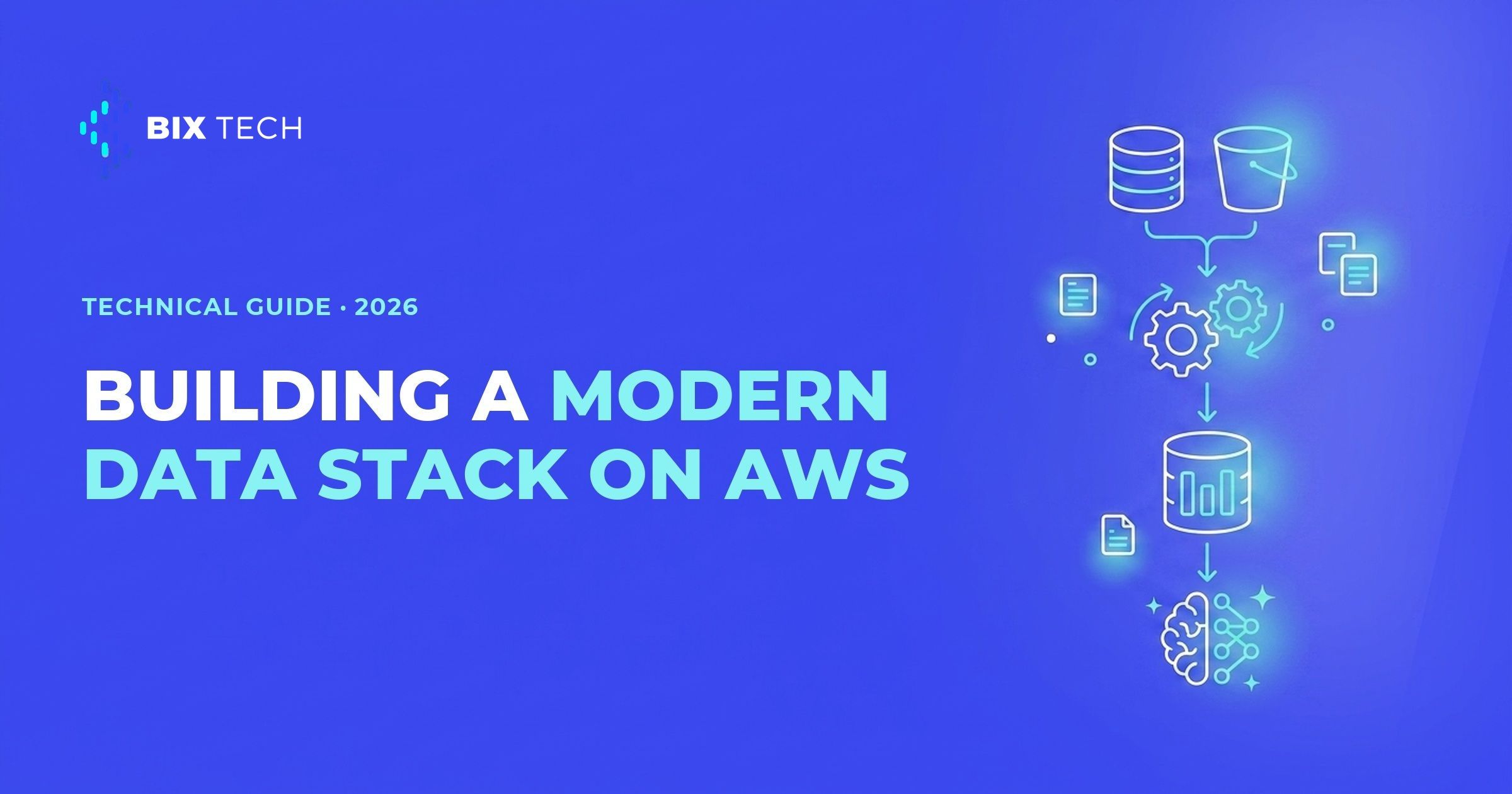
Building a modern data stack on AWS used to mean stitching together a dozen services and hoping the seams held. That has changed. Amazon S3, AWS Glue, Amazon Redshift, and Amazon Bedrock now cover the full path from raw storage to a governed warehouse to generative AI, and the connective tissue between them keeps getting tighter. For any team treating data engineering as the backbone of modern business intelligence, that convergence is the story worth understanding.
The pull toward a single, integrated stack is not hype. At its re:Invent 2025 event, AWS built most of its data announcements around wiring generative AI directly into the data platform, supporting open table formats like Apache Iceberg, and unifying governance across the lake and the warehouse, the same themes that shaped our read on AWS, Azure, and Google Cloud for data and AI. The result is a reference architecture most companies can adopt without inventing their own glue code.
This guide walks through the four pillars of a modern data stack on AWS and, more importantly, how they connect. Storage, transformation, analytics, and AI each have a clear home, and the value shows up when data flows between them without manual handoffs, a discipline that separates a tidy platform from one that quietly stalls a company's growth.
What a modern data stack on AWS looks like
A modern data stack on AWS is a layered architecture where each service owns one job and passes clean outputs to the next. Amazon S3 is the durable storage foundation, AWS Glue handles cataloging and transformation, Amazon Redshift serves fast analytical queries, and Amazon Bedrock brings foundation models to the data instead of shipping the data out to them. Framed this way, the stack mirrors the layered thinking behind any well-run data ingestion practice.
The layering matters because it decouples decisions. You can change how you transform data without touching where it is stored, or add AI without re-platforming your warehouse. That separation is exactly what teams weigh when they compare a data lakehouse against a data mesh as the shape of their foundation, and it is why open formats sit at the center of the design.
The four layers are not rigid silos, though. S3 underpins both the lake and, increasingly, the warehouse, while Bedrock can read from any of them. Understanding where the boundaries blur is what turns a diagram into a working platform, the same clarity that helps a team move past the point where they have built a warehouse and wonder what comes next.
The four building blocks, layer by layer
Amazon S3: the storage foundation
Amazon S3 is where the stack begins, holding raw and processed data as objects at effectively unlimited scale. Its durability and low cost make it the natural landing zone for everything from application logs to Parquet tables, which is why almost every data ingestion pipeline on AWS terminates in a bucket before anything else touches the data.
What changed recently is that S3 is no longer just a bucket of files. With S3 Tables, AWS added native support for Apache Iceberg, so the storage layer itself understands table semantics, schema, and versioning. That upgrade blurs the old line between lake and warehouse and gives the open-format foundation that a modern technical warehouse evaluation now assumes by default.
AWS Glue: cataloging and transformation
AWS Glue is the serverless layer that discovers, catalogs, and transforms the data sitting in S3. Its crawlers infer schemas and populate the Glue Data Catalog, which then acts as the shared metadata backbone that Redshift, Athena, and other engines read from, the kind of single catalog that keeps a data engineering practice from fragmenting.
Glue runs ETL and ELT jobs in Spark or Python without provisioning servers, so transformation scales up and down with the workload. Because the catalog is shared, a table defined once becomes queryable everywhere, which removes the duplicated schema definitions that so often trip up teams and echo the most common errors in data engineering projects.
Amazon Redshift: the analytical warehouse
Amazon Redshift is the columnar warehouse where fast, concurrent analytical queries live. It reads directly from S3 through Redshift Spectrum, and per AWS documentation it can now write directly to Apache Iceberg tables, so the warehouse and the lake share one open storage layer rather than maintaining two copies, a design that keeps a warehouse lean rather than expensive.
Redshift also leans on Zero-ETL integrations that replicate data from operational databases into the warehouse with little pipeline code, which shortens the path from transactional systems to analytics. That tighter loop is what ultimately feeds the dashboards and metrics behind sound business intelligence, where the value of the whole stack becomes visible to the business.
Amazon Bedrock: the generative AI layer
Amazon Bedrock brings foundation models to your governed data through a single API. According to AWS, Bedrock now serves close to a hundred models from multiple providers, and its AgentCore layer adds memory, evaluations, and policy constraints for production agents, the guardrails that any serious LLM governance program depends on.
The point of putting Bedrock inside the stack is proximity. Models can reason over data already sitting in S3 and Redshift instead of being copied to a separate platform, which is the foundation for reliable retrieval-augmented generation in production. It also reflects the broader shift toward agentic data engineering, where agents operate directly against governed tables rather than stale extracts.
How the layers fit together
The stack earns its keep when data flows through all four layers without manual handoffs. Raw data lands in S3, Glue catalogs and transforms it, Redshift serves the analytical queries, and Bedrock reasons over the governed result, a flow that mirrors the AI-native analytics pattern we described for warehouse-embedded models. The table below maps each layer to its job and the service that owns it.
| Layer | Job | AWS service | Fits when |
|---|---|---|---|
| Storage | Durable, open-format object storage | Amazon S3 (with S3 Tables / Iceberg) | You need a single source of truth for lake and warehouse |
| Transformation | Cataloging, ETL and ELT | AWS Glue | Schemas and pipelines should scale without managed servers |
| Analytics | Fast concurrent SQL queries | Amazon Redshift | Dashboards and reporting need low-latency access |
| Generative AI | Models and agents over governed data | Amazon Bedrock | You want AI reasoning next to the data, not copied out |
Reading the flow left to right shows why open formats matter so much. Because S3 Tables, Glue, and Redshift can all speak Iceberg, a table written once is readable by every engine above it, which is the same portability logic that makes a semantic layer valuable for AI agents. Governance travels with the data rather than being re-implemented per tool.
That shared foundation also keeps the AI layer honest. When Bedrock agents read from the same governed tables that power the dashboards, the answers stay consistent with the numbers the business already trusts, and deploying those agents follows the same operational rigor as running AI agents on Docker and Kubernetes. The integration, not any single service, is where the payoff lives.
When this stack fits your team
This architecture fits teams already invested in AWS that want control over each layer without hand-building the connections between them. The breadth of building blocks rewards groups comfortable assembling services, the same profile we flagged when comparing the major hyperscalers for data and AI. If your operational systems, identity, and analytics already run on AWS, data gravity alone makes consolidation the low-friction path.
It fits less cleanly when your center of gravity is elsewhere. A Microsoft-heavy shop may find a unified SaaS estate simpler, and an analytics-first team might prefer a serverless warehouse with AI folded into SQL. At BIX Tech we work across AWS, Azure, and Google Cloud, along with the data and engineering tools that sit on top of them, so the recommendation always tracks your context rather than a single vendor, a stance we keep whether the debate is Snowflake Cortex versus Databricks Genie or which cloud to standardize on.
The through-line is that a modern data stack on AWS is only as strong as the integration between its layers. S3 gives you open storage, Glue gives you cataloged transformation, Redshift gives you fast analytics, and Bedrock gives you AI where the data already lives, but the advantage comes from wiring them so data moves without friction. Get the seams right and the stack compounds; leave them manual and you rebuild the same brittle pipelines that a good data engineering foundation is supposed to retire.
If your company is designing or consolidating a modern data stack on AWS, our specialists can help you map S3, Glue, Redshift, and Bedrock to your workloads and governance needs. Talk to our team and move your data maturity forward. ⬇️

What is a modern data stack on AWS? A modern data stack on AWS is a layered architecture that moves data from raw storage to governed analytics to generative AI using integrated services. Amazon S3 stores the data, AWS Glue catalogs and transforms it, Amazon Redshift serves fast SQL queries, and Amazon Bedrock runs models over the governed result, all connected through open table formats like Apache Iceberg.
How do S3, Glue, Redshift, and Bedrock work together? Raw data lands in Amazon S3, AWS Glue crawls and transforms it while populating a shared catalog, Amazon Redshift queries it for analytics, and Amazon Bedrock reasons over the governed tables. Because S3 Tables, Glue, and Redshift all support Apache Iceberg, a table written once is readable across every layer without copying data between services.
Why use Amazon Bedrock instead of a separate AI platform? Amazon Bedrock keeps foundation models next to your governed data in S3 and Redshift, so agents reason over the same tables that power your dashboards rather than stale extracts. According to AWS, Bedrock serves close to a hundred models behind one API and adds memory, evaluations, and policy controls through AgentCore, which supports production-grade governance and retrieval-augmented generation.
Is a modern data stack on AWS right for every team? Not always, and the choice is situational. This stack fits teams already invested in AWS that want granular control over each layer. Microsoft-centric organizations may prefer a unified SaaS estate, and analytics-first teams might favor a serverless warehouse with AI in SQL. The right architecture depends on where your data already lives and which tools your team knows best.
What role do open table formats like Iceberg play in the stack? Apache Iceberg lets S3, Glue, and Redshift share one storage layer instead of maintaining separate copies. A table defined once carries its schema, versioning, and governance across every engine that reads it, which reduces lock-in and keeps the analytics and AI layers consistent with the same source of truth.