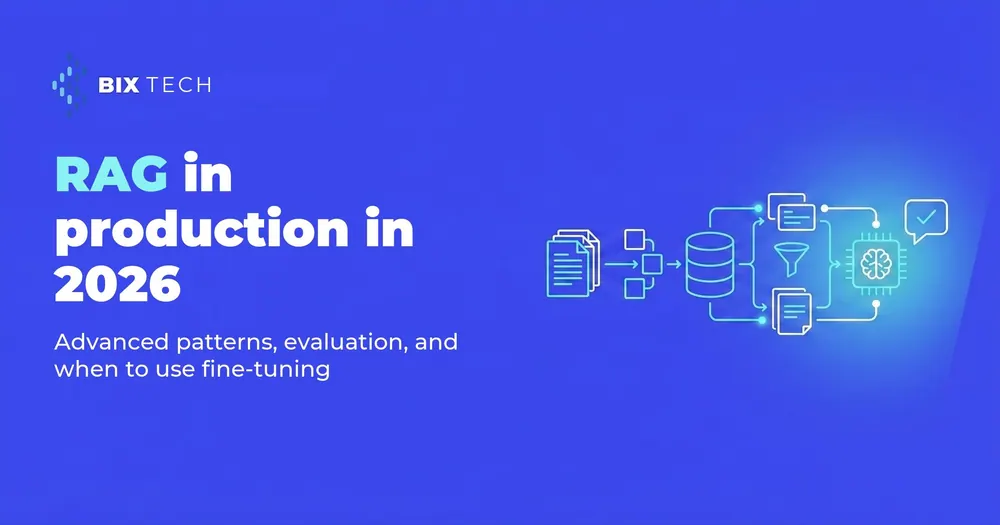
Getting a RAG demo to work is easy. Keeping it in production, with trustworthy answers and cost under control, is another story.
Running RAG in production has stopped being a proof-of-concept exercise and become an architecture decision. RAG (Retrieval-Augmented Generation, the technique that fetches document snippets and injects that context into the model's prompt) solved the most visible problem with LLMs: answering about data the model never saw during training. The prototype that impresses on Friday, though, tends to break once it meets real questions, a large document base and impatient users, exactly the scenario that shows up when you try to scale AI agents and assistants.
The bottleneck is rarely the model. It sits in retrieval: the wrong snippet enters the context and the answer comes out wrong, with the same confidence as a correct one. According to Gartner, more than 40% of agentic AI projects are expected to be canceled by the end of 2027, largely on rising costs and weak control over answer quality. A RAG that is neither measured nor tuned feeds that exact kind of abandonment, the opposite of what you expect when you move LLMs into real business workflows.
So it pays to unpack the three fronts that separate a showroom RAG from a production RAG: the advanced retrieval patterns, the evaluation frameworks that take guesswork off the table, and the point where investing in fine-tuning beats stacking more context. All of it with the stance of a team that works across multiple data and AI architectures, treating no single technique as a silver bullet.
The advanced patterns that hold up RAG in production
Basic RAG does three things: it splits documents into chunks, turns each chunk into a vector, and at query time fetches the closest vectors. That works until the base grows. From there, purely semantic search stumbles on exact terms, product codes and acronyms, and that is where the patterns matured that hold up production RAG, most of them resting on solid data architecture underneath.
Hybrid search combines vector retrieval with keyword search (BM25), capturing both meaning and the literal term. On top of that set, a reranker reorders snippets by real relevance before handing them to the model, which cuts noise in the context. This reranking step tends to deliver the biggest quality gain per dollar spent, and it leans on the same data quality discipline that carries any serious pipeline.
How you slice the documents matters too. Chunks that are too large dilute the information, while ones that are too small lose the context. Section-based chunking, with source and date metadata, lets you filter before you search and cite the source in the answer, something Anthropic popularized with its contextual retrieval technique, which prepends a document summary to each snippet. Keeping that base clean takes the same governed transformation of data every data project demands.
For questions that need multi-step reasoning, agentic RAG lets the model decide what to fetch, rewrite the query and check its own result before answering, behavior that depends on well-built retrieval infrastructure like fast semantic layers and caching. GraphRAG, in turn, structures knowledge as a graph of entities and relationships, useful when the answer depends on connections across documents rather than a single isolated snippet.
| Pattern | Problem it solves | When to apply it |
|---|---|---|
| Hybrid search (vector + BM25) | Exact terms, acronyms and codes semantic search misses | Bases with technical jargon, SKUs, proper names |
| Reranking | Irrelevant snippets polluting the context | Retrieval that returns many candidates |
| Contextual retrieval | Chunks that lose the document's context | Long documents, contracts, manuals |
| Agentic RAG | Multi-step questions and result verification | Decision flows, research, complex support |
| GraphRAG | Answers that depend on entity relationships | Highly connected knowledge, compliance |
How to evaluate RAG in production without guesswork
Without measurement, tuning a RAG turns into trial and error. Evaluation splits into two axes: retrieval quality (did the system fetch the right snippets?) and generation quality (did the answer use those snippets faithfully?). Treating the two separately is what lets you find whether the error lives in the search or in the model, the same way good data quality monitoring separates cause from symptom.
Frameworks like RAGAS consolidated a set of metrics that are now a market reference. Faithfulness measures whether the answer holds up against the retrieved snippets, without hallucination. Context precision and recall assess whether the right snippets came in and whether any were left out. Answer relevance checks whether it actually addresses the question, a yardstick close to the one you apply to BI that drives real decisions rather than just illustrates them.
In practice, build a golden set of reference questions and answers, run the evaluation on every change, and track the variation. An LLM can act as a judge to scale that analysis, as long as it is calibrated against human judgment on a sample, the kind of versioned, testable discipline you already see with dbt. After deployment, close the loop with real usage signals such as user feedback, question-reformulation rate and cost per answer.
| Metric | What it measures | Points to a problem in |
|---|---|---|
| Faithfulness | Whether the answer relies on the snippets, without inventing | Generation / hallucination |
| Context precision | Whether the retrieved snippets are relevant | Retrieval / reranking |
| Context recall | Whether an essential snippet was left out | Retrieval / chunking |
| Answer relevance | Whether the answer addresses the question | Prompt / generation |
| Cost per answer | Tokens and latency on each query | Architecture / efficiency |
RAG or fine-tuning: when to use each
The right question is not RAG or fine-tuning, but which problem each one solves. RAG delivers knowledge: data that changes, needs source citation and does not fit in training. Fine-tuning delivers behavior: tone, format, style and a very specific domain the model needs to internalize. Confusing the two is the root of much of the frustration with AI agent projects.
Fine-tuning starts to make sense when the bottleneck is form, not fact. If the model already has the information but gets the output format wrong, ignores the brand voice or fails on a closed jargon, adjusting the weights beats inflating the prompt. It also helps cut latency and cost, since a smaller tuned model can replace a giant prompt, a real gain once call volume grows, as in any data operation at scale.
In most production cases, the combination beats the either-or choice. A model tuned to the domain, fed by a well-evaluated RAG, pairs consistent behavior with up-to-date knowledge. That is the architecture behind most mature internal and customer-facing assistants, and it rests on a governed data base, the same foundation for anyone who already built a data warehouse and wants the next step.
| Criterion | RAG | Fine-tuning |
|---|---|---|
| Knowledge that changes often | Strong | Weak (needs retraining) |
| Citing the answer's source | Native | Not provided |
| Fixed tone, format and style | Limited | Strong |
| Cost to update | Low (update the base) | High (new training run) |
| Very specific domain or jargon | Partial | Strong |
| Latency per answer | Higher (search + context) | Lower (model directly) |
Where to go deeper on RAG
Retrieval quality is set before the model is ever called. choosing an embedding model for enterprise search covers the trade-off between accuracy, cost, and index size, and vector databases compared: Pinecone, pgvector, and Neo4j goes through what each one does well and the point at which pgvector inside an existing Postgres stops being enough. For the infrastructure side of that decision, building scalable enterprise AI with vector databases deals with sharding, refresh, and cost at volume.
On the retrieval and generation techniques themselves, mastering Retrieval-Augmented Generation covers the base pipeline end to end, and advanced RAG techniques moves into reranking, query rewriting, and multi-step retrieval for cases the simple pipeline gets wrong. intelligent RAG search engines applies the same components to internal search, which is where most companies first put RAG in front of users.
For the architecture decision, RAG architecture with Azure OpenAI and Azure AI Search is a concrete managed-service assembly with the governance pieces already in place, and fine-tuning vs RAG works through when adjusting weights beats expanding context.
Running RAG in production in 2026 is less about picking the technique of the moment and more about joining three disciplines: retrieving the right snippet, measuring the answer rigorously, and recognizing when to swap context for a model adjustment. Teams that treat this as engineering, not as a demo, are the ones that can trust what the AI answers and avoid becoming another canceled-project statistic. If your company is building RAG, agents or assistants on top of critical data and wants reliable answers with predictable cost, our specialists can help design the right architecture for your context. Talk to our team and move your data maturity forward. ⬇️
What is RAG in production? It is a Retrieval-Augmented Generation system serving real users, with scale, cost and quality under control. It goes beyond the prototype: it involves advanced retrieval, continuous evaluation of answers, and monitoring of cost and latency, so the model answers about company data reliably and traceably.
What is the difference between RAG and fine-tuning? RAG injects external knowledge into the prompt at query time, ideal for data that changes and needs source citation. Fine-tuning adjusts the model's weights to lock in behavior, tone and format. One shapes what the model knows; the other, how it answers. In production, the two are usually combined.
How do you evaluate the quality of a RAG system? Split evaluation into retrieval and generation. Measure faithfulness, context precision and recall, and answer relevance, using frameworks like RAGAS over a golden set of reference questions. After deployment, track user feedback, reformulation rate and cost per answer to close the loop.
When should I use fine-tuning instead of RAG? When the problem is form, not fact. If the model already has the information but gets the format, brand voice or a very specific jargon wrong, fine-tuning beats inflating the context. It also helps cut latency and cost at high volume, swapping a giant prompt for a smaller tuned model.
Does RAG eliminate model hallucinations? It reduces them, but does not eliminate them. By grounding the answer in retrieved snippets, RAG sharply lowers invented facts, as long as retrieval brings the right context. If the wrong snippet enters the prompt, the model hallucinates with conviction. That is why evaluating faithfulness and context precision is inseparable from any RAG in production.