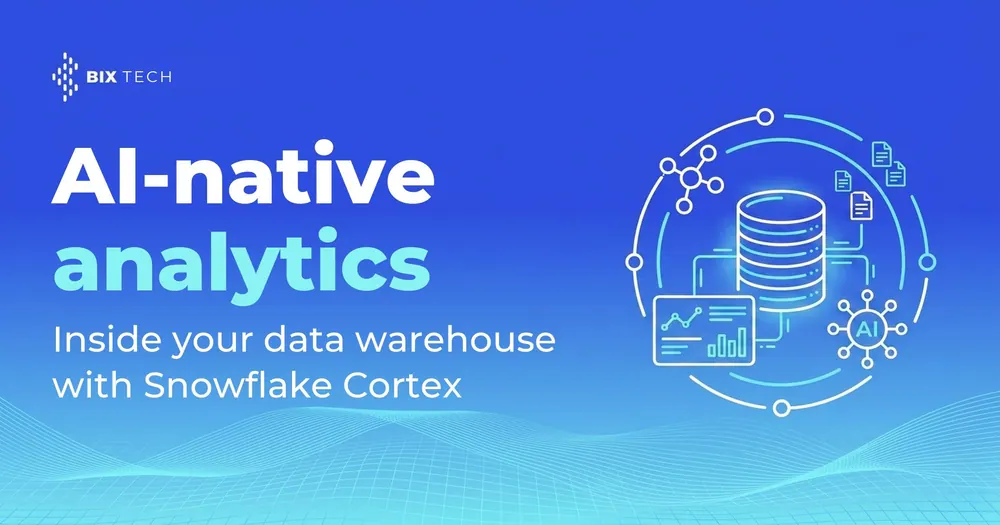
Building AI-native analytics with Snowflake Cortex has moved from a side project to a core part of the data platform itself. For years, putting artificial intelligence on top of an analytics base meant moving the data out: exporting tables, sending them to an external tool, processing, and loading the results back. In 2026, that pattern flipped, and AI now runs where the data already lives, inside the governed data warehouse.
This shift has a name: AI-native analytics. Instead of bringing the data to the model, you bring the model to the data. The practical payoff is direct: less movement, fewer scattered copies, and a smaller risk surface, the same principle behind any sound artificial intelligence strategy inside a company.
This guide walks through what changes with AI-native analytics, how Snowflake Cortex delivers that model inside the warehouse, and what to weigh before adopting it. If you are after the mechanics of AI functions in SQL, it is worth reading how to implement generative AI directly in your SQL tables; here the focus is the analytics layer and the architecture decision.
What AI-native analytics is and why 2026 is the turning point
AI-native analytics is the idea of embedding artificial intelligence features into the analytics platform itself, with no external pipeline. Natural-language questions, semantic search, and text generation happen next to storage and compute, not in a separate service. It is the natural continuation of bringing computation close to the data, the logic behind a lakehouse data architecture.
What made 2026 the turning point was not a single feature, but the maturity of the whole set. Language models are now offered as managed functions, governance followed AI into the perimeter, and data teams gained self-service tools over structured data. That movement lines up directly with the rise of agentic data engineering, where AI steps coordinate over the same base.
For the data team, the difference shows up in the daily routine. An AI analysis request used to become an integration project; now it becomes a query or an assistant over the layer that already exists. That cuts the friction between whoever asks and whoever answers, and gives time back to the work that truly needs data engineering.
How Snowflake Cortex brings AI inside the data warehouse
Snowflake Cortex is Snowflake's set of managed AI features, exposed as native SQL and Python functions that run on the platform's own infrastructure. There is no GPU to provision and no third-party API key to manage, which keeps AI inside the same security boundary as the warehouse, a concern that also drives responsible data privacy in the age of AI.
For analytics, four areas stand out. Cortex Analyst answers natural-language questions over structured data, bringing analysis closer to people who do not write SQL. Cortex Search delivers semantic search and passage retrieval, the foundation for RAG applications. LLM functions cover summarization, translation, classification, and generation. And agents orchestrate several of these steps, a path that connects to broader multi-agent systems.
| Cortex feature | What it solves for analytics | When it fits |
|---|---|---|
| Cortex Analyst | Natural-language questions over tables and metrics | Self-service BI without depending on SQL |
| Cortex Search | Semantic search and context retrieval | Foundation for RAG and assistants over internal docs |
| LLM functions | Summarization, classification, translation, extraction in bulk | Enriching tables and standardizing text at scale |
| Cortex agents | Orchestrating several AI steps | Flows that combine search, analysis, and generation |
The piece that ties it together is the semantic layer. Cortex Analyst depends on a semantic model that describes tables, metrics, and relationships in business language, so a plain-English question turns into the right query. That dependency puts modeling at the center of the project, a topic we go deeper into in the Snowflake Cortex versus Databricks Genie comparison. According to Snowflake's documentation, Cortex features are available in specific regions, so checking availability in your account is the first step.
What to weigh before adopting AI-native analytics with Snowflake Cortex
AI-native analytics with Snowflake Cortex fits well when the data already lives in Snowflake and the team wants to avoid moving it to external platforms. Even so, the decision stays situational: BIX Tech is agnostic, and the ideal platform depends on each operation's architecture, which is why we work with multiple cloud and data solutions, assessing the fit case by case.
Three points deserve attention before scaling. The first is the semantic model, because the quality of natural-language answers depends on how well metrics are described. The second is cost, since the functions consume credits proportional to the volume processed. The third is governance and regional availability, which decide where and how the feature runs, worth confronting alongside the broader platform architecture decision.
| Need | How Cortex answers it | What to watch |
|---|---|---|
| BI in natural language | Cortex Analyst over the semantic model | Invest in modeling before rollout |
| Assistant over documents | Cortex Search with RAG | Curation and permissions of the documents |
| Enrich data at scale | LLM functions in bulk | Estimate credits by token volume |
| Automate analytics flows | Cortex agents | Traceability of each step |
Where to go deeper on Snowflake
If the platform itself is still new to the team, what Snowflake is and what it does covers the components and the pricing model, the Snowflake architecture explained covers the separation between storage and compute that makes elastic scaling possible, and how Snowflake storage, compute, and scaling really work goes a layer below that, into micro-partitions and warehouse sizing, which is where most of the cost decisions actually live.
On Cortex, how to implement generative AI directly over Snowflake tables is the hands-on companion to this article, and Snowflake Cortex vs Databricks Genie compares the two natural-language layers on what they can and cannot answer.
For platform decisions, Databricks vs Snowflake in 2026 and the decisions that affect cost is the comparison most teams need first, and how Databricks and Snowflake work together on one platform covers the case where both already exist and the question is division of labor. Against the other warehouses, the BigQuery, Redshift, and Snowflake buyer’s guide compares all three on one set of criteria, and when to use BigQuery and when to use Snowflake narrows it to the two.
Redshift comparisons split by what you are optimizing for: Amazon Redshift vs Snowflake by use case covers the general decision, Snowflake vs Redshift benchmarks for intensive workloads covers performance under real concurrency, and Snowflake vs Redshift on security and compliance covers the requirements that decide the answer in regulated sectors. If the decision is already made, migrating from Amazon Redshift to Snowflake is the checklist.
For the transformation layer on top, dbt Core in Databricks and Snowflake covers running the same models against either warehouse.
Bringing AI-native analytics inside the warehouse cuts friction, but it does not remove the engineering decisions: modeling, cost, and governance still separate a pilot from a production capability. Snowflake Cortex shortens the technical path, and the real payoff shows up when that AI layer enters a well-designed data architecture. If your company is weighing how to build AI-native analytics without moving data out of the warehouse, our specialists can help structure the best architecture for your context. Talk to our team and move your data maturity forward. ⬇️

FAQ: frequently asked questions
What is AI-native analytics in Snowflake Cortex? It is the practice of running artificial intelligence features inside the analytics platform itself, without moving data out. In Snowflake Cortex, natural-language questions, semantic search, and text generation happen next to storage and compute, which cuts data movement and keeps the warehouse's governance intact.
How do you build AI-native analytics with Snowflake Cortex without leaving the data warehouse? You use managed features such as Cortex Analyst, for natural-language questions over structured data, and Cortex Search, for semantic search. Both run on Snowflake's infrastructure, over a semantic model that describes your metrics, with no data export and no external API to manage.
What is the difference between Cortex Analyst and Cortex LLM functions?
LLM functions like COMPLETE and SUMMARIZE process text in bulk from a prompt. Cortex Analyst is built for analytics: it answers business questions about tables and metrics using a semantic model. One transforms text, the other queries structured data in natural language.
How much does AI-native analytics with Snowflake Cortex cost? Cortex features consume Snowflake credits proportional to the volume processed, according to Snowflake's documentation. There is no separate subscription: the spend rolls into account usage. That is why it is worth estimating volume and designing the semantic model before rolling it out at scale.
Does AI-native analytics replace a traditional BI tool? It depends on the scenario. When the data already lives in Snowflake and the priority is governed self-service, Cortex complements or reduces the dependency on external layers. In other contexts, a dedicated BI tool or a different platform may fit better. The choice is situational and weighs cost, modeling maturity, and the existing architecture.