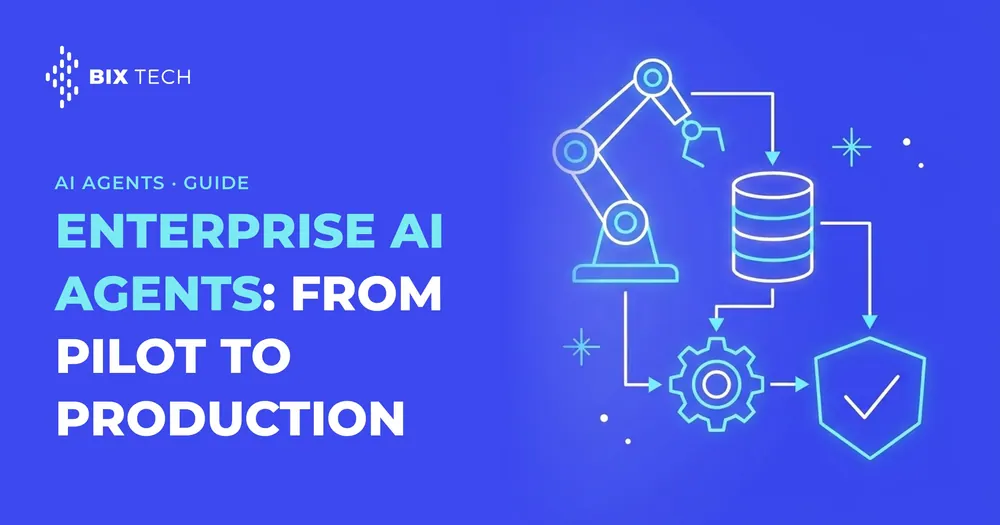
Enterprise AI agents are LLM-based systems that work inside a company's own processes: they read from internal data sources, decide which tool to use next and take actions in business systems, under the same identity, security and audit rules as any other enterprise application. What separates an enterprise agent from a demo is not the model. It is everything around it: scoped access to data, authorization enforced outside the model, evaluation against real cases, observability on every call, a cost per outcome someone is accountable for and a human in the loop where the stakes require one.
Most organizations are still on the demo side of that line. In June 2025, Gartner predicted that over 40 percent of agentic AI projects will be canceled by the end of 2027, citing escalating costs, unclear business value and inadequate risk controls. This guide is for the data, AI and engineering leaders who want to be in the other 60 percent. It covers how to pick the first use case, how much autonomy to give an agent, the architecture layers an enterprise agent needs, governance and security, a 90-day path from pilot to production and how to staff the work.
What makes an AI agent "enterprise"
A useful definition comes from Anthropic's engineering guide on building effective agents. It separates workflows, "systems where LLMs and tools are orchestrated through predefined code paths," from agents, "systems where LLMs dynamically direct their own processes and tool usage." The same guide recommends "finding the simplest solution possible, and only increasing complexity when needed." That advice matters more inside a large company than anywhere else, because every extra degree of freedom is one more thing security, compliance and operations have to sign off on.
It works on enterprise data, with enterprise permissions
The agent reads from the ERP, the data warehouse, the ticketing system, contracts and documents. Each of those sources already has access rules. An enterprise agent inherits them: it acts on behalf of a user or a service identity, and it never sees more than that identity is allowed to see. The mechanics of wiring an agent to databases, APIs and documents are covered in our guide on how AI agents connect to data sources.
It is accountable
Every action the agent takes can be traced to a request, a user, the data it read and the reasoning it produced. When a finance controller asks why a purchase order was flagged, someone can answer.
It is measured against a business outcome
A support agent is measured by tickets resolved without escalation, a procurement agent by contracts reviewed or savings identified. Token counts and response time are operating metrics, not the goal.
It is owned after launch
Models change, prompts drift, source systems get new fields. An agent in production needs a team that monitors it, evaluates it and improves it month after month, the same way an internal application does.
Choosing the first use case
Gartner's guidance on the same prediction is blunt: pursue agentic AI only where it delivers clear value or ROI, and focus on enterprise productivity rather than individual task augmentation. Gartner also warns about "agent washing," estimating that only about 130 of the thousands of vendors that call their products agentic actually offer agentic features. Both points push in the same direction: pick the use case before the product.
- A decision in the middle of the process. If every step is predictable, a workflow or a rules engine is cheaper and safer. Agents earn their cost when the next step depends on what the data shows.
- A clear success measure. Tickets resolved, documents processed correctly, discrepancies found, hours saved per analyst. Write it down before building.
- Data that already exists and is reachable. If the agent needs data nobody has integrated yet, the project is a data engineering project first.
- Bounded consequences. The first agent should recommend, draft or flag before it is allowed to execute. A wrong answer should be caught by a person, not by a customer.
- An owner in the business. Someone who will review outputs during the pilot and decide whether the agent goes live.
Processes that fit this profile are common in operations, finance, procurement, customer support and internal knowledge work: reconciling contracts against operational data, triaging and drafting replies to support tickets, answering questions over policy and technical documentation, or preparing a first pass of a monthly review for an analyst to check.
How much autonomy to give the agent
Autonomy is a design decision, not a property of the model. The same use case can be built with very different levels of freedom, and the right level depends on how predictable the task is and how expensive a mistake would be.
- How it works
- Fixed code path; the model classifies, extracts or drafts one step
- Fits when
- The steps are known in advance and rarely change
- Watch for
- Forcing exceptions into a rigid flow
- How it works
- The agent plans and calls read tools freely; actions that change data wait for a person
- Fits when
- The path varies by case, but the cost of a wrong action is high
- Watch for
- Approval queues that nobody owns
- How it works
- The agent plans, reads and acts within scoped tools and limits
- Fits when
- Actions are reversible, low impact and well evaluated
- Watch for
- Silent loops, runaway cost and permission creep
Most enterprise programs start in the middle and move individual actions to the right only after the evaluation data supports it.
The middle option is where most enterprise AI agents should start. The agent does the heavy lifting of reading, cross-referencing and proposing, and a person approves the actions that write to a system of record. As evaluation results build confidence, specific low-risk actions can be released from approval one at a time, which is far easier to defend to an audit committee than a single switch from "pilot" to "fully autonomous."
The architecture of an enterprise AI agent
The model is one layer out of six. Teams that treat it as the whole system end up with a convincing demo and a long list of blockers from security and operations.
- Interface and identityWho is asking, and on whose behalf will the agent act?Chat, ticketing or workflow entry points; SSO; user or service identity passed through
- OrchestrationHow does the agent plan, loop and stop?Agent framework, step limits, retries, approval checkpoints, state
- ModelsWhich model handles each step?Routing between larger and smaller models, fallbacks, structured outputs
- Tools and connectorsWhat can the agent read and change?Narrow, typed tools over APIs and databases; MCP servers; authorization in the target system
- Data and contextWhat does the agent know about the business?Warehouse and operational data, document retrieval, semantic layer, memory
- Observability and evaluationIs it right, and what did it cost?Traces of every call, evaluation sets, quality and cost per task, alerts
Tools and connectors
The tool layer is where enterprise agents succeed or fail. The Model Context Protocol describes itself as "an open-source standard for connecting AI applications to external systems," and it has become a common way to expose data sources and actions to agents without writing a custom integration for every model and client. A standard protocol does not remove the design work, though. Each tool should do one thing, take typed parameters and return only what the agent needs. A tool called get_open_invoices(customer_id) is easy to secure and to test. A tool that runs arbitrary SQL is neither.
Data and context
Agents are only as good as the context they receive. If definitions of revenue, customer or active contract differ between systems, the agent will reproduce the inconsistency at speed. A governed semantic layer or a curated set of views gives the agent the same definitions the business uses in its reports, and it is usually the most valuable investment in the whole project.
Observability and evaluation
Every model call, tool call and decision should be traced with the user, the inputs, the outputs, the latency and the token cost. On top of the traces, an evaluation set of real cases with known correct answers lets the team test each change to prompts, models or tools before it reaches users. Observability is also what makes cost control possible: our guide to AI FinOps and how to reduce LLM costs covers routing, caching and cost per outcome in detail.
Governance and security for enterprise AI agents
The OWASP GenAI Security Project lists Excessive Agency among the top risks for LLM applications: a system that can take damaging actions in response to flawed model output, whether the trigger is a hallucination or a prompt injection. OWASP traces it to three root causes, excessive functionality, excessive permissions and excessive autonomy, and each maps to a design choice in the architecture above.
- Least privilege per tool. Read-only credentials by default; write access only for the specific actions the use case needs, scoped to the user's own permissions.
- Human approval for high-impact actions. Payments, contract changes, customer communications and anything irreversible wait for a person during the pilot, and often after it.
- Limits that stop runaway behavior. Maximum steps per task, maximum spend per task and per day, rate limits on each tool.
- Full audit trail. Traces kept as long as the business process requires, linked to the user and the request.
- Input and output checks. Treat retrieved documents and tool outputs as untrusted input, and validate structured outputs before they reach another system.
- A risk framework the company already speaks. NIST's AI Risk Management Framework, released in January 2023, with a Generative AI profile added in July 2024, gives risk and compliance teams a shared vocabulary for mapping, measuring and managing these systems.
None of this needs to be built before the first line of agent code, but all of it needs to exist before the agent is allowed to act on production systems.
From pilot to production in 90 days
The gap between a pilot and production is rarely the agent's reasoning. It is integration, evaluation, security review and the operating routine around the agent. A 90-day plan that treats those as first-class work looks like this.
- Days 1 to 30Scope and prove
Pick one process and one success measure. Map the data sources and the actions involved, build read-only tools and a first agent that recommends but does not act. Assemble an evaluation set of real cases with the business owner, and turn on tracing from the first call.
- Days 31 to 60Harden
Add the write tools behind human approval, enforce authorization in the target systems and set step and spend limits. Run the evaluation set on every change, route simple steps to smaller models and pass the security review with the traces as evidence.
- Days 61 to 90Launch and operate
Release to a first group of users, review a sample of outputs every week and publish quality and cost per task. Agree who owns the agent, how incidents are handled and which action is the next candidate for less supervision.
The evaluation set is the asset that keeps paying back. It is what lets the team switch models when prices change, refactor prompts without fear and show the business owner that quality is stable or improving.
What this looks like in practice
For an industrial company with seven plants, BIX Tech built an AI-powered operational intelligence platform where agentic AI cross-references service contracts with operational data across all seven facilities at once. The platform identified an estimated 15 percent in savings in the analyzed services, with no cuts to service scope or quality. The agent did the cross-referencing that would have taken analysts weeks; people decided what to renegotiate.
At Grupo Soma, a retail group, the challenge was the next stage: operating agents that were already in use. On IAzzas, the company's AI assistant built on agents and MCP servers, the LLM cost and observability project put LangFuse observability on 100 percent of the MCP servers and introduced LLM routing, cutting token consumption and LLM costs by more than 70 percent while giving the team visibility into the conversational accuracy of the model and the MCPs.
Common mistakes to avoid
Who builds and runs enterprise AI agents
An enterprise agent needs a mix of skills that rarely sits in one internal team: an AI engineer for orchestration, models and evaluation; a data engineer who knows the sources and can build the context layer; a backend engineer for tools, identity and integration; and a product-minded lead who works with the business owner on the success measure. The work does not stop at launch, so the team needs to stay with the agent long enough to operate and improve it.
For many US companies, the internal data and platform teams are already stretched thin, and hiring four senior specialists for a single initiative takes months. A common pattern is a small external squad that builds the first agents alongside the internal team, then keeps running and evolving them while the company decides how much of that capability to bring in-house. The point of the arrangement is continuity: the people who built the evaluation set and the tools are the ones who adjust them when a model or a source system changes.
At BIX Tech, enterprise AI agents are part of our generative AI and agent development work, from use case selection and data integration to evaluation, observability and cost control. It usually runs as a dedicated squad of senior engineers in Brazil, with working hours that overlap US time zones, alongside your team month after month, so the agents keep improving after the pilot instead of stalling there.
FAQ
What are enterprise AI agents? Enterprise AI agents are LLM-based systems that work on a company's own data and processes, deciding which tools to use and taking actions in business systems. They differ from consumer assistants in their requirements: enterprise identity and permissions, audit trails, evaluation against business outcomes and an owner after launch. The model is one component; data access, security and observability make up most of the system.
How do enterprise AI agents differ from workflows and RPA? Workflows and RPA follow a fixed path defined in advance, which makes them cheaper and more predictable for repetitive tasks. Agents decide the next step based on what they read, which suits processes with exceptions and judgment calls. Many good solutions combine both: a fixed workflow with an agent handling only the step that needs reasoning.
How long does it take to put an enterprise AI agent in production? A focused first use case can go from scoping to a supervised production release in about 90 days, if the data it needs is reachable. The timeline grows when the project first has to integrate data sources or settle conflicting business definitions. Security review and evaluation should run in parallel with development rather than at the end.
How do you keep AI agents secure? Give each tool the minimum permissions it needs, enforce authorization in the systems the agent calls rather than in the prompt, and require human approval for high-impact or irreversible actions. Add step and spend limits, trace every call and treat retrieved content as untrusted input. The OWASP guidance on Excessive Agency is a good checklist for the design review.
How do you measure the ROI of enterprise AI agents? Define the business measure before building, such as tickets resolved, documents processed correctly or savings identified, and compare it with the baseline process. Track cost per completed task, including failed runs and retries, alongside quality from an evaluation set. That pairing shows whether the agent is worth scaling and where to optimize.