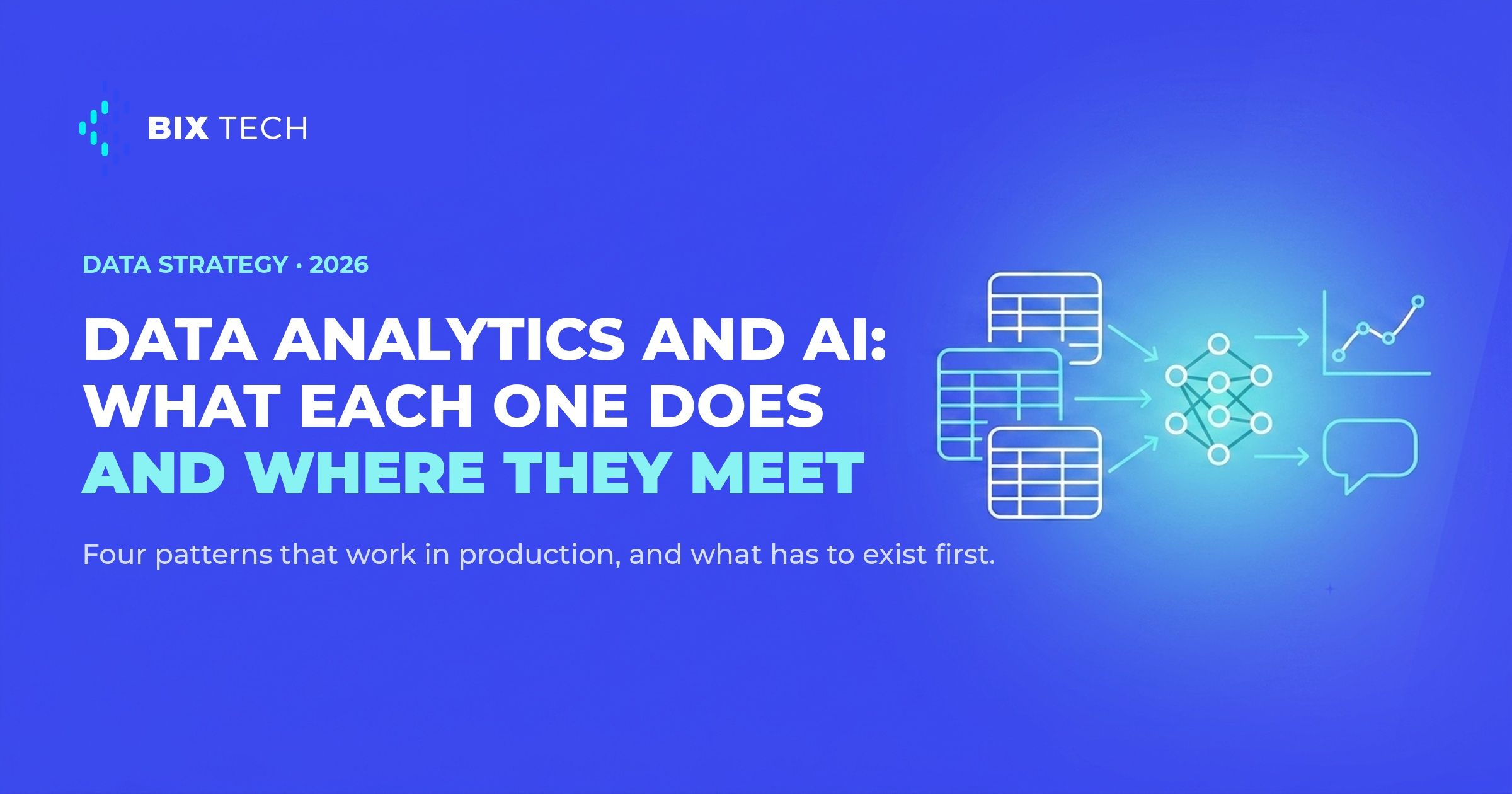
Data analytics and AI answer different questions from the same tables. Analytics explains what already happened and why, working from data the company has already collected. AI learns a pattern from that data and produces something new from it: a forecast, a classification, a routing decision, a written answer. Vendor decks blur the two, and that is where most disappointing projects begin.
The confusion carries a real cost. A company that buys an AI product expecting it to explain last quarter's margin drop receives a plausible sentence with no accounting behind it. A company that reviews dashboards expecting them to predict next quarter's demand receives a trend line and an educated guess. Each team concludes the technology underdelivered, while the actual failure sat in the question they asked of it.
The useful way to think about the relationship is as a supply chain rather than a rivalry. Analytics produces the modeled, tested, defined data that a model needs as input. The model returns predictions and generated text that flow back into reporting, alerting and self-service. Break the first half and the second half degrades quietly, which is the most common way an AI initiative fails without anyone declaring it failed.
What data analytics and AI each actually do
The two disciplines share tooling, and increasingly share a platform, so the distinction has to come from the work itself.
Data analytics: accounting for what happened
Analytics is descriptive and diagnostic. It takes recorded events, joins them into a coherent model of the business, aggregates them into metrics, and explains movement in those metrics. Revenue fell four percent; the analyst traces it to one region, one product line, two lost accounts. Every number is traceable to rows in a table, which is what makes it defensible in a board meeting.
That traceability is the property analytics is optimized for. A metric has a definition, a lineage and an owner. When someone disputes it, the answer is a query. This is also why analytics work looks so unglamorous: most of it is modeling, reconciliation and testing, because the output is only as trustworthy as the joins underneath it.
AI: learning a function and acting on it
AI, in the sense that matters for a data team, means fitting a function from historical examples and applying it to new cases. A demand model learns from three years of orders and estimates next month. Feed a classifier enough labeled tickets and it routes new ones on its own. Language models learn from text and produce text, including SQL, summaries and explanations.
The output is a probability or a generated artifact, not an accounting entry. It generalizes to cases nobody has seen, which analytics cannot do, and it carries uncertainty that a SUM never carries. Understanding both properties at once is what separates a team that ships models from a team that ships demos. If the distinction between these disciplines and the wider field is still fuzzy, our explainer on data science draws the boundaries in more detail.
Where data analytics and AI meet
Going from analytics into AI, the model consumes what the analytics layer produced. Features are columns someone modeled. Labels are outcomes someone defined and recorded consistently. Training windows depend on history that was captured without gaps. Snowflake's documentation for its forecasting function is blunt about the dependency, noting that the more consistent your data is, the more accurate your forecasting model will be, and shipping preprocessing specifically to interpolate missing time steps and aggregate duplicates. A forecast on a table with irregular timestamps returns a number. The number is just wrong in a way no error message reports.
Going from AI back into analytics, the model becomes a new input to reporting. Forecasts appear alongside actuals. Anomaly scores drive alerts. A language interface lets someone ask a question without writing SQL. Here the prerequisite is semantic: the model needs to know what "revenue" means in this company, which table holds it, and which filters are always applied. That is the job of a semantic layer, and its absence is the single most common reason natural-language querying produces confident nonsense.
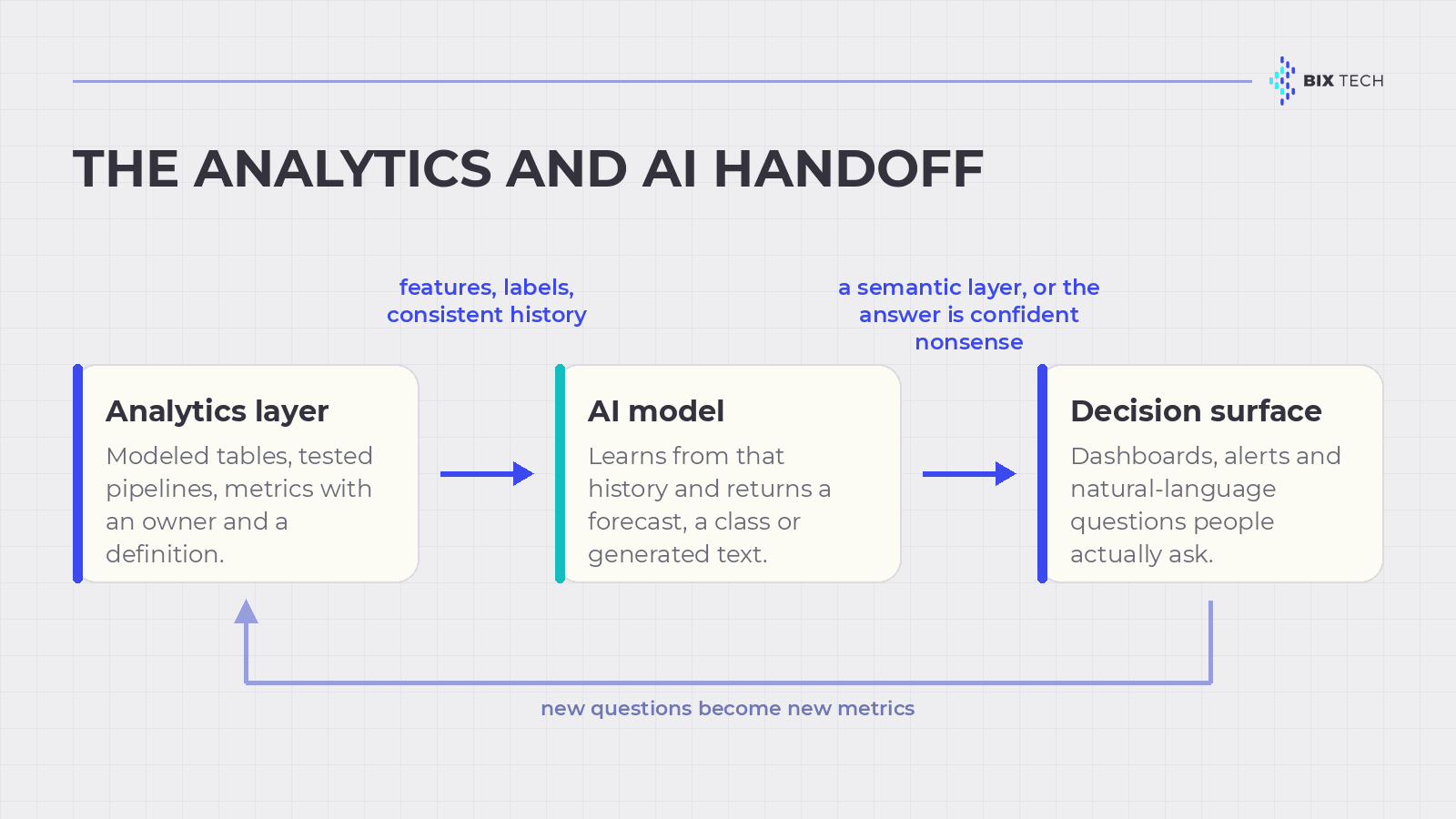
The handoff between data analytics and AI runs in both directions, and each direction has a prerequisite that projects tend to skip.
Both platforms are explicit about this. Cortex Analyst states that it uses semantic views to understand your data and generate accurate SQL, defining logical tables, dimensions, facts, metrics and relationships. Databricks Genie grounds every answer in organizational data governed through Unity Catalog, and its documentation describes adding metrics, business rules and verified answers to improve response quality. Databricks also documents agent metadata inside metric views specifically to improve agent accuracy. Neither product treats the semantics as optional, and neither generates them for you.
Four patterns that work in production
Forecasting on top of a modeled warehouse. A time series of a governed metric feeds a forecasting function, and the output lands next to actuals in the same dashboard. This is the cheapest useful pattern because the platform ships the model, so the entire effort goes into the series itself. Our guide to predictive analytics covers how to frame the question before touching a model.
Anomaly detection as data quality monitoring. Instead of asserting thresholds by hand, a model learns the normal shape of volume, freshness and distribution, then flags departures. It catches the failures nobody thought to write a test for. It also generates false positives during genuine business change, so it works as a complement to explicit data quality assertions rather than a replacement for them.
Natural-language querying over a semantic layer. A business user asks a question in plain English and receives a governed answer. The value is real and the prerequisite is heavy: entities, metrics, relationships and sample values all have to be defined and maintained. dbt's MetricFlow exists for exactly this reason, letting teams define metric logic once and commit it to version control so the definition is reviewable rather than reinvented per analyst.
Document AI turning unstructured input into analyzable rows. Invoices, contracts and scanned forms become columns a warehouse can aggregate. This pattern expands what analytics can cover at all, since the data was previously unqueryable. Extraction quality varies by document type and needs a review path for low-confidence fields, which our walkthrough on how to turn scanned PDFs into structured data treats as part of the pipeline rather than an afterthought.
| Pattern | What it produces | What must already exist | Where it breaks |
|---|---|---|---|
| Forecasting on a modeled warehouse | Forward estimate beside actuals | Clean time series, consistent grain, defined metric | Irregular or gapped timestamps produce a confident wrong number |
| Anomaly detection for data quality | Alerts on abnormal volume, freshness, distribution | Enough history to learn normal behavior | Real business change reads as an anomaly |
| Natural-language querying | Governed answer without SQL | Semantic model: entities, metrics, relationships, sample values | Undefined or ambiguous metrics yield plausible wrong SQL |
| Document extraction to rows | Structured columns from unstructured files | Consistent document types, review path for low confidence | Layout variation and handwriting degrade accuracy silently |
Where one does not replace the other
AI is weak at exactly what analytics is built for. Attribution needs a defensible chain from a number back to the rows that produced it, and a generated explanation cannot supply that chain. Causality needs an experiment or a valid design, and a correlation learned from history stays a correlation regardless of model size. Governed metrics need one definition the finance team signs off on, which is a matter of organizational agreement rather than inference.
Snowflake states the boundary plainly in the Cortex Analyst limitations: the service answers questions resolvable with SQL and does not generate insights for broader business questions such as "what trends do you observe?". That line is worth reading twice before scoping a project, because the gap between those two things is where expectations usually go wrong.
Analytics has the mirror-image weakness. It cannot generalize to a case it has no rows for, cannot rank ten thousand items by likelihood, cannot read a contract. Asking a dashboard to do those jobs wastes the same money in the other direction.
What has to exist before you combine them
Four foundations decide whether a combined project survives contact with production, and none of them are AI work.
Data quality comes first, because a model trained on inconsistent history encodes the inconsistency and then applies it at scale. Semantic definitions come second, since any interface that translates language into a query needs to know what the words mean in your business. Governance comes third: lineage, access control and an audit trail, so an answer can be traced and a permission boundary actually holds. Operational discipline comes fourth, covering versioning, monitoring for drift and a rollback path, because a model that degrades quietly is worse than one that fails loudly.
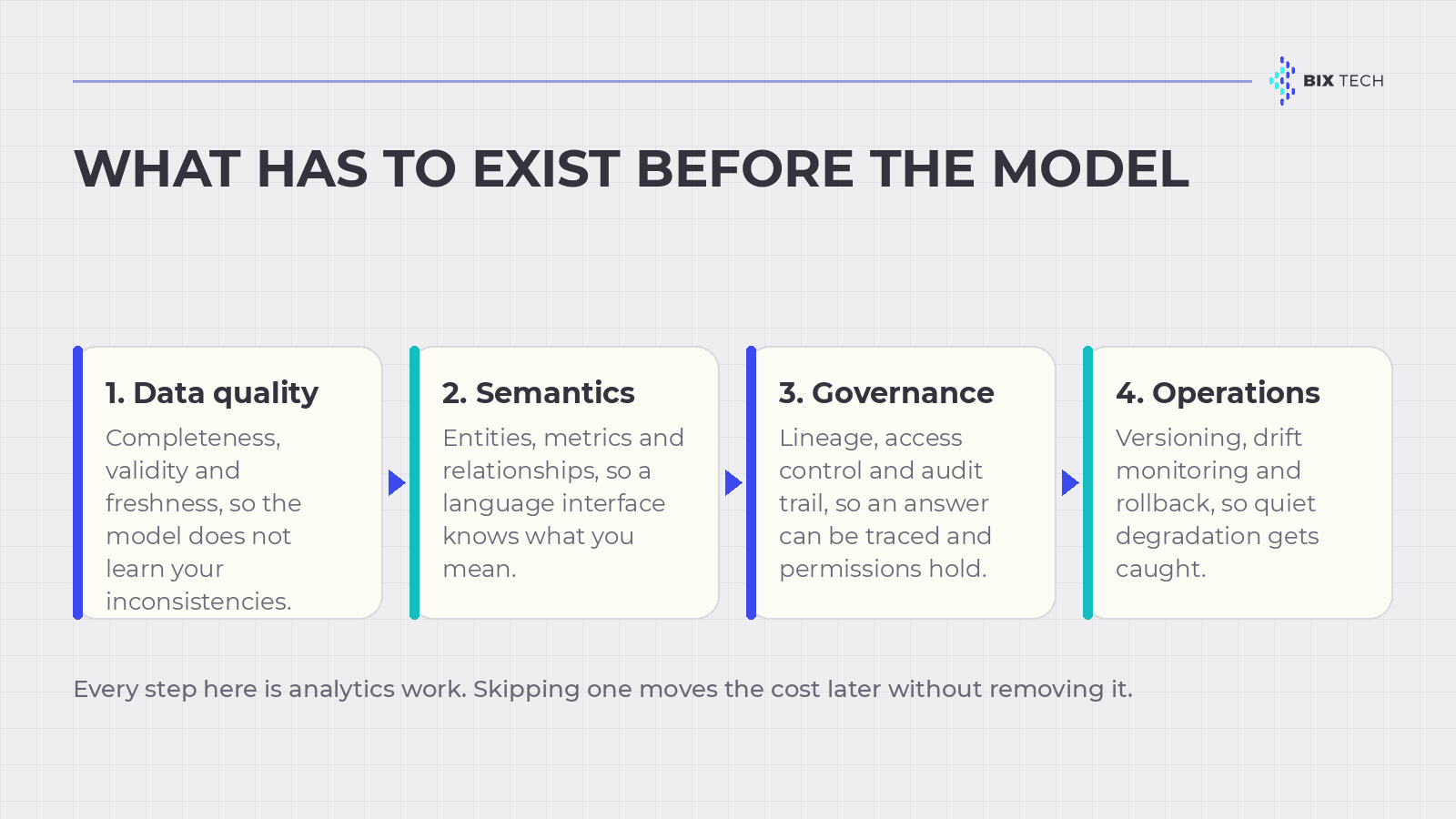
The four foundations in order. Every one of them is analytics work, which is why skipping them moves the cost later instead of removing it.
Teams that already run a tested pipeline and a governed metric layer tend to add AI capability in weeks. Teams that skip to the model spend the same weeks discovering their data was never ready, then rebuild the foundation anyway. BIX Tech works across Snowflake, Databricks, Microsoft and open-source stacks, and this sequence holds regardless of which platform is underneath.
Where to go deeper
How do I get the data foundation right? Start with the modeling layer: what a logical data model is explains the blueprint that everything downstream depends on. From there, dbt semantic models shows how to build a metrics layer an AI agent can query without guessing, and decentralized data governance covers keeping definitions consistent when several teams own their own data.
How does AI plug into existing analytics? AI business intelligence walks through using language models to turn dashboards into decision tools, and creating an AI copilot for data teams covers the path from a natural-language question to an answer people trust. On specific platforms, Snowflake Cortex and Databricks show how each vendor wires AI into the warehouse itself.
How do I keep it trustworthy once it runs? MLOps reference architecture covers deployment and drift monitoring, explainable AI addresses making a prediction auditable, and LLM governance deals with controlling language-model behavior at enterprise scale. For decision systems that update themselves as conditions change, adaptive AI covers the architecture and the risks. For the enterprise-wide view, enterprise AI in 2026 covers where it pays off first and the constraints that decide whether a project reaches production.
Data analytics and AI are not competing answers to the same question. Analytics establishes what is true about the business, and AI extends that foundation into prediction, classification and language. Every serious combination of the two rests on the same unglamorous groundwork: modeled data, defined metrics, enforced governance, monitored pipelines. Get that right and the AI layer becomes straightforward. Skip it and no model will compensate.
That groundwork has a concrete definition on the AI side too, and the pillars and self-assessment checklist that show whether a dataset can support real models are covered in what AI-ready data actually means.
If your company is planning to layer AI onto an existing analytics stack, or trying to understand why a pilot never reached production, our specialists can help you assess the foundation and sequence the work. Talk to our team and move your data maturity forward. ⬇️

What is the relationship between data analytics and AI?
Data analytics explains what already happened using data a company has collected, while AI learns patterns from that same data to predict, classify or generate something new. Analytics supplies the modeled, tested inputs a model needs, and the model returns forecasts and generated answers that flow back into reporting. The relationship is sequential, not competitive.
Is AI replacing data analytics?
No. AI cannot supply what analytics exists to provide: a defensible chain from a number back to the rows that produced it, one governed metric definition the business agrees on, and causal reasoning grounded in experiment design. Snowflake's Cortex Analyst documentation states directly that it answers questions resolvable with SQL and does not generate insights for broader business questions.
What do you need before combining data analytics and AI?
Four things, in order: data quality, so a model does not encode existing inconsistency; semantic definitions, so any language interface knows what your metrics mean; governance covering lineage, access control and audit trail; and operational discipline for versioning, drift monitoring and rollback. Skipping these is the most common reason an AI pilot never reaches production.
Why does natural-language querying give wrong answers?
Almost always because the semantic layer is missing or incomplete. A language model translating a question into SQL needs defined entities, metrics, relationships and sample values to pick the right table and filters. Without them it produces syntactically valid SQL against the wrong columns, and the answer looks confident. Both Snowflake and Databricks require a semantic model for this reason.
How do you start combining analytics and AI without a large project?
Begin with forecasting on a metric you already govern. The platform supplies the model, so the work goes into the time series itself, and the output lands beside actuals where people already look. It validates whether your data foundation holds before you commit to anything requiring labeled training data or a full semantic model.