Enterprise AI in 2026 no longer has an adoption problem. Stanford's AI Index reports that 88% of organizations now use AI in at least one part of the business, and generative AI shows up in at least one business function at 70% of them. The unresolved problem is financial. McKinsey's State of AI 2026, fielded in May and June with 1,719 respondents, found that 37% attribute at least some EBIT impact to AI, essentially the same share as the year before, while the group reporting 5% or more of EBIT from AI holds steady at 6% of respondents.
That gap is the whole story of the year. Spending kept climbing, deployments spread across more functions, and the share of companies converting any of it into margin stayed flat. According to McKinsey, what separates the top cohort tracks workflow redesign far more closely than budget: high performers are 2.8 times more likely to say they rebuilt the process itself instead of layering a model on top of the old one.
So the useful question is no longer whether to invest. It is which work survives contact with production, what the 2026 constraints actually cost, and which compliance dates are already binding.
What enterprise AI means in 2026
Enterprise AI is the application of artificial intelligence inside large, complex organizations, where three requirements dominate every technical choice: scale, because the system touches millions of transactions and petabytes of history; governance, because compliance, privacy and model risk are auditable obligations; and interoperability, because nothing runs in isolation from the ERP, the warehouse and a decade of legacy integrations. The stack blends classical machine learning, natural language processing, computer vision and language models, and under those constraints the hard part sits in the integration rather than the model.
Three things genuinely changed since 2025. The first is price. Stanford's AI Index, drawing on Epoch AI's tracking, records the cost of querying at GPT-3.5-level quality falling from about $20 to $0.07 per million tokens in roughly 18 months, with median declines near 50x per year across benchmarks. Inference stopped being the line item that decides feasibility, which moved the cost question to retrieval infrastructure, evaluation, human review and observability.
The second is agents. McKinsey found 62% of organizations at least experimenting with AI agents and only 23% scaling them in even one business function, while the AI Index puts actual agent deployment in the single digits across nearly every function. Gartner expects more than 40% of agentic AI projects to be canceled by the end of 2027, citing escalating costs, unclear value and inadequate risk controls. An agent that can act needs an identity, a scope and an owner before it needs a better prompt.
The third is regulation with dates attached, covered further below. Together these shifts explain why the practical work moved from choosing models to engineering the conditions under which a model is allowed to operate. If your team is still settling how prediction and reporting relate, the groundwork in what data analytics and AI each actually do comes first, and modern data architecture for business leaders covers the platform decisions underneath.
Where enterprise AI pays off first, and how to tell before you build
A use case is worth building when four things are true at once: a named business owner, a decision that repeats often enough to matter, data that already exists with access rules already settled, and a unit of work you can count before and after. Miss the fourth and the pilot ends in a debate about whether it worked, which is the most common way a promising project dies quietly.
The table below is the triage we use to sequence a portfolio, comparing families of use cases by what has to exist before the first line of code, how much human judgment stays in the loop, and what you measure.
| Use case family | What has to exist first | Human in the loop | What you measure | Realistic time to first value |
|---|---|---|---|---|
| Document extraction (invoices, contracts, claims) | A sample of the same form type, plus a field-level confidence threshold | Review queue for anything under the threshold | Straight-through rate, cost per document, correction rate | 4 to 8 weeks |
| Internal knowledge retrieval | Permissioned content, a freshness policy, an evaluation set of real questions | Person reads the answer and its citations | Answer accuracy on the eval set, deflection, time to answer | 6 to 10 weeks |
| Forecasting (demand, churn, cash) | Clean history and a backtest window that respects seasonality | Planner approves or overrides the number | Forecast error, inventory turns, plan adherence | 8 to 12 weeks |
| Assisted support and sales | Transcripts, an intent taxonomy, CRM write access | Agent decides, model suggests | Handle time, first-contact resolution, conversion | 6 to 10 weeks |
| Autonomous multi-step action in regulated flows | Identity per agent, scoped permissions, complete audit trail | Approval gate per consequential action | Blocked versus allowed actions, incident rate, rework | Longest; build the gate before the agent |
Document extraction earns the top row for a specific technical reason. Custom extraction models return a per-field confidence score, so you can set a threshold and split the flow: above it, straight-through processing; below it, a person reviews. A language model that hands back a JSON object gives you no per-field score to threshold, so it can be more accurate on average while leaving you unable to say which document deserves a second look. Production approval depends on the fields you can catch, and averages do not build a review queue.
Retrieval sits second because it fails in a way that looks like success: weak retrieval produces a fluent, confident, wrong answer, and nobody notices until a decision goes bad. The patterns that hold up in practice, with how to evaluate them, are in RAG in production in 2026. If the foundation itself is still in question, this readiness guide for leaders is the cheaper first step.
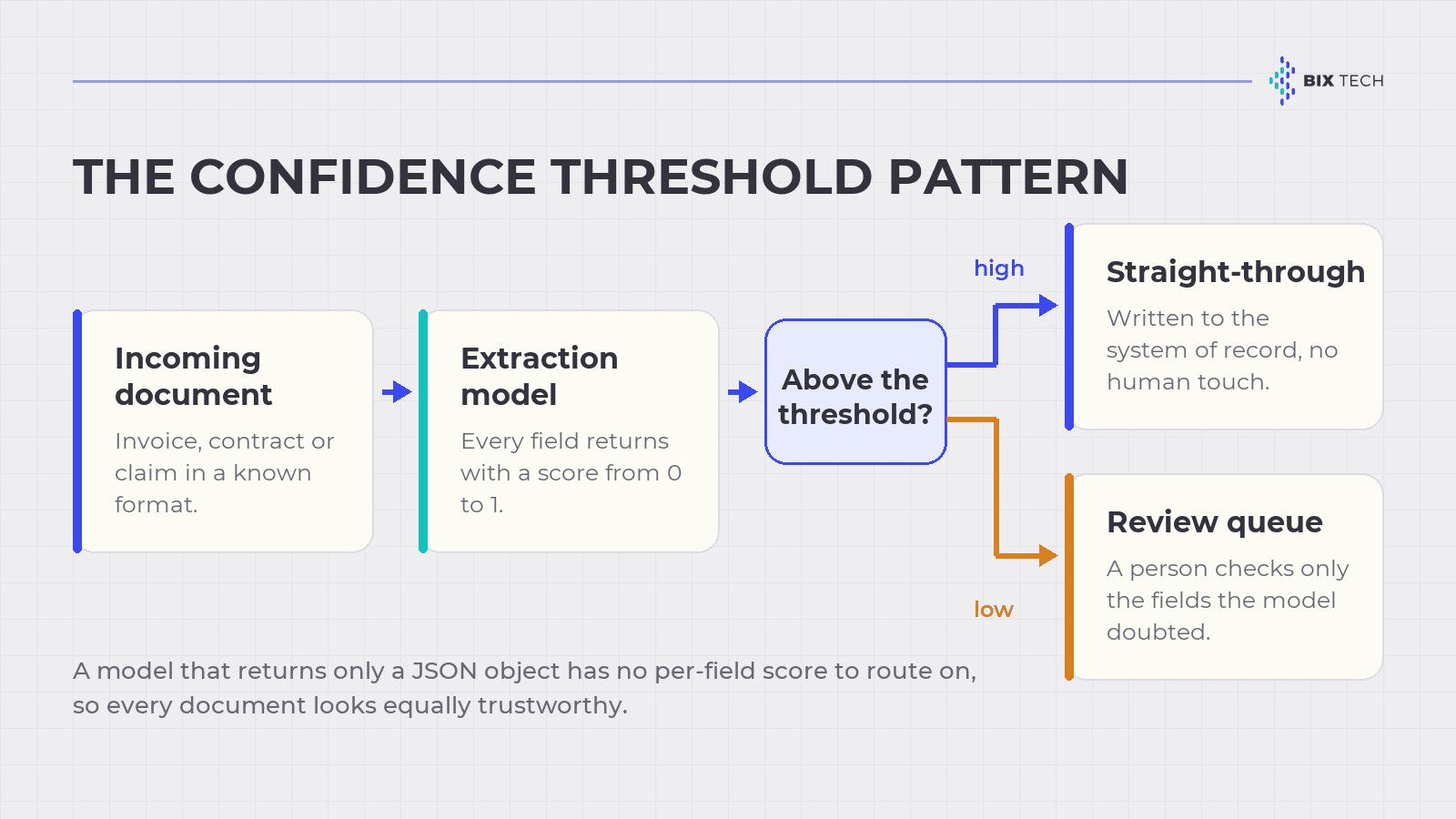
The pattern that makes extraction approvable: a field-level threshold that routes low-confidence output to a review queue instead of into the system of record.
The three constraints that decide whether enterprise AI ships
Once a use case clears triage, three constraints tend to decide its fate, and none of them is model quality. Cost behaves differently than it did a year ago, agents force an identity problem that pilots never faced, and nothing reaches production without evidence that it works on cases you did not cherry-pick.
Cost moved from the model to the workflow
With inference prices where they are, the model is rarely the expensive part. The real total cost of ownership sits in vector storage and its refresh, evaluation runs on every change, the human review capacity your confidence threshold implies, observability, and the engineering time to keep integrations alive. Therefore the metric that matters is cost per resolved case, not cost per thousand tokens, because the first one includes the human minutes the design forces you to spend.
The levers are ordinary engineering. Cache the parts of a prompt that repeat, route easy requests to a smaller model and reserve the large one for the hard tail, batch anything that is not interactive, and keep context lean rather than stuffing every document into the window. Track utilization per use case so a stalled pilot stops billing. Operationally this belongs with the rest of the model lifecycle, which is what the MLOps reference architecture is for.
Every agent needs an identity and a human sponsor
This is the constraint most 2025 pilots did not anticipate. When software acts on its own behalf, service accounts and shared API keys stop being defensible, because you cannot answer who authorized an action after the fact. Microsoft's agent identity governance documentation shows where the platforms landed: agent identities are accounts inside Entra ID, each with a human sponsor accountable for lifecycle and access decisions, access granted through packages that carry expiry dates and approval cycles, Conditional Access applied at the blueprint level so every agent created from it inherits the policy, and sponsorship transferred automatically to the sponsor's manager when someone leaves.
Read that as a design brief rather than a product pitch. Whatever platform you run, an agent in production needs a unique identity, permissions scoped to the task and nothing wider, an access grant that expires by default, and a named person who answers for it. Gartner warns that applying one uniform governance policy to every agent regardless of autonomy leads to failure, because it collapses the difference between what an agent can do and how far its access reaches, and it expects 40% of enterprises to demote or decommission agents by 2027 over gaps found only after a production incident. Guidance for the control layer above this is in implementing guardrails for enterprise AI, and the pipeline side of agent work is in agentic data engineering.
Evidence, because trust is not a control
Nothing goes to production on the strength of a demo. Each use case needs a versioned evaluation set built from real cases with known answers, a regression run on every prompt, model or retrieval change, and logging that stores each output with its sources and decision path. Drift monitoring belongs here too, since the population of documents and questions moves even when the model does not.
Verification tooling matured in the same direction. AWS documents automated reasoning checks in Bedrock Guardrails as mathematical validation of natural-language output against policies you define, aimed at rule-heavy domains such as eligibility, lending and claims, and the documentation is explicit that the checks run in detect mode only, returning findings and explanations rather than blocking content. That distinction shapes the workflow: a detector tells you where to put a human, and it never removes the need for one. Azure's equivalent layer is covered in Azure AI Foundry.
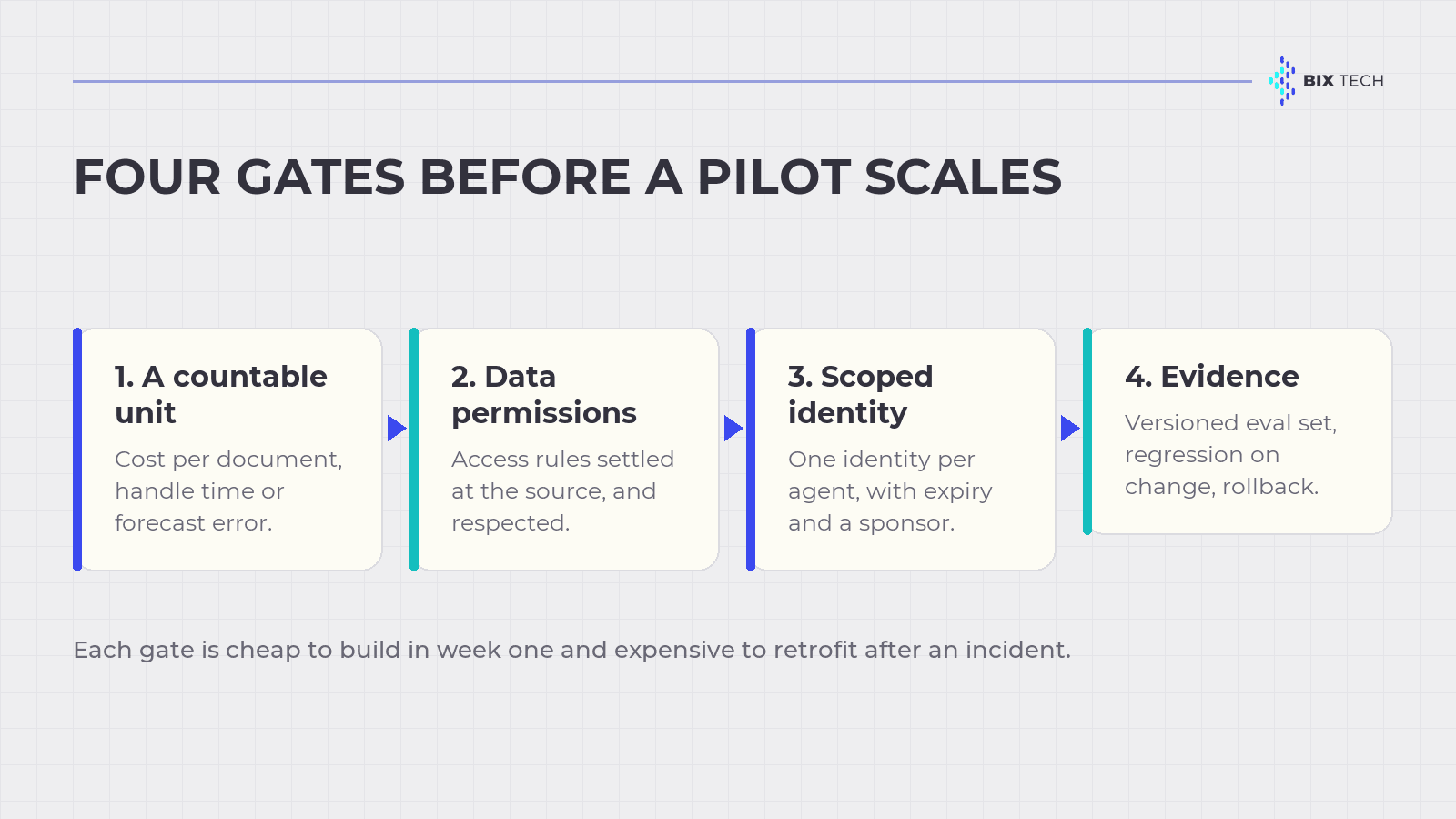
Four gates worth enforcing before scale. Each one is cheap to build early and expensive to retrofit after an incident.
Governance and the compliance calendar you can no longer postpone
Enterprise AI governance stopped being a policy document in 2026 and became a set of dates. From 2 August 2026, according to the European Commission, the AI Office and national authorities began enforcing the AI Act, and the Article 50 transparency obligations started to apply: interactive systems have to tell people they are dealing with AI, deepfakes have to be labeled, and AI-generated or altered content has to carry machine-readable marks so it can be detected downstream. The Commission's own announcement of the 2 August enforcement date is the reference to give your legal team.
The high-risk obligations moved, and they did not disappear. The Digital Omnibus on AI, in force since late July 2026, deferred compliance for standalone high-risk systems under Annex III to December 2027, and for AI embedded in products already covered by EU product-safety law to August 2028. For anyone building in HR, credit, insurance, education or critical infrastructure, that buys engineering time rather than a reprieve, and the documentation those obligations demand is the same documentation your own auditors will ask for.
On the standards side, ISO/IEC 42001, published in December 2023, is the international standard for an AI management system, and it has become the artifact enterprise procurement asks about. Certification comes from an accredited body and is maintained through surveillance audits, which is why vendors selling to regulated buyers now treat it as a sales prerequisite. Its overlap with the AI Act is high, since both want an inventory, an owner per system, documented risk assessment and evidence that the controls actually run.
The first 90 days, if you are starting now
Sequencing matters more than tooling, so this is the order that tends to hold. The first two weeks go to picking two or three use cases from the triage table, naming owners, defining the unit you will count, and inventorying every model, prompt and agent already running in the business, which is almost always more than anyone expects. Weeks 3 and 4 build the minimum stack: permissioned data access, retrieval where it is needed, an evaluation harness, and the identity model for anything that will act on its own.
Then come four weeks of building with production patterns from the first commit, meaning logging, thresholds, review queues and rollback instead of a notebook. Put real users in front of it in weeks 9 and 10 and measure accuracy, latency and workflow fit, including how often people override the system and why. The last two weeks roll out to a limited audience, train the teams whose work changed, and decide with data whether the second use case gets funded. Governance runs in parallel the whole time, and the reasoning behind that is laid out in enterprise AI governance, while the privacy controls underneath it are in data privacy in the age of AI.
Vendor selection deliberately comes last, because every major platform now covers the same capability list on paper and the differences that matter only show up against your residency rules, your identity provider, your latency budget and your team's existing skills. We work across the main clouds, warehouses and model providers precisely because that answer changes per operation, and a leadership-level framing of the trade-offs is in our guide for business leaders.
The companies converting enterprise AI into margin in 2026 are not running better models than everyone else. They picked work with a countable unit, rebuilt the process around the new capability instead of decorating the old one, gave every automated actor an identity and an owner, and kept evidence that the thing still works. That is unglamorous engineering discipline, and it is the entire difference between the 6% reporting real EBIT impact and the majority still reporting activity.
If your company is scaling enterprise AI beyond pilots, or trying to understand why a promising proof of concept never reached production, our specialists can help you triage the portfolio, design the governance layer and sequence the work. Talk to our team and move your data maturity forward.

Frequently asked questions about enterprise AI
What is enterprise AI?
Enterprise AI is the use of artificial intelligence across a large organization under three constraints that smaller projects ignore: scale, governance and interoperability with existing systems. It blends machine learning, natural language processing, computer vision and language models, and its defining feature is that the model is embedded in a governed business process rather than used standalone.
Why do so few companies see financial impact from enterprise AI?
Because adoption and redesign are different investments. McKinsey's 2026 survey found 37% of organizations attribute any EBIT impact to AI and only 6% report 5% or more, with high performers 2.8 times more likely to have rebuilt the underlying process. Adding a model to an unchanged workflow moves activity metrics without moving margin.
What does the EU AI Act require from enterprise AI in 2026?
Since 2 August 2026 the AI Act is enforced by the AI Office and national authorities, and Article 50 transparency applies: users must be told they are interacting with AI, deepfakes must be labeled, and generated content must carry machine-readable marks. Obligations for standalone high-risk systems were deferred to December 2027 by the Digital Omnibus.
Should enterprise AI start with RAG or fine-tuning?
Retrieval usually comes first, because it keeps proprietary data out of the training loop, updates as the source updates, and returns citations you can audit. Fine-tuning fits narrow, stable tasks with a consistent output format and enough labeled examples. Test retrieval against a real evaluation set before paying for a training run.
How do you budget an enterprise AI project?
Budget per resolved case, not per token. Inference prices fell sharply, so the durable costs are retrieval infrastructure and its refresh, evaluation runs, human review capacity implied by your confidence thresholds, observability, and integration maintenance. Model the human minutes your design requires, since that line usually exceeds the model bill at enterprise volume.