Every team that automates document work eventually hits the same fork: which OCR stack in 2026 actually fits the documents in front of them. Optical character recognition (the technology that turns an image of text into machine-readable characters) is no longer one thing. It splits into three broad approaches, and the distance between them is wider than it has ever been. Picking the wrong one shows up later as manual rework, a surprise cloud bill, or a pipeline that stalls under real volume, the same way a mismatched decision surfaces months after any AI system reaches production.
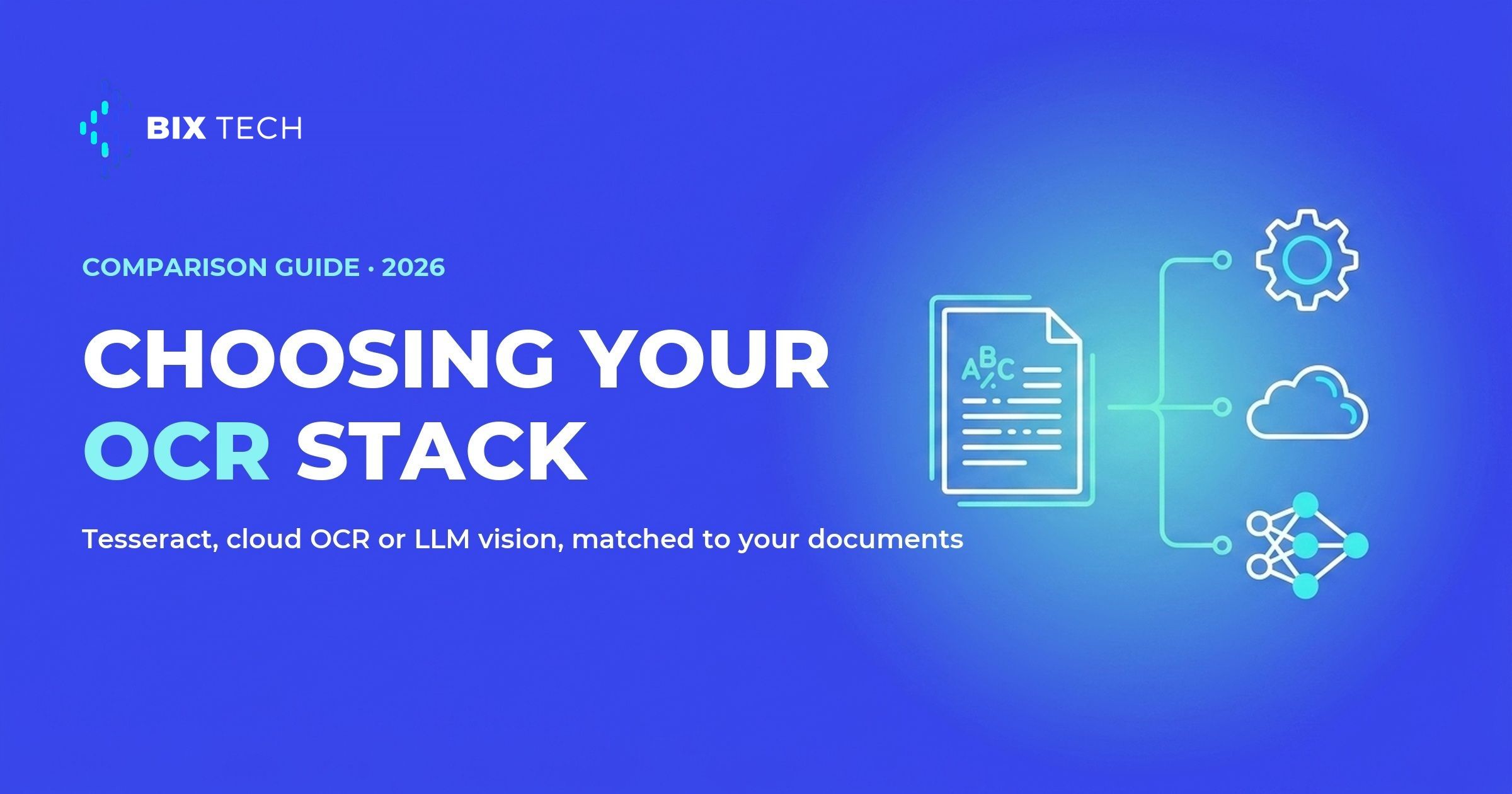
The three approaches are the open-source engine, the cloud OCR API, and the LLM vision model. Tesseract represents the first, managed services like AWS Textract, Azure AI Document Intelligence and Google Document AI represent the second, and multimodal models like GPT-4o, Claude and Gemini represent the third. Each reads a page in a different way, prices it differently, and fails differently. Public benchmarks such as OmniDocBench show the ranking flips depending on the document, which is exactly why evaluating on your own data beats trusting a leaderboard.
This guide compares the three OCR approaches on the criteria that decide a real project: accuracy by document type, cost, latency, data privacy, and how much engineering each one demands. BIX Tech works across all three, so the intent here is orientation rather than a verdict. The right OCR stack in 2026 depends on your documents, your volume and your constraints, the same situational logic a consultancy applies across several data and cloud stacks.
The three OCR approaches, and where each one fits
Before comparing numbers, it helps to see what each approach actually is. The technology matters less than the match between the tool and the document, a pattern that repeats in almost every data engineering automation project. Here is how the three break down.
Tesseract and open-source engines
Tesseract is the long-standing open-source OCR engine, maintained on its official repository and still widely deployed. It runs locally, carries no licensing fee, and processes many pages per second on a plain CPU. That makes it a natural fit for high-volume, low-latency pipelines with clean printed text, where predictable cost control often weighs more than reading messy handwriting. Its limits are well known: degraded scans, unusual layouts and handwriting reduce accuracy, and it returns raw text rather than structured fields.
Cloud OCR APIs
Cloud OCR services turn document extraction into a managed API call. AWS Textract, Azure AI Document Intelligence and Google Document AI read printed text, tables, forms and key-value pairs, and they ship prebuilt models for invoices, receipts and IDs. They scale without infrastructure work and integrate with the cloud platform a team already runs on. The trade-off comes as per-page pricing, data leaving your environment, and accuracy that varies by document type and language.
LLM vision models
Multimodal large language models read a page closer to the way a person skims it, interpreting layout and text together and returning structured output in a single pass. Models like GPT-4o, Claude and Gemini handle receipts, handwriting and bad photos that trip older engines, and they can follow a prompt to emit exactly the JSON fields you ask for. That flexibility carries higher latency and cost per page, plus the observability discipline any LLM in production needs to catch silent errors before they reach a customer.
How the three OCR approaches compare
The table below lines up the three approaches on the dimensions that usually decide a project. Read it as a map of trade-offs, not a scoreboard, because the same row points in different directions depending on whether you process a million clean invoices or a thousand handwritten forms. This is the kind of comparison teams also run when they weigh analytics options next to the data warehouse.
| Dimension | Tesseract / open-source | Cloud OCR APIs | LLM vision models |
|---|---|---|---|
| Deployment | Self-hosted, on-prem or edge | Managed API | Hosted API or self-hosted open VLMs |
| Clean printed text | Strong and fast | Strong | Strong |
| Handwriting and degraded scans | Limited | Moderate to strong | Strong |
| Layout and structured fields | Raw text, heavy post-processing | Prebuilt forms and tables models | Structured output from a prompt |
| Cost model | Compute only, no per-page fee | Per-page pricing | Per-token or per-image, higher per page |
| Latency and throughput | Very high throughput on CPU | High, scales elastically | Lower, seconds per page |
| Data residency | Stays in your environment | Leaves to the provider | Leaves to the provider when hosted |
| Typical best fit | High-volume clean print | Standardized business docs at scale | Messy, varied or handwritten docs |
Two patterns stand out. Open-source engines and cloud APIs converge on clean printed text, so the deciding factors there become cost, throughput and where the data is allowed to live, questions that overlap heavily with data pipeline security. On messy or handwritten documents, vision models tend to pull ahead, which is why many teams reserve them for the hard slice rather than the whole pipeline.
How to choose an OCR stack in 2026 for your documents
Start from the documents, not the technology. Clean, standardized, high-volume paperwork rewards a fast engine or a cloud API. Varied layouts, handwriting or fields that demand interpretation reward a vision model. Sensitive data changes the calculus entirely, since anything that leaves your environment falls under enterprise LLM and data governance and, in regulated sectors, legal limits on where documents can be processed.
Volume and budget set the second boundary. A cent or two per page is trivial at a thousand documents and painful at ten million, so the cost model often decides more than raw accuracy does. Teams that watch cloud spend closely tend to route the easy majority of pages through the cheapest path and escalate only the exceptions to a pricier model.
Think about what happens after extraction, too. OCR output is rarely the finish line; it feeds search, analytics or a retrieval pipeline over enterprise documents. Structured, consistent fields matter there, so the ability to output clean JSON and to trace it with lineage across the pipeline can outweigh a small accuracy edge on any single page.
The hybrid pattern most pipelines land on
In practice, few production systems in 2026 pick a single approach and stop. The common design runs a cheap, fast engine or cloud API over the bulk of documents, then routes the low-confidence or complex cases to a vision model for a second pass. That layering keeps cost near the floor on the easy majority while reaching high accuracy on the hard minority, the same escalation logic behind well-run agentic data engineering workflows. Confidence scoring, human review on the tail, and monitoring for drift as document formats change are what turn this from a demo into infrastructure.
More than the engine or the model size, what makes an OCR stack pay off is matching each approach to the documents it reads and measuring quality on your own data before you commit. Tesseract, cloud OCR and LLM vision each earn their place in a different scenario, and the strongest pipelines often combine more than one. Start with a baseline, price it honestly, and let the documents decide.
The OCR engine is only one layer of a larger system; how extraction fits with confidence scoring, review and production operation is covered in our guide to document AI pipelines.
If your company is choosing an OCR stack in 2026 to turn documents into reliable, structured data, our specialists can help you design the extraction, evaluation and deployment pipeline that best fits your context. Talk to our team and move your data maturity forward. ⬇️
What is the difference between Tesseract, cloud OCR and LLM vision? Tesseract is a self-hosted open-source OCR engine that reads printed text fast and cheaply on your own hardware. Cloud OCR services like AWS Textract, Azure AI Document Intelligence and Google Document AI are managed APIs that also extract forms and tables. LLM vision models like GPT-4o, Claude and Gemini interpret layout and text together and return structured output from a prompt.
Which OCR stack is best in 2026? There is no single best OCR stack in 2026; the right choice is situational. Open-source engines fit high-volume, clean printed text with tight cost control. Cloud OCR APIs fit standardized business documents at scale. LLM vision models fit messy, varied or handwritten documents. Many production pipelines combine two of them rather than picking one.
Is Tesseract still worth using in 2026? Yes, in the right scenario. Tesseract remains fast, free of licensing cost, and easy to run locally, which suits high-volume pipelines with clean printed text and strict data-residency needs. It struggles with handwriting, degraded scans and complex layouts, and it outputs raw text, so teams often pair it with post-processing or a vision model for the hard cases.
How much does cloud OCR or LLM vision cost per page? Pricing is usually per page for cloud OCR and per token or per image for LLM vision, which makes both meaningfully more expensive per document than a self-hosted engine that only costs compute. At low volumes the difference is negligible; at millions of pages the cost model often drives the architecture, which is why many teams route only the difficult documents through the pricier path.
Can you combine OCR engines and LLM vision in one pipeline? Yes, and it is the common pattern in 2026. A typical design runs a cheap engine or cloud API over most documents, scores confidence, and escalates only the low-confidence or complex pages to an LLM vision model. This keeps cost low on the easy majority while reaching high accuracy on the hard minority, with human review and drift monitoring on the tail.