A feature store is the piece of machine learning infrastructure most teams discover they need only after something breaks in production. A model that scored perfectly in a notebook starts making strange predictions live, and the culprit is almost always the same: the data used to train it does not match the data it sees when serving. That mismatch has a name, training-serving skew, and solving it by hand does not scale past a handful of models. It is the same reliability gap that shows up whenever a data team moves from experiments to a real MLOps reference architecture for deployment and monitoring.
Features are the inputs a model learns from: a customer's average order value over 30 days, the number of failed logins in the last hour, the rolling churn signal for an account. Computing those values once, storing them, and serving the exact same definition to both training and inference is the whole point of a feature store. Without it, the logic that builds a feature during training tends to drift away from the logic that rebuilds it at request time, which is the same consistency problem a governed metrics layer solves for analytics.
This guide walks through what a feature store actually is, the concrete signals that tell you when you need one, and how teams build the offline and online layers in practice. The tooling matters far less than treating features as a shared, versioned asset, the same discipline behind any semantic layer that AI agents can trust.
What is a feature store, and the problem it solves
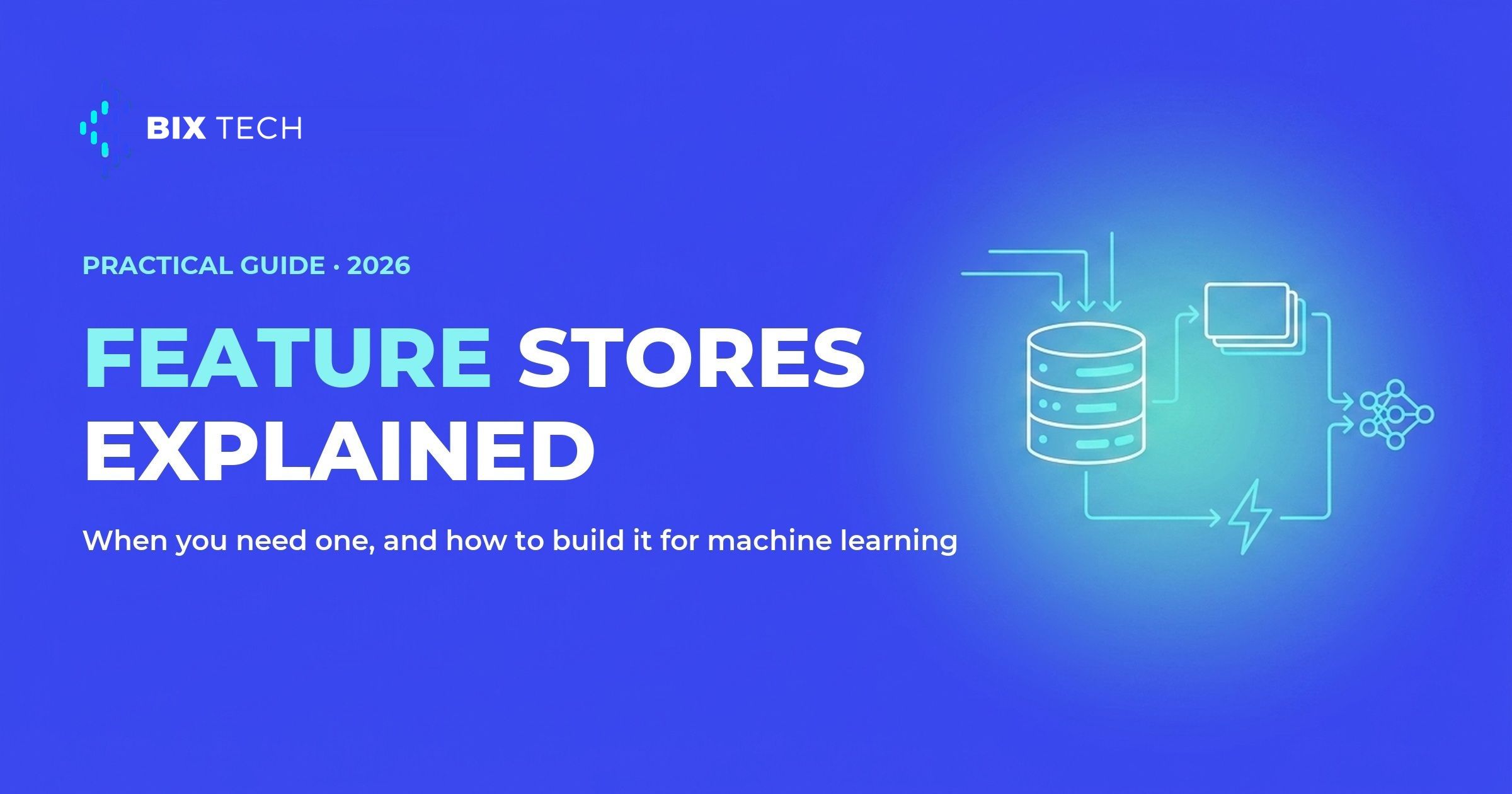
A feature store is a data system that centralizes the definition, computation, storage and serving of features for machine learning. It sits between your raw data platform and your models, so a feature is written once and reused everywhere, instead of being re-engineered inside every training script and every serving endpoint. Think of it as the layer that turns scattered feature logic into a governed catalog, much like a lakehouse organizes raw and curated data for the rest of the stack.
The core problem it addresses is duplication and drift. In a team without one, the data scientist writes SQL to compute "average purchases in the last 90 days" for training, and months later an engineer rewrites similar logic in the serving API. Those two implementations diverge, and the model quietly degrades. A feature store removes that risk by making the pipeline that computes a feature the single source of truth, an approach that pairs naturally with the traceability you get when you wire lineage into your pipelines.
There is a productivity angle too. When features live in a shared registry with clear ownership, a new model can reuse work that already exists rather than starting from zero, which is the same reuse principle that makes agentic data engineering workflows faster. Teams stop rebuilding the same aggregations and start composing models from a growing library of trusted inputs.
When you actually need a feature store, and when you don't
Not every project justifies one. A single model, retrained on a batch schedule, scored offline and never serving real-time predictions, rarely needs the extra machinery. Introducing a feature store there adds operational weight without a payoff, the same way spinning up a full Docker-based data engineering environment can be overkill for a one-off analysis. The honest answer is that the value shows up with scale and with real-time serving.
The clearest signal is real-time inference. If your model needs feature values computed at request time, fraud scoring on a transaction, a recommendation as a user browses, the online serving layer of a feature store becomes hard to replace. Fraud detection is the textbook case: the "number of transactions in the last five minutes" has to be fresh and identical to how it was defined in training, a low-latency requirement that echoes the demands of any system you monitor with proper observability. Guessing at that value in the serving path is how skew creeps in.
The second signal is team scale. When several data scientists ship several models against overlapping data, feature reuse and governance stop being nice-to-haves. A shared store prevents ten slightly different definitions of "active customer" from spreading across projects, the same discipline that keeps orchestration reliable across many pipelines. The table below maps common situations to whether a feature store earns its place.
| Scenario | Feature store payoff | Why |
|---|---|---|
| Single batch model, offline scoring | Low | One pipeline, no serving skew, little reuse |
| Real-time predictions (fraud, recommendations) | High | Online serving needs fresh, consistent features |
| Many models across a growing team | High | Reuse and governance prevent duplicate definitions |
| Early proof of concept, one dataset | Low | Machinery outweighs the benefit at this stage |
| Regulated domain needing auditability | High | Versioned features give lineage and reproducibility |
How a feature store works: offline store, online store, and registry
A feature store is usually three components working together. The offline store holds the full history of feature values, optimized for large scans, and it is what training reads to build datasets with correct point-in-time values. It typically lives on the same platform as your warehouse or lake, so it inherits the scale and cost controls you already tune there. Getting point-in-time correctness right, joining each label to the feature values as they existed at that moment, is what prevents data leakage during training.
The online store is the low-latency counterpart. It keeps only the latest value of each feature in a fast key-value database, so a serving request can fetch what a model needs in milliseconds. Keeping the offline and online stores in sync from the same feature definition is the mechanism that finally kills training-serving skew, and it is the part that benefits most from a warehouse with native ML and AI features. The two stores answer different questions: history for training, freshness for serving.
Tying them together is the registry, a catalog of feature definitions, their owners, data types, and the pipelines that populate them. The registry is where governance happens, and it is the natural home for the versioning and access rules that a lakehouse governance layer like Unity Catalog already enforces on tables. Without a registry, a feature store is just two databases; with one, it becomes a governed product other teams can discover and trust.
How to build a feature store, step by step
Start by defining features as code, not as ad-hoc queries. Write each feature as a versioned transformation, with a name, an entity it belongs to (a customer, a device, an account), and the source it reads from. This is the same "logic as a reusable asset" mindset that underpins a production-grade RAG or ML system, and it makes every downstream step, testing, backfilling, serving, far easier.
Next, build the materialization pipelines that compute those features on a schedule and write them to both stores. Batch jobs populate the offline history, and either streaming jobs or scheduled syncs push the latest values to the online store, an orchestration problem that fits cleanly on a modern data stack built on cloud primitives. At this stage you decide freshness: how often each feature updates, and how much latency your serving path can tolerate.
On the build-versus-buy question, the choice is situational, which is exactly how a data and software consultancy approaches it, since the right architecture always depends on the operation. The open-source project Feast, documented at Feast's official site, lets teams assemble a store on top of infrastructure they already run. Managed options such as Databricks Feature Engineering in Unity Catalog and Amazon SageMaker Feature Store trade some flexibility for less operational overhead, and they slot into stacks a team may already use for the rest of its MLOps lifecycle.
Finally, close the loop with monitoring. Track feature freshness, distribution drift, and serving latency, because a feature store that silently stops updating is more dangerous than no store at all. This observability is the same safeguard that keeps AI agent systems accountable in production, and it turns the store from a one-time build into a living part of the platform.
More than the vendor or the framework, what makes a feature store worth the investment is treating features as a shared, versioned and monitored asset from the first model onward. The offline store gives you correct training data, the online store gives you fresh serving values, and the registry gives you governance. Wire those three together deliberately, and training-serving skew stops being an incident you firefight and becomes a problem your architecture already solved.
Once features reach training and serving consistently, the next production choice is the framework the model runs on, and how export paths, latency and hardware targets differ is laid out in TensorFlow vs PyTorch for production deployment.
If your company is scaling machine learning and running into inconsistent features or training-serving skew, our specialists can help you decide whether a feature store fits your context and design the architecture around it. Talk to our team and move your data maturity forward. ⬇️

What is a feature store in machine learning? A feature store is a data system that centralizes how machine learning features are defined, computed, stored and served. It writes each feature once and reuses it for both model training and real-time inference, so the same definition feeds every model. This removes duplicated logic and prevents the training-serving skew that silently degrades models in production.
When do you need a feature store? You need a feature store when models serve real-time predictions, such as fraud scoring or recommendations, or when several data scientists build many models against overlapping data. In those cases, reuse, governance and low-latency serving justify the machinery. A single batch model scored offline, or an early proof of concept, usually does not need one yet.
What is the difference between an offline and an online feature store? The offline store keeps the full history of feature values for building training datasets with correct point-in-time values, optimized for large scans. The online store keeps only the latest value of each feature in a fast database for millisecond serving. Syncing both from one definition is what eliminates training-serving skew.
What is training-serving skew, and how does a feature store prevent it? Training-serving skew happens when the logic that builds a feature during training differs from the logic that rebuilds it at inference time, so the model sees inconsistent inputs and degrades. A feature store prevents it by making one feature pipeline the single source of truth, materializing the same values to both the training and serving layers.
Should you build a feature store or use a managed one? It depends on your stack and team. Open-source options like Feast let you assemble a store on infrastructure you already run, giving maximum control. Managed services such as Databricks Feature Engineering or Amazon SageMaker Feature Store reduce operational overhead and fit teams already invested in those platforms. The right choice is situational, not universal.